
On 18 November, we reported on the new regulations governing the granting of exemptions to business owners based in the area under the – admittedly provocative – headline “Can resident parking be made legally watertight? The City of Leipzig says: No’. In this context, we also recapitulated the hurdles that had to be overcome when resident parking was introduced in Leipzig.
As announced in the article, we contacted the Public Order
Office and received replies which we do not wish to withhold from
our readers. Unusually, we shall begin with the third question and
its answer, as this deserves closer consideration. 
Question 3
The question:
To the best of your knowledge, is it possible to amend Resolution VI-DS-03681-DS-07 in
order to find a simpler solution for businesses that complies with
the law?
The answer:
As the judgement of the Higher Administrative Court of Bautzen
clearly demonstrates, a local authority resolution cannot override
the federal provisions of the Road Traffic Regulations (StVO) or
the requirements of the Administrative Regulation on the Road
Traffic Regulations (VwV-StVO), nor can it replace them with
deviating, less stringent conditions. The decisive factor remains
whether, in a specific individual case, there is a particular
urgency or hardship that justifies an exception to the general
traffic regulations. Amending the resolution with the aim of
generally making it easier for businesses to obtain exemptions or
of setting lower requirements for this would therefore be
incompatible with federal regulations.
Research: Naturally, in anticipation of the reference to federal legal requirements, we looked into how this works elsewhere. By way of example, we examined the Hanseatic City of Bremen, where the Office for Roads and Transport states the following under ‘Information and Requirements for Resident Parking – Commercial’:
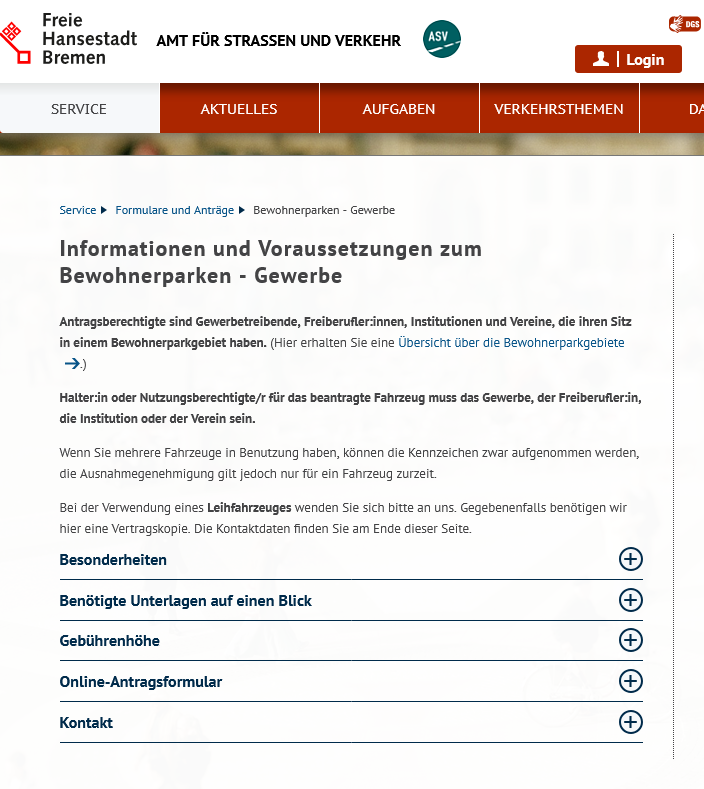
Website of the Hanseatic City of Bremen: Resident Parking – Commercial – Office for Roads and Transport. Screenshot: LZ
- Those eligible to apply are business owners, self-employed individuals, institutions, and associations that have their registered office within a resident parking zone.
- The business, self-employed person, institution, or association must be the owner or authorized user of the vehicle for which the application is being made.
- One exemption permit is issued per business (as well as per self-employed person, institution, public authority, association, etc.).
Under ‘Required documents’, it states:
- for businesses: no documents are required if the business is registered in the City of Bremen’s business register. Otherwise, please enclose a copy of current proof that the business is based within the resident parking zone
- for self-employed individuals, institutions and associations, a current copy of proof of the workspaces / office premises (for example, in the form of a current confirmation from the landlord, a current extract from the commercial register, a current tenancy agreement, a current electricity bill or a current telephone bill)
- A copy of the vehicle registration certificate, Part I (fully unfolded)
The application therefore does not require a detailed justification and can be completed easily online. The points are summarized here; you will find the full description of the procedure via the link above.
Conclusion: Even though Bremen is a federal state in its own right – and is therefore subject to state rather than local regulations – it is possible to deviate from federal requirements. Even if we take the regulations for the City of Munich as an example, there is no obligation to provide a justification there. What is important here is the reference to the legal basis: the Road Traffic Regulations (§46(1)(4a)) and Munich City Council resolutions on parking space management. This might perhaps be comparable to the situation in Leipzig. However, Munich also makes one important point clear: “In the ‘Altstadt’ and ‘Hauptbahnhof’ parking permit zones, parking permits cannot generally be issued to commercial residents.”
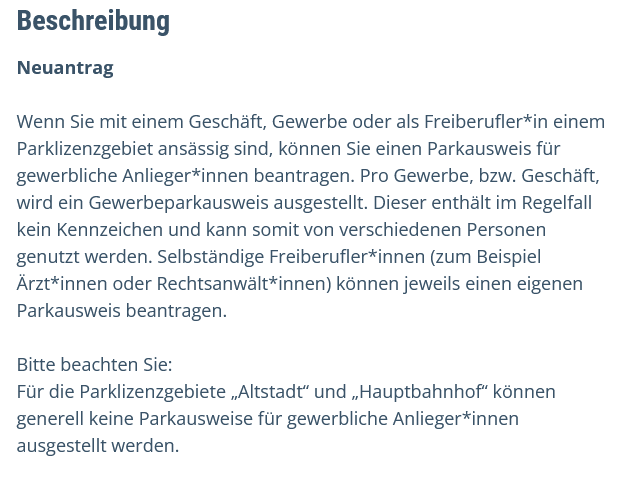
Parking permit for commercial residents – Local Traffic Enforcement – City of Munich Screenshot: LZ
So, whilst exceptions can be defined, there is no obligation to do so.
Question 1
Question: How should the wording regarding the justification be interpreted?
Answer: The requirements for the justification of an application for a special permit are set out in the statutory provisions of Section 46(1) of the Road Traffic Regulations (StVO) and the General Administrative Regulation on the Road Traffic Regulations (VwV-StVO) issued in this regard.
The VwV-StVO relating to Section 46 expressly states:
‘Granting an exemption is therefore only justified in particularly urgent cases. Strict requirements must be imposed on the evidence of such urgency.’
It must therefore always be a specific individual case that differs significantly from the situation of other road users. Furthermore, the grounds put forward for an exemption must, whilst observing the principle of proportionality, clearly outweigh the public interest pursued by the relevant traffic regulation. The term ‘urgent’ is not to be understood here in the sense of ‘hasty’, but rather in the sense of ‘particularly necessary’ or a ‘case of exceptional hardship’.
When submitting an application, this means that the mere establishment of a business within a residents’ parking zone and the associated interest in being able to park a company vehicle in the immediate vicinity of the business premises are not, in themselves, sufficient. Rather, it must be clearly demonstrated why an exemption is necessary in this specific business case and why the business’s requirements cannot be met reasonably through the regular stopping and parking facilities or other organizational solutions.
The wording, which states that a justified individual case must differ significantly from other businesses with similar interests, is thus intended to ensure that there are indeed special circumstances justifying a deviation from the general traffic regulations. A blanket privilege for certain occupational or business groups is not compatible with the statutory requirements.
Conclusion: That sounds logical, so why are the rules different in other towns? To answer this, we need the text of the judgement, which we requested in Question 2. However, the reasoning behind the wording ‘justified individual case which differs significantly from all other businesses with similar interests located within the respective resident parking zone’ is missing.
Bautzen Higher Administrative Court (6th Senate), judgement of 11 August 2025 – 6 A 138/23
In response to our enquiry, the City of Leipzig did not send us a copy of the judgement, which it certainly has, but instead sent us the summary from beck-online. We are not quoting from this, partly for copyright reasons, but particularly because it is largely an AI-generated summary. The judgement itself is still not available online on the Higher Administrative Court’s website.
What was the case about?
A notary based in the Waldstraßenviertel district complained that he had not been issued with parking permits for two of his employees. The main thrust of the complaint was that business owners are issued with two parking permits without justification, whereas for the self-employed, these are only granted following a case-by-case assessment – or not at all. The notary is demanding equal treatment for business owners and the self-employed.
Note: In the case of the Hanseatic City of Bremen, there are no significant differences between businesses and self-employed individuals (image)
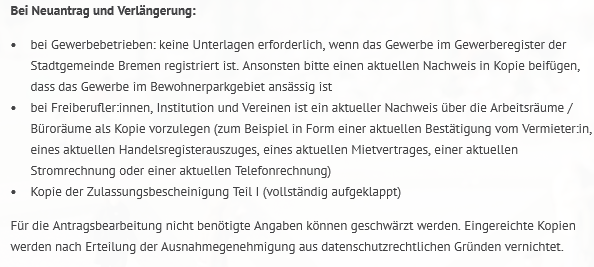 Hanseatic City of Bremen
resident parking for businesses – screenshot: LZ
The legal proceedings centred on the principle of equal treatment, in this case the equal treatment of commercial enterprises and self-employed professionals. Although the Higher Administrative Court (OVG) found a breach of the principle of equal treatment, the claim was nevertheless dismissed on the grounds that the claimant was unable to prove the objective necessity.
The court found here that the City of Leipzig, in the interests of administrative simplification, had dispensed with examining the exceptional case for commercial enterprises, and that this was not in accordance with the ‘spirit and purpose of the federal statutory provisions’ and the associated administrative regulation.
We shall conclude here; we leave further analysis to legal experts, who will have access to the full text of the judgement.
Conclusion: It takes a fair bit of imagination to deduce the measures described in the preceding article from the AI-generated abstract on beck-online. Looking at Bremen and Munich, for example, it does seem possible to enact a simplified exemption scheme for commercial enterprises that complies with the law. But one must be willing to do so.
Empfohlen auf LZ


So können Sie die Berichterstattung der Leipziger Zeitung unterstützen:




There is one comment