Dieser Artikel ist auch in deutscher Sprache verfügbar: Zum deutschen Artikel.
There are questions from residents at Leipzig City Council meetings that simply fade into obscurity because the residents themselves do not step up to the microphone again to follow up. But the answers to their questions are still available in the council’s information system. And at the last council meeting on 30 September, a Leipzig resident raised an issue that, for the city’s peaceful residents, is virtually non-existent. After all, who actually needs firearms in a peaceful society? Nobody. Yet the figures tell a different story.
And yet the deadly incident on 8 October in Berngau in the Upper Palatinate wasn’t even what prompted the question. On 8 October, a 60-year-old gun owner shot and killed two officials from the regulatory authority when they sought to check that his ten firearms were being stored in accordance with the law. Nor was he willing to allow himself to be arrested peacefully.
He was then seriously injured in an exchange of fire with the police. And the politicians appeared – as usual – at a loss. “Hunter, sport shooter, no police record – ‘We don’t know why it escalated like this’”, ran the headline in *Der Spiegel*.
And a day later: “The Berngau gunman used to be in the police force. The 60-year-old, who shot dead two employees of the district administration office in the Upper Palatinate, was a trainee police officer in the late 1980s. Investigators are not revealing why he was dismissed.”
Hypocritical ‘deep sorrow’
Roman Grafe, spokesperson for the initiative ‘No murder weapons as sporting weapons!’
, could only respond sarcastically to the Bavarian Minister of the Interior’s flimsy excuses: “What else must happen before the politicians in charge put an end to the madness of legal firearms being used as lethal toys and playthings? It is not enough for leading politicians to routinely express ‘deep sorrow’ whilst doing nothing to tackle the sporting firearms craze in Germany.
How many more people will be shot dead by sport shooters before the majority of those not directly affected show sufficient solidarity and push through a ban on lethal sporting firearms in Germany too? A ban such as the one that was implemented in the UK within a year following the primary school massacre in Dunblane in 1996.
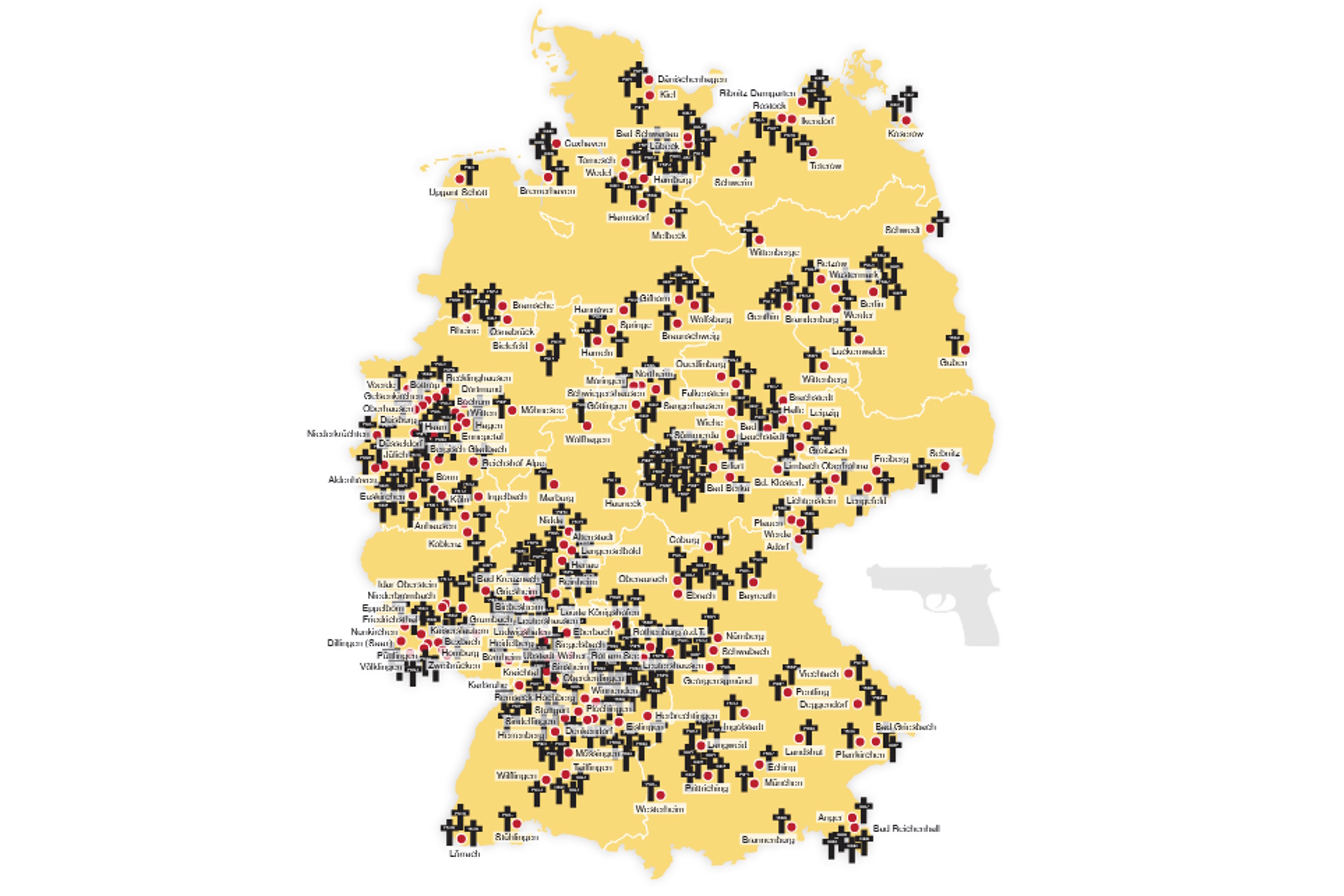
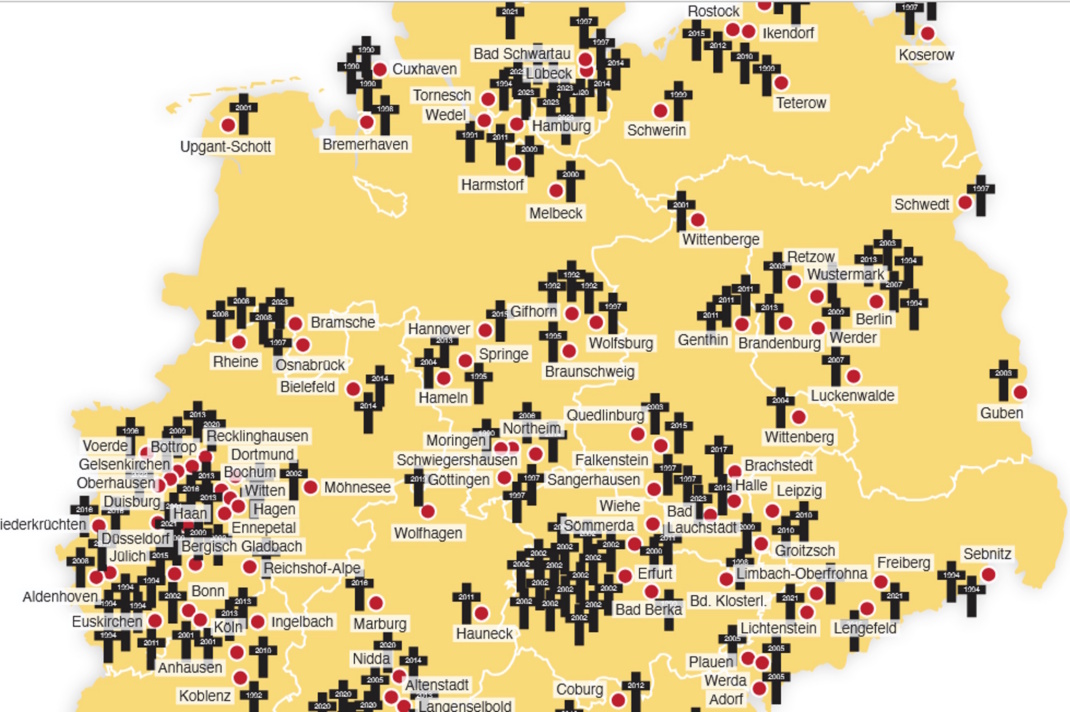
People killed by ‘sporting firearms’ in Germany from 1990 to 2024. Map: ‘No murder weapons as sporting firearms!’ initiative
The Bavarian Minister for the Interior, Joachim Herrmann, stated on the morning after the bloody attack in Berngau that the findings so far provided no indication of what could be done differently in future. Herrmann, a sport shooter himself, has made similar comments following other shootings involving sport shooters. As the ‘Bavarian Minister for Sport Shooting’ (in his own words), Herrmann has played a key role in opposing effective tightening of gun laws.
Even if gun control officers were equipped in future like SWAT team members, the protection would still be inadequate: see, for example, the killings by sport shooters in Georgensgemünd (2016) and Anhausen (2010).
‘You cannot kill with a weapon you do not possess: no murder weapons as sporting firearms!’
Firearms in Leipzig
As I said: the resident did not know any of this when he asked the city council how many firearms are actually in private ownership in Leipzig
.
For him, the establishment of the defence contractor Covenant in the north of Leipzig was the trigger: “As a heated debate has just flared up over the establishment of a private defence contractor specialising in aircraft, I find myself wondering how many legal firearms are registered across the whole of Leipzig and how many people are authorised to possess them? And whether this group of people is also regularly checked, as well as the secure storage of these weapons. Hence my specific questions.”
These are entirely valid questions. After all, the events in Berngau also demonstrated that even the staff of the Public Order Office, who regularly check that firearms are being stored properly, are at risk. Across Saxony, there are around 40 such staff members. Leipzig allocates a staffing level of 4.67 for this purpose – in other words, presumably five staff members, one of whom works part-time.
Nevertheless,
the Public Order Office struggled to provide the figures
and muddled its way through all sorts of legal provisions: “The transfer of data stored in the National Firearms Register (NWR) is permitted exclusively in the context of rights to information under press law and within the framework of the Firearms Register Act (WaffRG).
Section 13 of the WaffRG governs the purpose-limited transfer of data to the requesting bodies listed therein, whilst Section 24 of the WaffRG governs the non-purpose-limited transfer of data to the authorities listed therein and the publication of parts of the operational statistics.
As a right to information under press law arising from Article 5(1), second sentence, of the Basic Law cannot be assessed on the basis of the resident’s enquiry, as the enquiry does not satisfy the purpose-specific requirement of Section 13 of the WaffRG and was not made by any authority within the meaning of Section 24 of the WaffRG, there is no entitlement to the requested information under the provisions of the special legislation.”
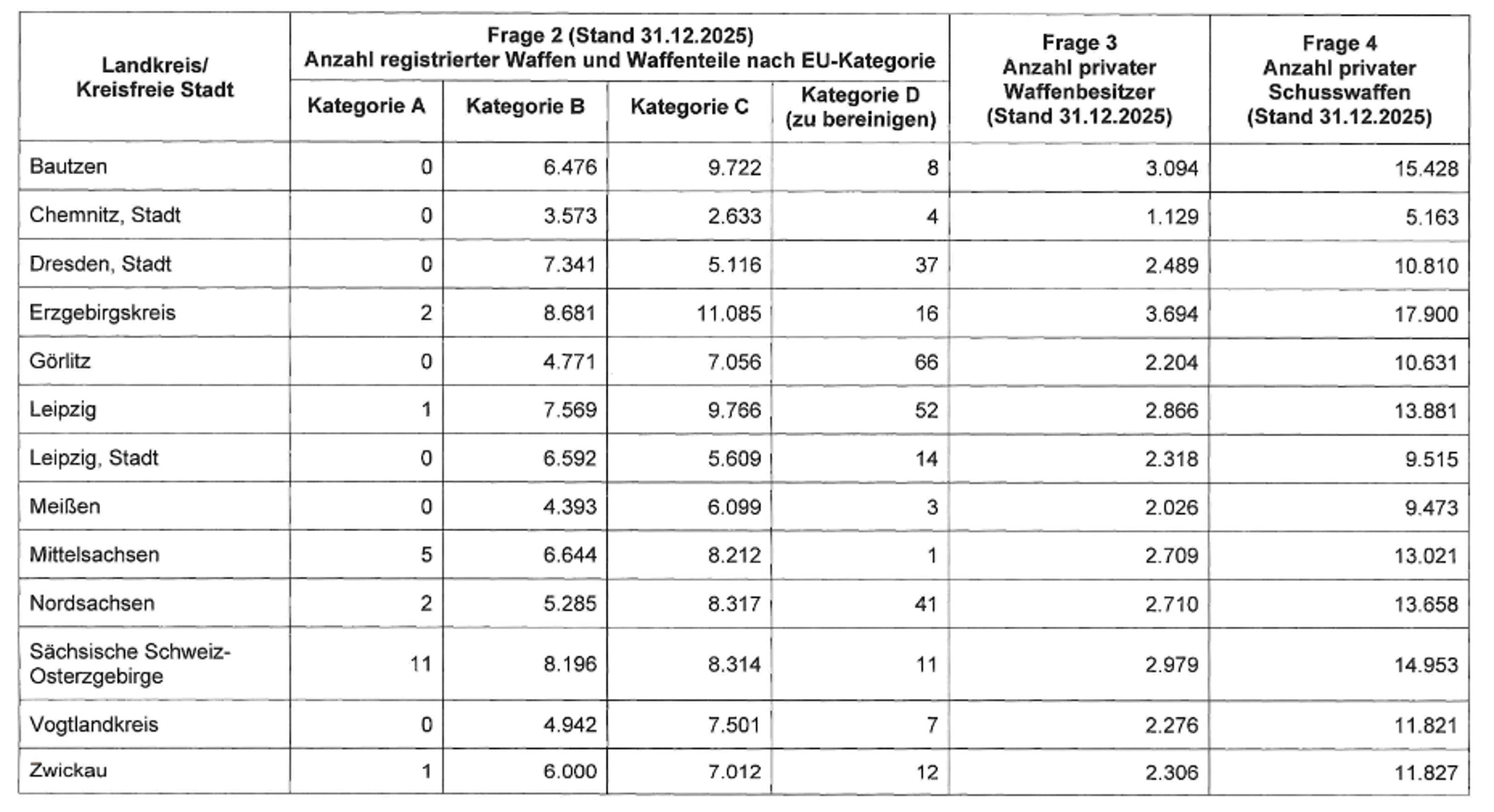
Registered firearms in private ownership in Saxony as at 31 December 2025. Graphic: Free State of Saxony, SMI
But in fact, the figures are public. For example, through the recent parliamentary question tabled in February by Juliane Nagel
, a member of the Leipzig State Parliament
, to which the Public Order Office also refers. And these figures are actually alarming and prove Roman Grafe and the initiative ‘No sporting firearms as murder weapons!’ right: These arsenals of weapons have nothing to do with the traditional German enjoyment of social sport shooting. In Leipzig alone, 9,515 firearms are registered, which, as at 31 December 2025, were attributed to 2,318 owners.
One must not be misled by the categories listed – they merely group firearms by type and ammunition.
An overview of firearms according to EU categories.
Firearms in rural areas
And that is still a relatively small number. Virtually all districts record significantly higher levels of gun ownership, with the highest figures found in the Erzgebirgskreis, Bautzen and Sächsische Schweiz/Osterzgebirge districts.
And the resident asked, quite rightly: “How often are these individuals checked for suitability and for the handling and storage of firearms?”
A question which, of course, takes on a completely different meaning when one considers the incident in Berngau.
The Public Order Office’s response: “The personal reliability and suitability of holders of a firearms licence are regularly reviewed every three years in accordance with Section 4(3) of the Firearms Act (WaffG).
Section 36(3) of the Weapons Act does not specify a frequency for checks on the safe storage of firearms and ammunition subject to authorisation. Nevertheless, the City of Leipzig carries out storage checks every year.”
Empfohlen auf LZ


So können Sie die Berichterstattung der Leipziger Zeitung unterstützen:





There is one comment