Dieser Artikel ist auch in deutscher Sprache verfügbar: Zum deutschen Artikel.
It was then, on 19 November during the council meeting, that the motion entitled ‘Municipal commemoration for women and girls affected by violence’ – of all things – was the focus of attention when a protest in the public gallery forced the council meeting to be suspended. Yet the vociferous protest had absolutely nothing to do with the topic under discussion. This was nothing new for the council.
After all, the council had already
debated femicide and how best to commemorate the women who had been
killed on several occasions. 
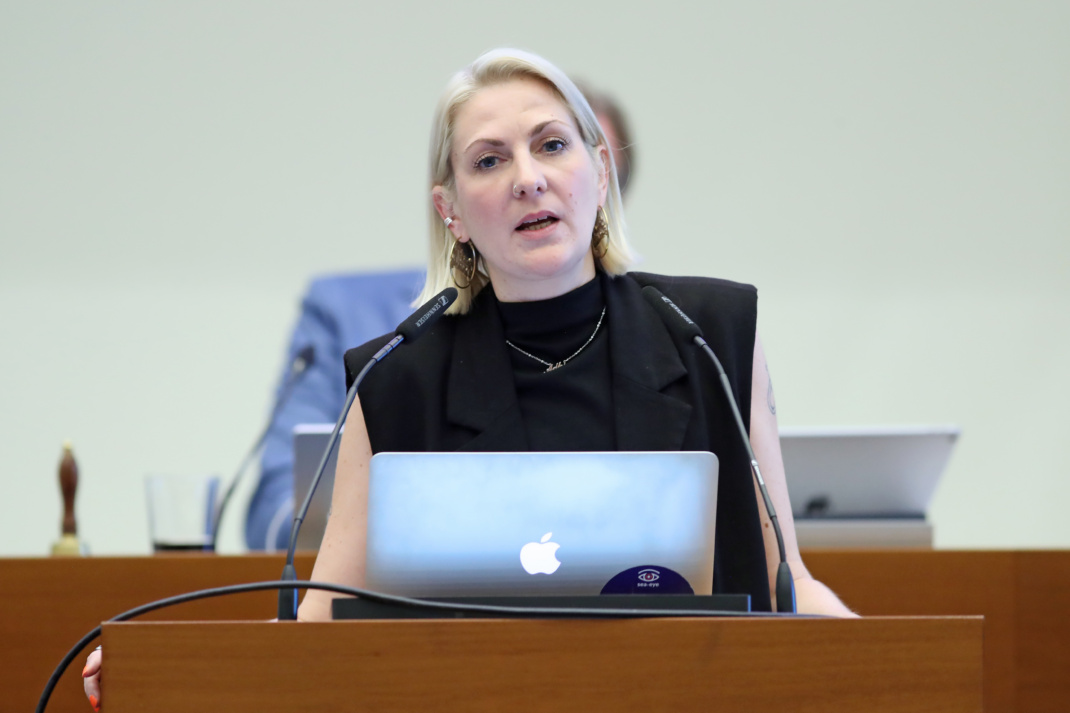
This time, the discussion took a concrete turn with two motions from the Green Party group, which Marsha Richarz had actually intended to present. However, due to illness, she was represented by Anne Vollerthun, who pointed out that the killing of women simply because they are women remains a marginalised issue, even in the media, and is often referred to in police reports as ‘domestic violence’ or a ‘tragic family drama’.
But that is not what it is. It is about male claims of ownership, patriarchal thinking and misogyny. “These are not tragic acts of domestic violence,” said Vollerthun. Although that is precisely how they are often interpreted. And thus reduced to isolated incidents rather than being seen as a symptom of a patriarchal and misogynistic society.
The blue bogeyman
It’s only logical, then, that a deeply misogynistic party like the AfD would react in exactly the same way. The AfD parliamentary group once again put Sylvia Deubel forward, who actually managed to twist the issue of violence against women in such a way that, in the end, the AfD’s favourite topic – migrants – came to the fore once more, along with the claim that violence against women had, of all things, increased as a result of immigration from 2015 onwards.
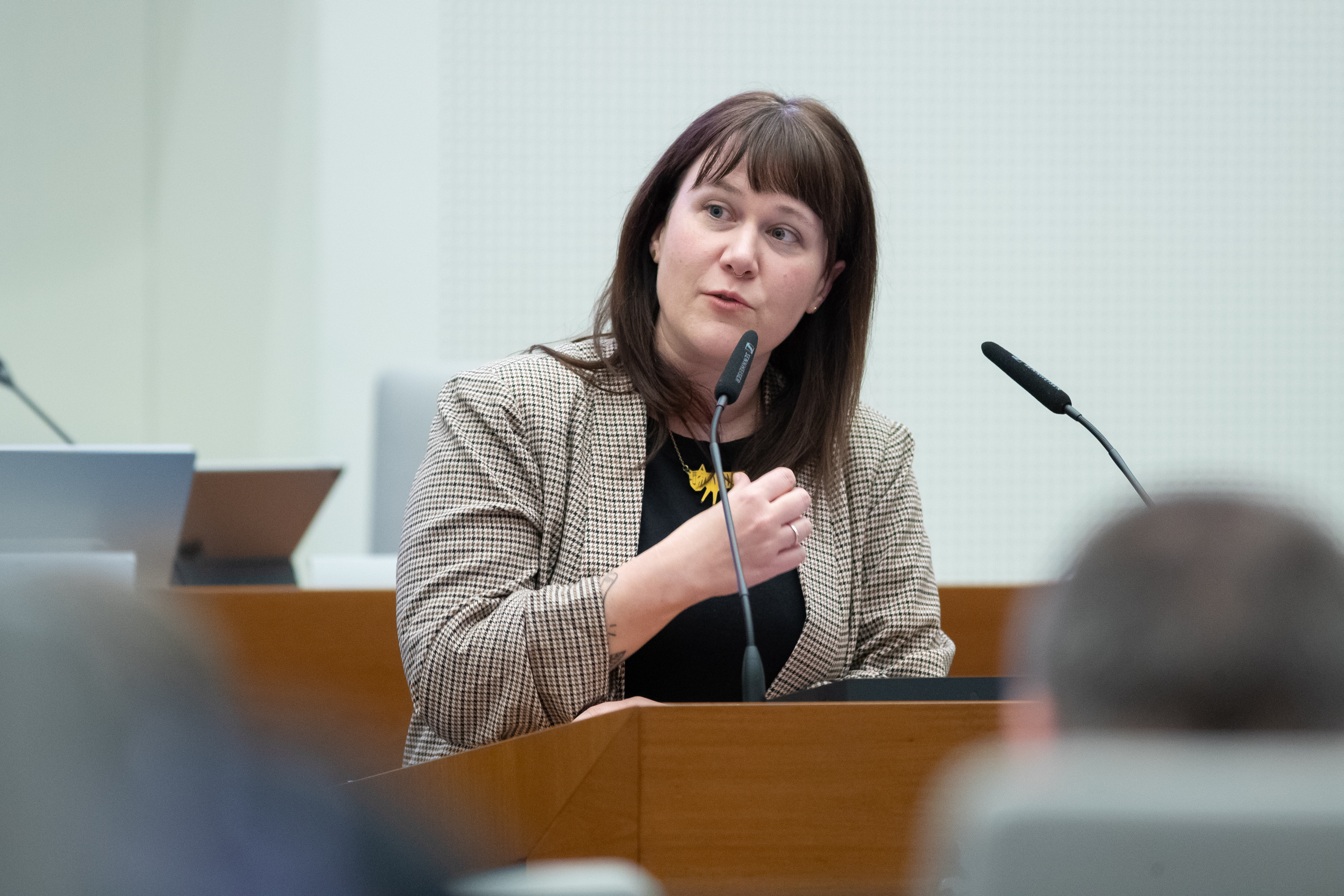
You really couldn’t twist the issue any more thoroughly than that. And, as SPD city councillor Pia Heine pointed out, one thing in particular is missing: compassion. Which, however, is quite typical of the AfD. Left Party city councillor Juliane Nagel was even more explicit: what Deubel had cobbled together using all sorts of figures was, ultimately, a racially framed justification.
As is customary for the AfD, this was also dressed up with the buzzword ‘ideology’. As if acknowledging the fact that women are repeatedly the victims of unchecked male violence were some sort of ideology. And not a reason to bring the issue even more clearly into the public eye.
A day of remembrance
For example, with the memorial site for women who have been victims of femicide in Leipzig, approved by the City Council, at Dorotheenplatz, which is to be officially unveiled in March 2027. Secondly, with an annual day of remembrance, which the Greens had proposed: “From 2027 onwards, the City of Leipzig will hold an official municipal commemoration once a year for women and girls affected by violence.
On this day, the city administration will hold an annual official commemorative ceremony at the femicide memorial, which is due to be unveiled in the first quarter of 2027. The Municipal Equality Officer and civil society initiatives will be closely involved in the planning and organisation.”
The city administration did not, however, consider this to be particularly effective, and it was primarily Mayor Burkhard Jung who determined the wording of the administration’s alternative proposal: “Publicly addressing violence against women and girls is, in principle, welcomed. The introduction of a municipal day of remembrance will not go ahead. Instead, it is proposed that, within the framework of the planned ‘memorial site for the victims of femicide’, we examine how civil society organisations can be provided with targeted organisational support by the City of Leipzig in their commemorative activities.”
Burkhard Jung also admitted that he would have preferred it that way. However, the administration’s proposal failed to secure a majority and was rejected by 21 votes to 41, whilst the Greens’ motion received a clear vote in favour by 35 votes to 22.
Time for minutes’ silence
A second motion by the Green Party group called for an annual minute’s silence in the City Council to commemorate the victims of femicide – a place where this remembrance can also be publicly visible. The figures are distressing enough, as the Greens’ motion noted: “In Leipzig, 12 femicides have already been committed in the past five years. Each of these acts is an expression of deeply rooted gender-based violence that permanently undermines the sense of safety felt by women and girls.
A minute’s silence following such an act raises public awareness of femicide as a structural problem, rather than treating it as a series of tragic but private isolated incidents. Since 2020, the Spanish Parliament has observed a minute’s silence following every confirmed case of femicide. This practice has not only raised public awareness but has also intensified the political debate on preventive measures.
A regular minute’s silence symbolises solidarity with victims and their families, increases the pressure on the relevant authorities to develop effective prevention and protection strategies, and helps to raise awareness within society. Leipzig should follow this example and thereby send a clear signal in support of women’s rights.”
However, the administration was unwilling to go along with this either, preferring instead to propose a seemingly more cautious alternative: “On an ad hoc basis and in individual cases, the City Council shall observe a minute’s silence following consultation within the Council of Elders.”
And as CDU city councillor Sabine Heymann had put this proposal from the administration to the vote, it was the first to be voted on and secured the necessary majority with 35 votes to 28.
This could well have an impact, because – if the city takes the resolution seriously – a minute’s silence would then have to be observed in the City Council following every new case of femicide in Leipzig.
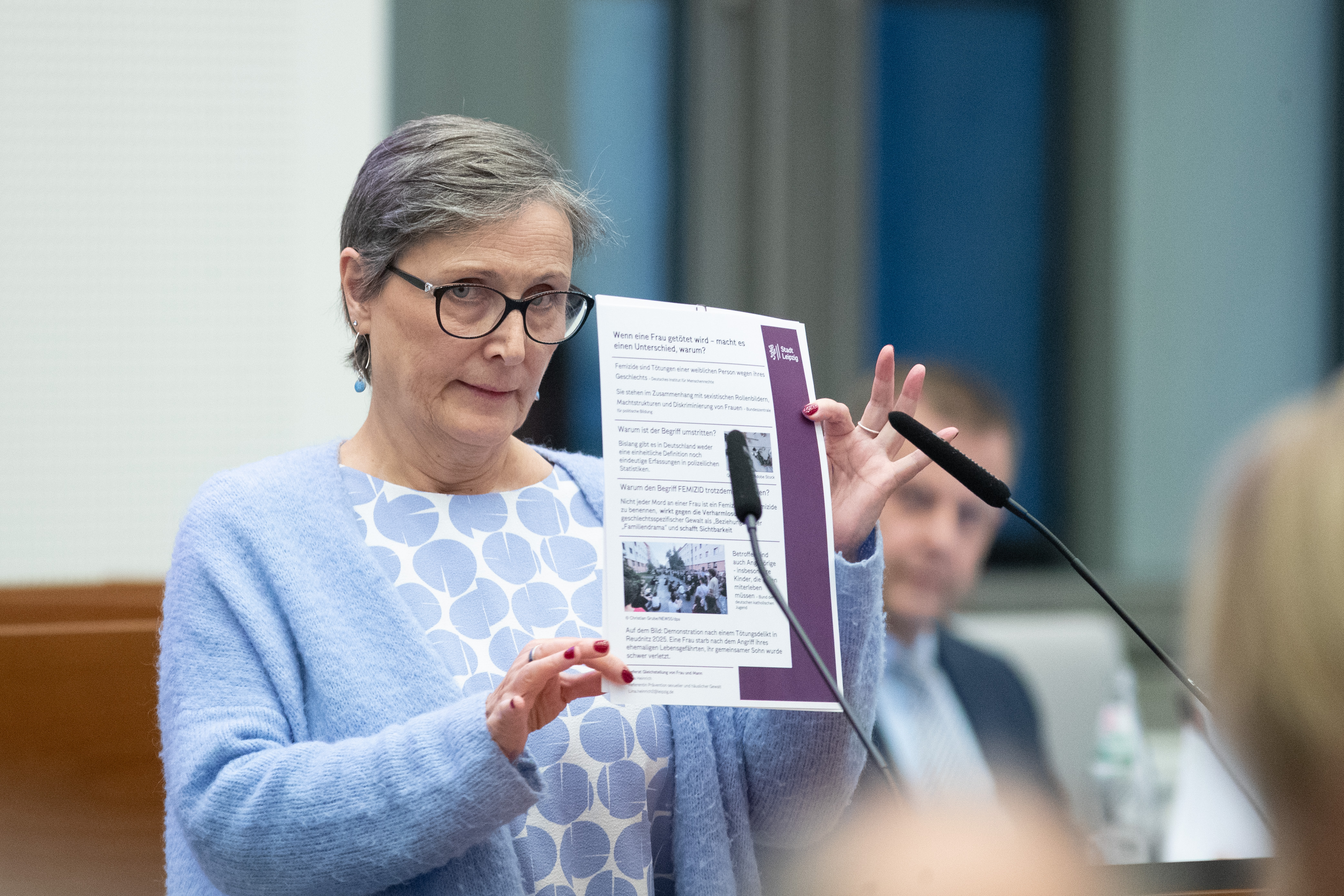
However, Left Party city councillor Beate Ehms used this council meeting not only to distribute handouts containing definitions of femicide to all political groups, but also to draw attention to the Network against Domestic Violence and Stalking in Leipzig, which has been working for years to create support services for affected women and girls and to make them aware that they do not have to put up with men’s controlling behaviour and abuse.
Information on this topic can be found on the network’s website.
And an important date to note: on Wednesday 25 November, to mark the International Day for the Elimination of Violence against Women, there will also be a demonstration in Leipzig under the slogan ‘The anger that remains’. It starts at 3.30 pm at Johannisplatz and proceeds via Richard-Wagner-Platz to Dorotheenplatz, where the memorial to the victims of femicide is due to be unveiled in March 2027.
Empfohlen auf LZ


So können Sie die Berichterstattung der Leipziger Zeitung unterstützen:





There is one comment