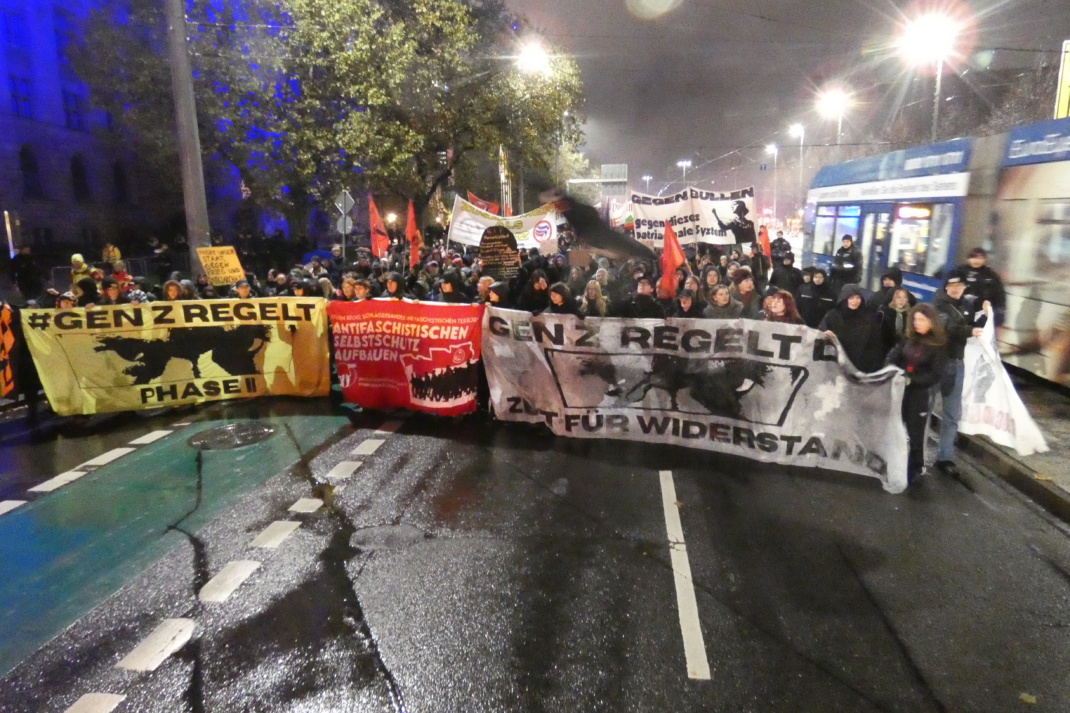
The first round of the German Gen Z demonstrations was neither a success nor a failure. Not too many people took part (significantly fewer than announced), but according to the organisers, the 100,000 mark was nevertheless surpassed. In the run-up to the events, the media’s attention was focused on possible outbreaks of violence, whilst afterwards one thing prevailed above all else: a media blackout. The media certainly bear some of the blame for this.
But the constant whingeing that the ‘evil media’ ignore everything good and important itself ignores a key basic rule of public relations: it is not the topic that generates media attention, but the way in which it is presented.
Now, the recent Genz-Z demonstrations on 20 November in Germany were quite a disappointment. Attendance figures have plummeted by around a quarter, which is a disastrous sign for a movement that is only just gaining momentum. Only the most recent climate demonstrations can rival them in terms of ineffectiveness – a fact that even their founder, Greta Thunberg, now finds puzzling.
Not because she has given up the fight for the climate, but because she recognises the strategic futility inherent in this methodological stalemate: people keep doing the same thing, even though it has had no effect for years, and hope for a suddenly different outcome.
Gen Z: A quintessentially German tragedy?
When it emerged a few weeks ago that there were to be Gen Z demonstrations in Germany, I took a look at their website. We are here in Germany, the land of meek endurance and polite admonishment. In that respect, my hopes that at least the teenagers would come across as a bit wilder, a bit more disruptive, were relatively low.
But even that sliver of hope was soon dashed: anyone skimming through the German Gen Z website gets the impression that it’s being run by an advertising agency from Berlin-Mitte – keen on political correctness, careful not to upset anyone, with a cute squirrel winning everyone over.
It’s no wonder that the middle-class parents of these well-behaved children (“My Sören is very politically active!”) are happy to tag along. Unfortunately, it’s just as obvious that no genuine youth movement can emerge in this way. As a result, as mentioned at the outset, attendance figures plummeted dramatically by the second demonstration. One problem is the movement’s lack of a recognisable face – but that’s not unusual at such an early stage. The other problem runs deeper.
The wording, the political correctness, the exclusionary attitude masquerading as inclusion (all politically aware city-dwellers with proper manners are welcome) are uncomfortably reminiscent of the German climate demonstrations of recent years. Particularly when considering a youth that wants to stand up against the misdeeds of adults, one seriously wonders why this youth comes across as so grown-up and conformist.
Why do they submit to the rules of a system that they actually want to criticise? In their public demeanour, at least, I can see no difference from a campaign run by a ‘modern’ local SPD branch – and that is truly bitter.
Learning from the climate movement means: learning to lose
The (German) climate movement still hasn’t got the message. They’re voluntarily reducing themselves to supplicants to the fossil-fuel right when, for example, Stefan Rahmstorf asks on a public stage in 2026 whether the German Chancellor and his ministers have read the IPCC reports – and still fails to understand that these people aren’t acting out of ignorance.
People talk of ‘struggles’, yet their sharpest weapon is a formal plea to the opponent to stop being an opponent. And then they wonder why, in the year 2026, so few people are backing them.
Instead of taking a critical look at one’s own behaviour and methodology, one attributes the causes to war, politics and the press (though these influences certainly exist). Yet a core element of strategy is adapting methodically to a changed situation – but following the coronavirus-induced withdrawal from the public eye, this has not happened. No adaptation, no change, apart from that of the ‘Last Generation’ movement.
The well-behaved middle classes continue to politely hold up cardboard signs, as if they were fighting over a tree in the park, rather than for the survival of us all. Methodologically ultra-conservative and, of course, ineffective to the point of absurdity – and Gen Z is following their lead.
But anyone who demands political correctness from young people excludes more young people than they include. The Talahons from Grünau, the Bratzenkids from Schönefeld, the stoned gaming kids who don’t play GTA 6 for reasons of political education … you won’t win them over like that. If you even want them on board at all. Yet anyone who tries to talk young people out of their tendency towards ‘Sturm und Drang’ robs them of what defines them: that decidedly rough-and-tumble, sometimes boundary-pushing process of breaking away from the family home.
To pull that tooth out of Germany’s Gen Z, unfortunately, there’s no need at the moment for hyper-moralising adults or strict conservatives – they’ve pulled it out themselves. We saw the result on 20 November: the movement collapsed before it had even begun, and if Mum and Dad hadn’t joined in, there would have been even fewer of them. Sadly, this was to be expected, however sad it may be.
So what happens next – will it even continue?
The solution lies in the often-preached but rarely practised ability to ‘stick it out’. Even the organisers behind the demonstrations should be able to tolerate teenagers setting fire to a rubbish bin now and then, even though that isn’t ‘all right’. Instead of placing ‘Against all violence!’ at the very top of the statement – as Lars Klingbeil urged – and thereby proactively submitting to the right-wing narrative, we should accept that a genuine uprising doesn’t work without causing some damage.
If you bang your fist on the table, there’s bound to be a bang – we can’t expect conditions like those in France here anyway, so why all the panic over three burning rubbish bins across the whole country?
In France, the pressure worked and forced the government to make concessions, despite a level of violence that, in some cases, could no longer be justified by anything. In Germany, the main message to politicians is a different one: ‘We’re well-behaved; you have nothing to fear from us.’
The statement from Germany’s Gen Z reads like a trite list of political correctness, regurgitating all the talking points we’ve heard ad nauseam – for most people, these are simply self-evident truths. But where are the cheeky comments? Where is that effective thorn in the side of social normality?
A movement that (as yet) has no face to draw the crowds must, above all, entice the masses with the prospect of ‘great’ actions. The fact that young people are particularly experience-oriented makes matters all the more difficult when you have no genuine experience to offer.
In any case, today’s Gen Z in our country is about as wild as a Green Party information evening, as conformist as an average non-commissioned officer to the Bundeswehr’s chain of command, and as effective as … well … the climate movement. The result is currently the same for both groups: a lot of effort, little return and hardly any social relevance.
As far as the climate movement is concerned, I see no improvement on the medium-term horizon. We’ve already gone far too far in the wrong direction to turn back now. We’ve poured too much energy into futility to seriously admit these mistakes; rather, we’ve cultivated them and are now content if an action at least satisfies a sense of self-efficacy.
And they have long since driven away all those people who view this pseudo-strategy with similar criticism – where is a profound renewal supposed to come from now? Game over, climate movement, and it’s not Springer or Katherina Reiche’s fault.
Gen Z is a young movement, even if it has smacked of progressive boomers right from the start. But it is still in its infancy, and perhaps the disappointment of 20 November will prove to be a cathartic experience.
Instead of imitating the older generation, who, with a stubborn ‘Now more than ever!’, cling to the weakest methods, we can only hope that young people will come up with the idea of doing things differently now more than ever. More uncomfortable. More provocative. More angry. That’s how pressure is created; pressure brings about change – and only then will the future actually work out.
Dominic Memmel, born in Würzburg in 1980 and based in Leipzig since 2014, works as an activist, communications consultant and podcaster. Visit the author’s page.
Empfohlen auf LZ


So können Sie die Berichterstattung der Leipziger Zeitung unterstützen:




There is one comment