
Dieser Artikel ist auch in deutscher Sprache verfügbar: Zum deutschen Artikel.
On 16 September 2026, the Dutch foundation SOMI (Stichting Onderzoek Marktinformatie) announced, at a joint press conference with the Leipzig-based law firm Spirit Legal in Berlin, that it was bringing a class action against Snap Inc., the company that operates the Snapchat platform.
The plaintiffs state: “The action is directed against fundamental flaws in the platform. SOMI accuses Snap of disregarding the principles of ‘inherently safe design’: risks must be avoided or minimized at the product design stage, and the responsibility for managing them must not be shifted onto children, parents, and schools. After all, media education is of no help against a product that is fundamentally dangerous.”
Who is SOMI?
The “Foundation for Market Information Research” was established ten years ago, originally to investigate distortions of competition in the Netherlands, as Hans Franke, one of the founders and a member of the board, explained. Hans Franke went on to say: “In May 2024, we were recognized as a European litigation foundation. This gives us the right, in accordance with the Directive on collective redress procedures in Europe, to represent people before all courts in Europe – essentially in the 27 EU Member States.”
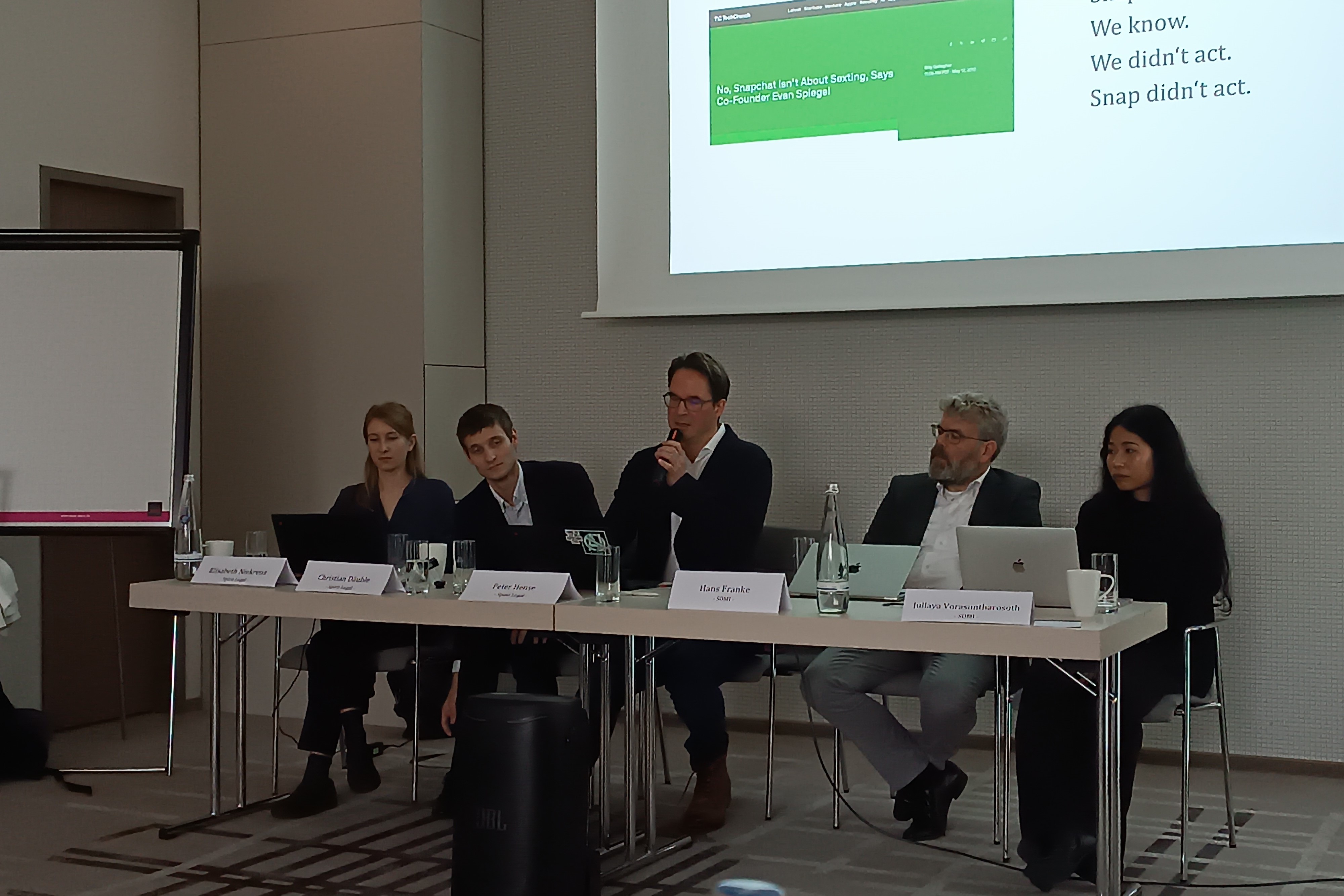
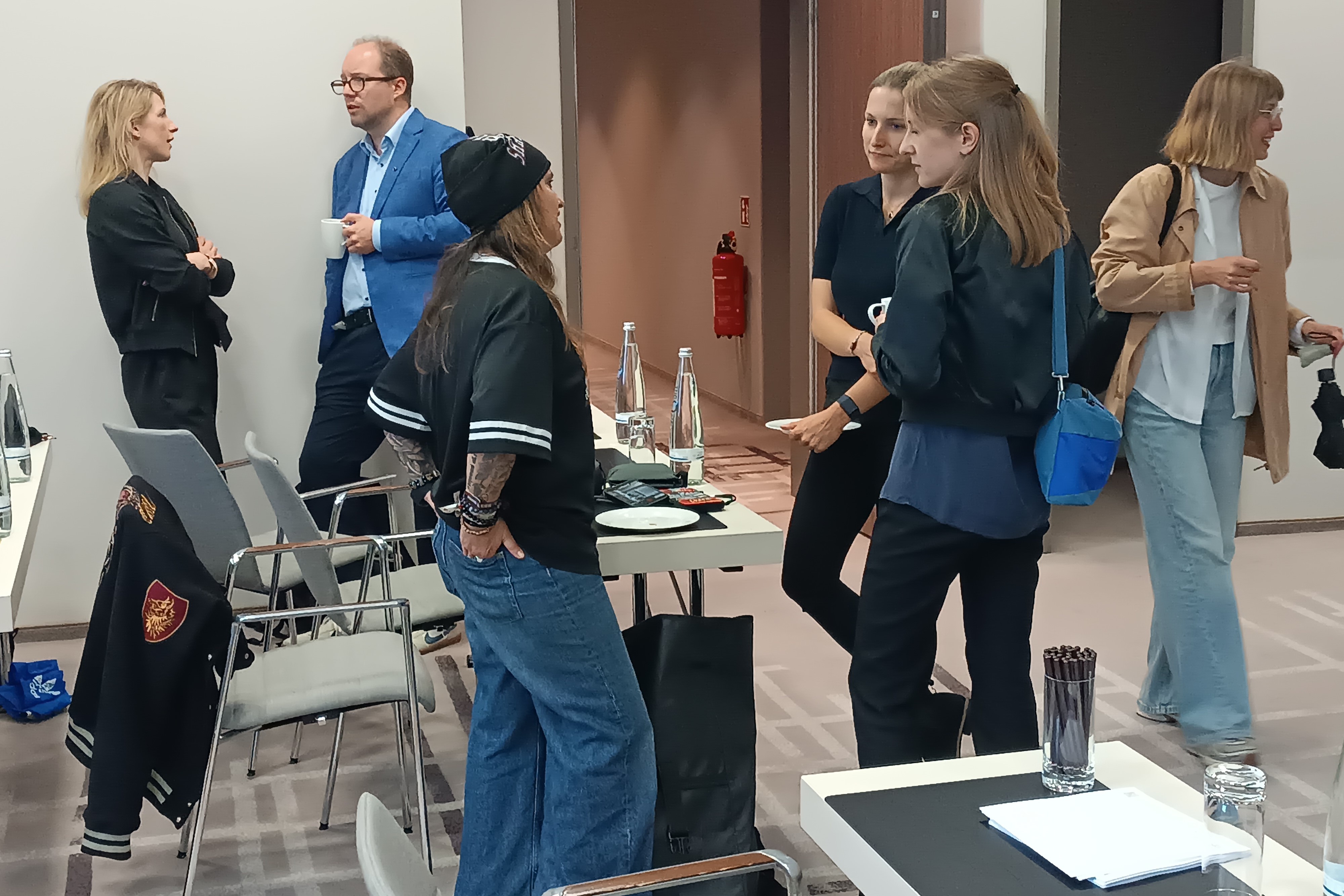
Elisabeth Niekrenz, Christian Däuble and Peter Hense (Spirit Legal) Hans Franke and Jullaya Vorasuntharosoth (SOMI) Photo: Thomas Köhler
SOMI is already pursuing several legal proceedings against various platforms; we reported in February 2025 on one such case, in which SOMI is also represented by Spirit Legal.
What are the grounds for the legal action?
Hans Franke described it as follows: “Snapchat is structured in such a way that it is possible to show children lots of things that you wouldn’t want their parents to see, and then make that content disappear again. The entire structure of the app is designed to exploit this architecture to present children with all sorts of pornographic rubbish and all sorts of products that are not intended for them and which must not be sold or offered to them anywhere in the EU. It is this advertising that makes Snap a profitable business. So the addictive design has the effect of keeping children glued to their screens for as long as possible. It is not because parents are bad parents, nor is it because children are lazy. It is because the software is designed to keep children engaged with it.”
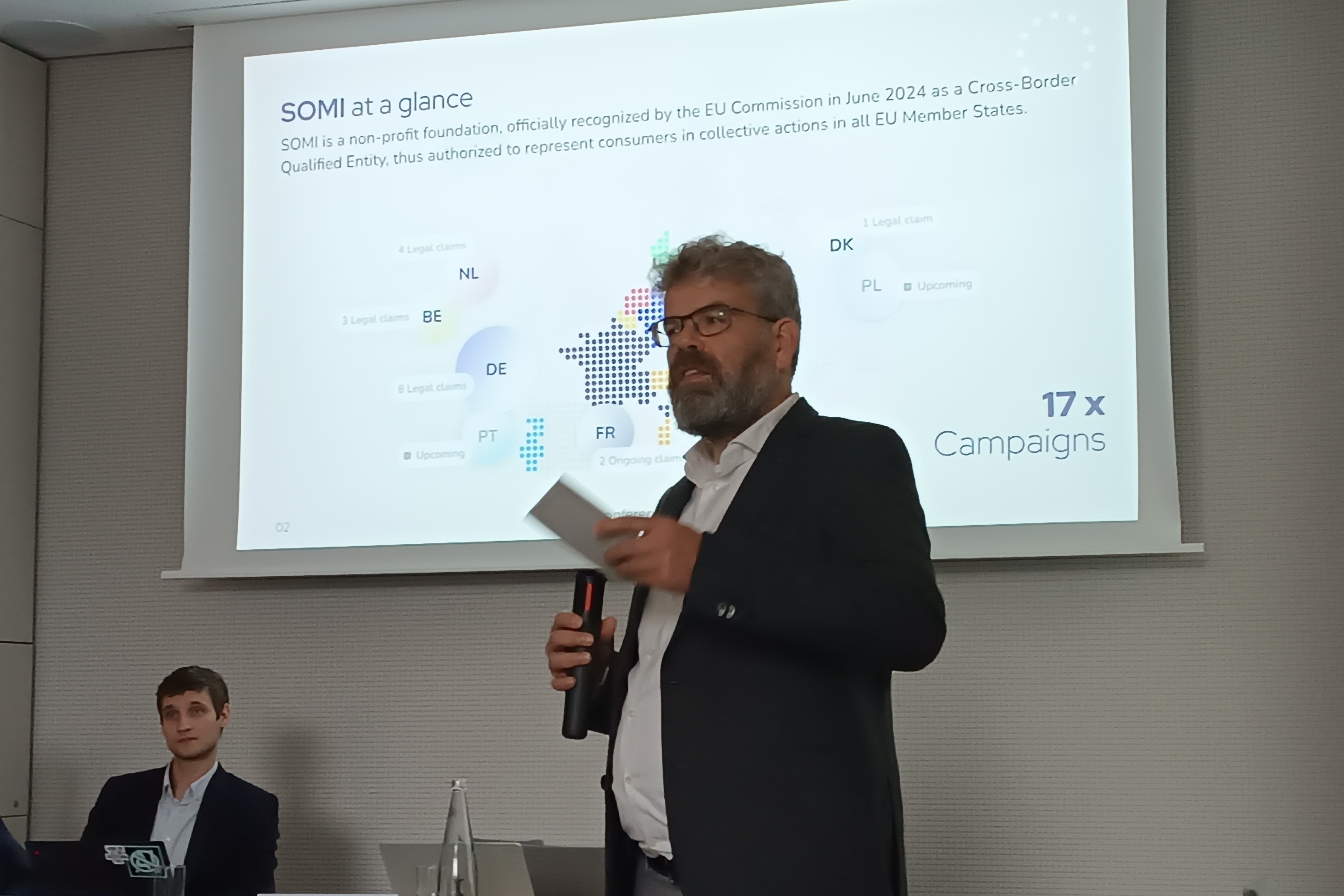
Hans Franke (SOMI) during his presentation. Photo: Thomas Köhler
Peter Hense, a specialist solicitor in IT, data protection, trademark and competition law, and travel industry law at the Leipzig-based law firm Spirit Legal, took the floor. He cited examples from the years since 2012, which demonstrate that this is not a new problem. Things are already happening in the US too. As early as 2024, the Attorney General of New Mexico brought a lawsuit against Snap Inc., and in the course of this case, internal messages from the company also came to light.
It emerged that reports of cyber-grooming are not being investigated. The company itself had written: “Over 90 per cent of reports at account level are currently ignored, and instead we simply ask the affected person to block the other person.” This appears to be systematic.
Even if the company’s sole response to sextortion – that is, the blackmailing of victims using intimate images – is: “I’m so pissed that we are overrun by this sextortion shit right now”, this demonstrates an unacceptable attitude towards sexualized violence.”
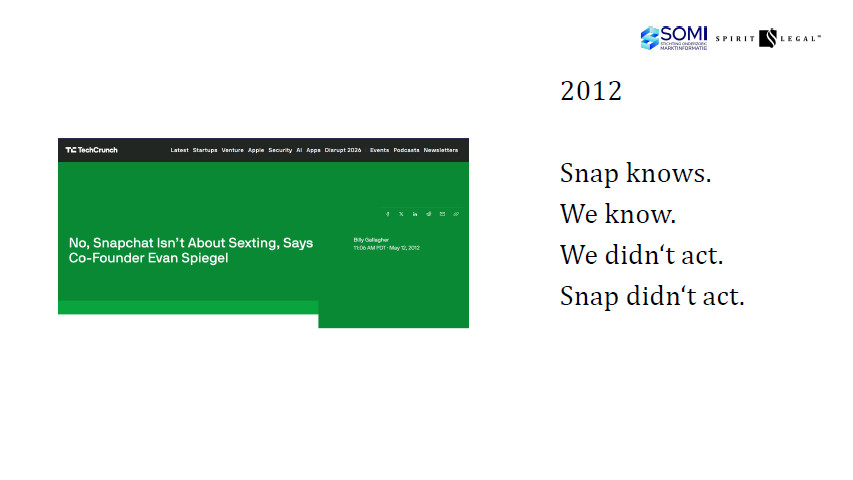
Snapchat and sexting, presentation by SOMI & Spirit Legal. Screenshot: LZ
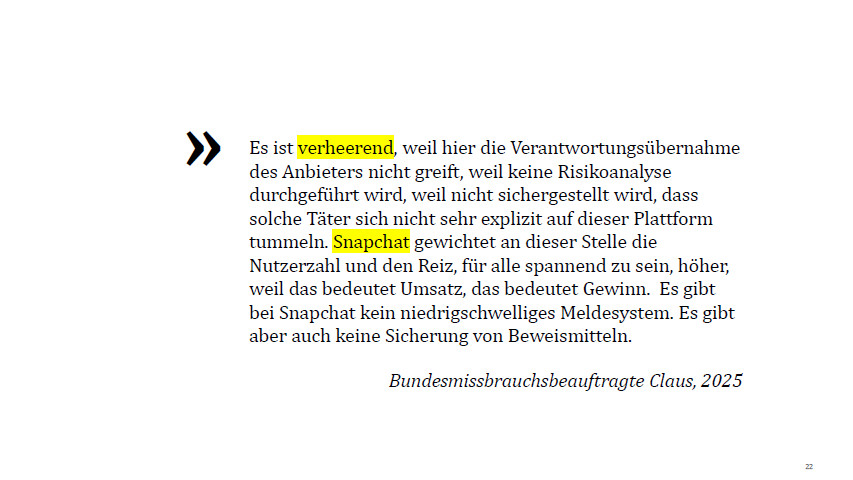
This came to light in Germany a year ago: “The Federal Government’s Commissioner for Child Abuse, Kerstin Claus, has accused the operators of the Snapchat app of deliberately and intentionally disregarding child and youth protection. It is perfectly clear that users’ ages are not checked. »And there are no checks on how openly perpetrators are operating either.« This makes Snapchat a »haven for perpetrators«.”
Cyber-grooming, sextortion, drug dealing and recruitment for criminal activities are the main allegations levelled against Snapchat and Snap Inc.
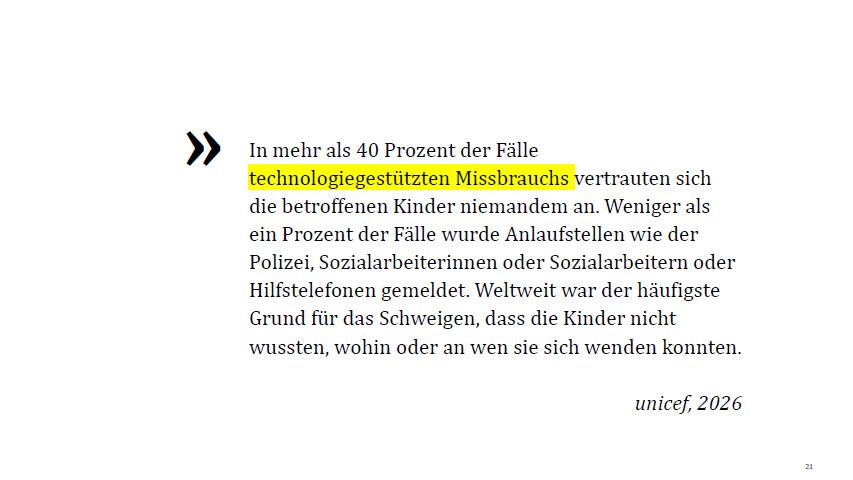
UNICEF 2006 on ‘technology-facilitated abuse’, presentation by SOMI & Spirit Legal. Screenshot: LZ.
Comments on the legal basis
At present, the solution favoured by politicians appears to be: let’s ban children from social media! This also results in a de facto ‘obligation to register with age verification’ for all social media users. According to Peter Hense, this constitutes a reversal of the burden of proof.
Christian Däuble, a solicitor specializing in data protection law, competition law and European law at Spirit Legal, spoke about the legal basis of the claim. “Since April 2023, Snapchat has been a ‘very large online platform’ and is therefore subject to the strictest regulations and provisions of the DSA. These include, amongst other things, the ban on displaying adverts based on profiling that uses sensitive data. On Snapchat, facial recognition and the resulting emotion and mood metrics are used to measure biometric data, which is then seamlessly integrated into an advertising profile.”
Snap’s own chatbot, MyAI, also appears to be problematic. “Children perceive it as a conversation partner; it’s always there, it never gets tired, and it’s always responsive. Believing they are having a private conversation, it is very likely that information will be shared and assessed – information that may relate to a person’s health status, sexual orientation or political views; all of which are data categories that are subject to special protection. These conversations – as Snapchat actually states quite clearly in its privacy policy – are used to contextualize advertising.”
Elisabeth Niekrenz, a solicitor specializing in data protection and IT law at Spirit Legal, explained that Snapchat is committing massive and systematic breaches of the GDPR. The misuse of personal data, particularly that of children and young people, appears to form the basis of Snapchat’s business model. Ms Niekrenz elaborated on this:
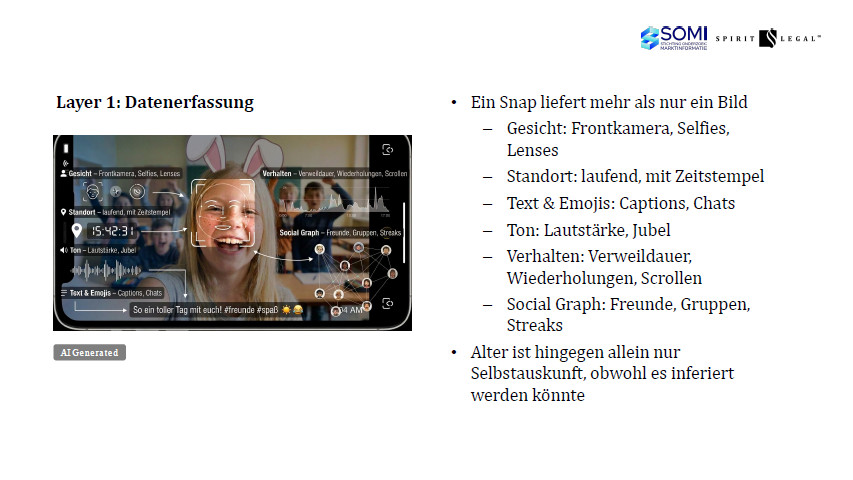
“After all, monetization naturally takes place through the commercialization of personal data, in the form of personalized advertising and personalized content. This concerns sensitive topics such as location data, which naturally enables movement profiles; it particularly concerns biometric data, which falls under the special protection of Article 9 of the General Data Protection Regulation; and it also concerns data that allows inferences to be drawn about usage behaviour. These include inferences about issues such as mental health, depending on what content I view, where I linger, and what interests me. Inferences about developing sexual behaviour, which are then fed back directly. Through feedback loops, you are repeatedly presented with topics that you have clearly lingered on. These legal breaches are particularly flagrant in the case of people under the age of 16, because the protection provided for in Article 8 of the General Data Protection Regulation for people under 16 is being circumvented.”
More breaches of the GDPR, the DSA and, ultimately, the AI Act were cited than can be listed in a single article. Spirit Legal and SOMI have compiled these and are calling on people to report their own documented experiences of breaches via stopsnapchat[at]somi.nl.
What is the aim of the lawsuit?
SOMI aims to put an end to unlawful practices, enforce specific changes to Snapchat and assert claims for damages on behalf of those affected through collective proceedings – across Europe. The basis for this is the EU Directive on Collective Redress, which has permitted collective actions (class actions) in all Member States since 2023.
Following the press conference, we spoke to Elisabeth Niekrenz, who summarized the issue for us once again.
Conclusion
: It is high time we protected our children from such influences on social media; Snapchat must design its platform in such a way as to ensure the protection of children and young people. Experience shows that these proceedings take a long time, which makes it all the more important to file these claims.
Empfohlen auf LZ


So können Sie die Berichterstattung der Leipziger Zeitung unterstützen:





There is one comment