Dieser Artikel ist auch in deutscher Sprache verfügbar: Zum deutschen Artikel.
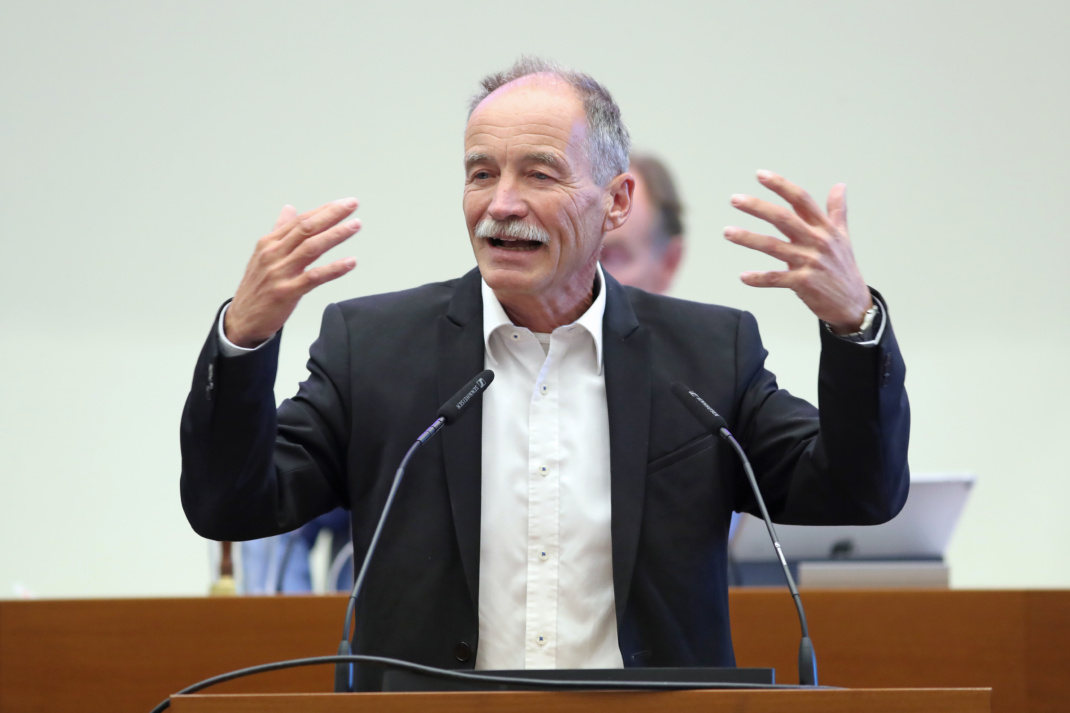
Sven Morlok has been a member of Leipzig City Council again since 2014, having previously represented the FDP there from 2004 to 2009. In the intervening years, he was a member of the Saxon State Parliament and a minister in the Free State’s government. He understands the formalities of council work like no other and is often the voice calling for objectivity. Since the 2024 city council election, he has been the sole FDP city councillor; Dr Reinhold, who won a seat for the FDP, is not actually a member of the FDP and is now an independent city councillor.
As the Free Group, to which Sven Morlok belongs, consists of two city councillors from the party Die PARTEI, a Pirate Party member and Mr Morlok, it was probably forgivable that I initially thought of a motion from Die PARTEI when I came across the motion ‘In Burkhard We Trust’ in the council information system. I was quickly informed that it was an idea put forward by Sven Morlok.
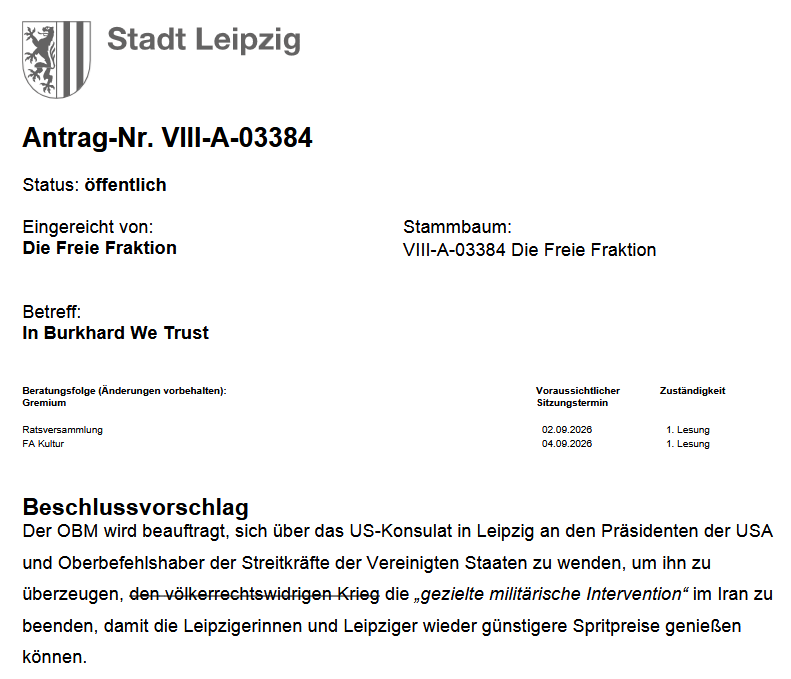
‘In Burkhard We Trust’ motion screenshot: LZ
What does the motion say?
“The Mayor is instructed to contact the President of the United States and Commander-in-Chief of the United States Armed Forces via the US Consulate in Leipzig, in order to persuade him to end the war in Iran – which contravenes international law – the ‘targeted military intervention’ in Iran, so that the people of Leipzig can once again enjoy lower fuel prices.”
This is highly uncharacteristic of Sven Morlok, who, as recently as 3 September, in an amendment tabled by the BSW, demanded that the Mayor should not include any unlawful motions on the agenda of the council meeting. The motion was on the agenda for the council meeting on 2 September and was due to be brought before the council there. Shortly before the council meeting, it had disappeared from the agenda.
What was the purpose of this motion, and why had it suddenly vanished? We arranged a meeting with Sven Morlok. This took place on 8 September.
The conversation
Mr Morlok, knowing you as I do, surely you can’t be serious about the motion ‘In Burkhard We Trust’? How did you come up with the idea?
The idea came about because we constantly receive motions from other political groups – particularly from the Left and the Greens – calling for the Lord Mayor to advocate for all sorts of things at federal or state level. I believe that the Municipal Code of the Free State of Saxony and the City of Leipzig’s main statutes are being deliberately circumvented here, because these are all matters that do not fall within the City Council’s remit. If the Lord Mayor lobbies the Free State of Saxony to ensure we receive funding for the new ball sports hall, then that is a matter concerning Leipzig. Or if it’s about federal funding for the Monument to Freedom and Unity, of course he should campaign for that.
To the best of my knowledge, however, the social welfare laws of the Federal Republic of Germany apply to the whole of Germany and not just to Leipzig, just as environmental legislation does. This naturally leads one to wonder whether the provisions of the Municipal Code are not being deliberately circumvented here. The City Council has no jurisdiction over these matters.
So we thought to ourselves, the price of petrol is also an issue. I mean, if we look at the state election in Saxony-Anhalt, the AfD has repeatedly complained about the high petrol prices and said that something must finally be done. If this really is such a major issue, then naturally the Lord Mayor must also champion the cause. The person primarily responsible for the high fuel prices is, after all, Donald Trump with his war against Iran, and as we have the Consulate-General in Leipzig, Burkhard Jung simply needs to cross the road – he doesn’t even need to travel to Berlin. He doesn’t need to approach the state government, which would then have to convince 15 other state governments to secure a vote in the Bundesrat.
So we thought this would be a simple matter for the Lord Mayor: just to pop across the road, champion the cause and do something for the people of Leipzig.
That sounds very pragmatic, but is this a motion with which you’re seeking to highlight absurd motions?
Exactly – we’ve had those discussions about the military use of the airport. The airport is a commercial airport; it has a general operating licence and is expressly not a military airport. Military flights may be carried out on a case-by-case basis, subject to approval by the Federal Government. That is precisely why these discussions make no sense – this needs to be pointed out.
It is important to me that we restore the city council’s remit to what is actually laid down in the Local Government Act. That is why I also asked to speak when the topic of sea rescue came up. Personally, I found it very difficult to speak out on this matter, because I can understand and empathise with the plight of these people. What is happening there is terrible. But it is simply not the role of a local council in the Federal Republic of Germany to deal with maritime rescue in the Mediterranean or anywhere else.
Of course, it is a humanitarian issue. And when people counter by asking, ‘What’s the problem with putting out a collection box at City of Leipzig events?’, Then I simply ask myself: if we were to set up donation boxes at City of Leipzig events for every humanitarian problem in the world, would there be a few hundred, or a few thousand of them there? That cannot be the city’s responsibility, and nobody is stopping anyone from walking around Leipzig with a donation box.
This discussion already took place in 2019 and 2020, when, following the City of Leipzig’s accession to the ‘Safe Havens Cities’ alliance, the question arose as to whether the City of Leipzig could or could not do certain things.
One issue, of course, is whether, when refugees arrive here, we take people in. If they are in distress at sea and in need of shelter, then it is naturally the City of Leipzig’s responsibility to decide on this, including via legally stipulated quotas. I am very much in favour of doing that. That is, of course, a different issue from collecting donations for sea rescue.
The city of Leipzig now faces its next challenge: the budget. Based on experience from previous budgets, there will probably be another flood of motions seeking to commit additional financial resources. What will happen here?
I’m not at all sure whether there really will be a flood of them. I do have the feeling that the various parliamentary groups have recognised the seriousness of the situation. But there will certainly be motions for additional expenditure. The trouble is that, from a purely formal point of view, the next two-year budget is unproblematic, as we are still benefiting from the exemption granted by the Free State. Theoretically, we could spend money like there’s no tomorrow over the next two years. After all, the only thing we have to adhere to is repaying the cash advance we then take out over the next ten years.
But that is precisely the problem. We are already unable to repay our existing loans and the additional cash-flow loans taken out so far within the next ten years. Anything else we borrow now will be added on top and cannot be repaid either. Ultimately, this limits the future prospects of the younger generation, because there will be less money left for them. I am very curious to see what will happen if this two-year budget is now passed quite casually with a large amount of money – what will be done in two years’ time. Because then, shortly before the city council election, a two-year budget will have to be passed for which the exemption no longer applies, and it will have to balance the books.
Burkhard Jung and Sven Morlok might find themselves in a tight spot. They and Burkhard Jung will no longer be there by then. The mayor will be re-elected in 2027, and you don’t want to stand for re-election at the next city council election.
I certainly won’t be standing again. But once again, from a purely formal point of view – a purely legal one – this budget is straightforward. The real test will come with the next biennial budget, because that’s when the relevant regulations will come into force. And then I’ll see what happens when, two or three months before a local election – before a city council election – a budget has to be approved that requires drastic cuts just to balance the books.
Another major issue, which is of course linked to finances, is that of staffing. What is your view on the deployment of staff? Has the issue of increasing efficiency finally been taken on board at the Town Hall?
I do believe that we need to increase the pressure on the HR department. Without pressure, people tend to get complacent in certain situations. This isn’t a criticism of the administration; it’s exactly the same for us in our private lives and in businesses. As long as things are going well, we don’t pay much attention to these matters. It’s only when things get tight, or a bit more difficult, that you take a closer look. That’s only human; it’s not a criticism of anyone, but of course it also helps to spot issues.
One example that struck me was in relation to ‘profiles’. The issue was how to optimise fleet management. The City of Leipzig realised that fuel cards exist – that is, you can have cards from various oil companies which are linked to a specific vehicle. Staff can then use the fuel card to pay at the petrol station, and once a month the city receives an invoice from the oil company. The cards can be assigned to specific cost centres and the invoices are automatically posted correctly in SAP. What has the City of Leipzig been doing up to now? All staff members used to pay out of their own pockets, receive paper receipts, probably stick these onto a form, submit the paper form, apply for reimbursement, and the money was
then
transferred.
I don’t think there’s any need to go into further detail about the administrative effort involved in such a process. I’m sure everyone can picture that. If you describe it that way, then surely digitisation is slowly getting on the right track?
Yes, of course we have to think about the fundamentals. If you want to enable purely computer-based workstations, flexible working arrangements or working from home, then you naturally need a way to access files online. If the file is only available in paper form, none of this is possible. In Germany, we have funding schemes from the federal government or the state for all sorts of things, but the administration has to fund the digitisation of files from its own resources. I do wonder whether that’s the right approach? If we’re trying to achieve cost savings at local authority level, then surely the federal government should step in and provide local authorities with substantial funding for document digitisation, in order to create the conditions for the new world of work.
In your view, what are the next major hurdles facing the city?
The main hurdle is actually the obstructionist stance of the political groups on the city council. Of course, we can talk about improving the revenue situation. For example, at the last city council meeting, we discussed a budget proposal from the BSW to increase the tax on second homes. The administration proposed a corresponding amendment to the by-laws, but the city council shelved the whole matter. It was unclear how this would apply legally to students and apprentices. The result was that something the city council had already decided on – namely, the increase in the second-home tax – was not approved.
As for nursery fees, these have not been increased since 2017. Since 2017, earnings in the Free State of Saxony have risen by 40 per cent. At the highest level, a 20 per cent increase was proposed. But even a 20 per cent increase – that is, half the proposed amount – is not possible because of fundamental obstructionist tactics by the CDU and The Left, and probably also by the AfD. When you face this kind of obstruction, you simply cannot make any progress on the budget. It then becomes impossible to hold a proper discussion. This is particularly true given that, thanks to relevant social discounts, a quarter of all Leipzig residents would not be affected by the childcare fee increases at all.
We’re coming to the end, so let’s jump back to the beginning. The motion ‘In Burkhard We Trust’, which we discussed at the start, has, of course, been removed from the agenda. Did you remove it?
No, it wasn’t us. The Lord Mayor has formally declared the motion to be unlawful. What we will do is lodge an objection to this ruling. We will demand a further review and make it clear that the points raised as criticisms of our motion could just as easily have been raised against many other motions. At the last council meeting, during an administrative statement – in which he himself was the proposer – the Lord Mayor suggested that he should lobby the Free State of Saxony on a particular matter. If the Lord Mayor suggests this, who would accuse someone like Burkhard Jung of striking out an unlawful administrative statement? I think no one would.
Mr Morlok, thank you for the discussion.
Transparency note: The author was a member of Leipzig City Council for the Pirate Party from 2019 to 2022 and, together with Sven Morlok, was part of the Freibeuter parliamentary group.
Empfohlen auf LZ


So können Sie die Berichterstattung der Leipziger Zeitung unterstützen:





There is one comment