Dieser Artikel ist auch in deutscher Sprache verfügbar: Zum deutschen Artikel.
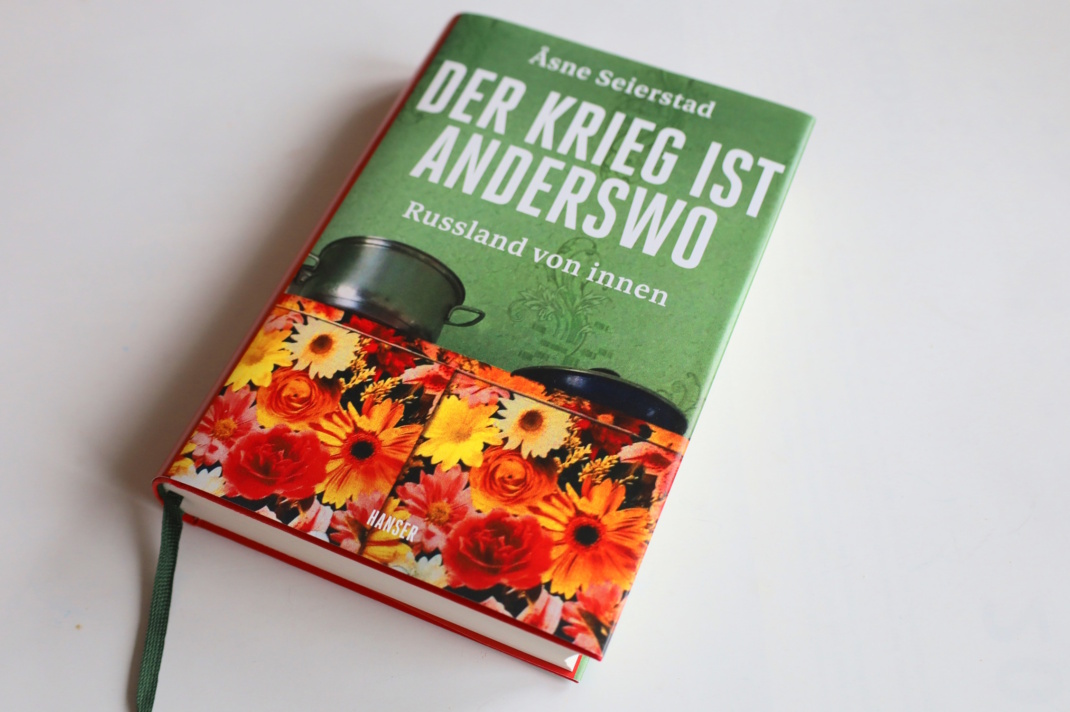
How does one write about Russia and the Russian people – in the midst of a war? When even the use of the word ‘war’ is banned there, and foreigners are viewed with suspicion the moment they set foot in the country? In 2022, immediately after Putin launched his ‘special military operation’, the Norwegian journalist Åsne Seierstad nevertheless told herself that this is precisely what needs to be done. Go there and speak to the people. No third-hand news. That’s when journalism truly becomes journalism: when you go there yourself and speak to the people.
She has done this on several occasions since 2022. This book recounts it all across 600 pages. There is currently no more concise way to gain an insider’s view of Russia. Her journeys took her as far as Siberia, to that village in the taiga where Andrej grew up, to which the entire first chapter is dedicated. Andrej achieved a degree of fame in Norway, as in the middle of winter he crossed the border between Russia and Norway – which is heavily secured on the Russian side – to seek asylum there.
He had already been on the run for months, having deserted from one of the Wagner Group units that played a central role in the early months of Putin’s full-scale invasion of Ukraine, when the Russian army’s first attempt to to capture Kyiv within three days had failed so miserably, and the operation had turned into a protracted attempt to take control of eastern Ukraine.
At times, the Wagner troops were the elite force here, forcing the advance with brutal ruthlessness. Including, and indeed particularly, through brutality against their own people. It was not Andrei’s first war. Yet this one threatened to become an endless war for him, from which there was only one way out – in a body bag.
A Russian soldier
But Åsne Seierstad wanted to know more about him; she had him recount his entire life story himself – from his childhood in that village in Siberia, to the tragic death of his mother and his father’s brutal parenting methods. She wanted to understand why someone like Andrej ultimately enlisted with Wagner, having already served in the Russian army a few times before, and as recently as 2014 in eastern Ukraine, when Putin first had Crimea annexed and then sent his soldiers into Donetsk and Luhansk.
In truth, Andrej had had enough of war. But he never really managed to find his place in society. And he was by no means the only one. What Andrej experienced with his father was no exception; rather, it was typical of Russian fathers’ understanding of ‘proper’ upbringing. Reading Åsne Seierstad, one feels transported into a world familiar from 200 years of Russian literature – from the classics of Chekhov and Dostoevsky just as much as from Soviet literature. It is as though, despite all the revolutions, nothing has ever changed in the tragedy of this vast country. Certainly not in the provinces.
As if people were indeed nothing more than ‘dead souls’, to quote Gogol. Pawns in the hands of a draconian power that imprisoned those who did not comply in merciless labour camps. Something Anton Chekhov wrote about as early as 1890 in his travelogue ‘In Siberia’.
Which Åsne Seierstad, of course, mentions. For it also touches on the area where Andrei grew up, but where Stalin himself was once imprisoned in a labour camp until he managed to escape through the taiga. Yes, the very same Stalin who then, in the 1930s, had millions of people shot and exiled to the Siberian camps.
The image of Russia in propaganda
Åsne Seierstad knows her Russia. She also studied here in the early 1990s, when, under Yeltsin, anything seemed possible – even a new, democratic, free Russia. A Russia that still haunts the minds of many Western politicians today, who refuse to accept that Yeltsin’s successor turned back the clock and established a new autocracy, turned elections into a farce and dreamt of a new empire in which there could be no independent Ukraine.
It was, after all, merely Russian ‘borderland’ and had always belonged to Russia, according to the arguments which – as Åsne Seierstad repeatedly discovers – have taken root in the minds of most Russians. After all, this narrative had been broadcast on every channel since 2014 at the latest, whilst all independent media in Russia were gradually silenced and journalists were simply declared to be ‘foreign agents’.
Åsne Seierstad also made contact with the last remaining independent journalists in Russia, the stalwarts of *Novaya Gazeta*, who shortly afterwards also lost the editorial offices they had so bravely defended. Stormed by FSB agents. That is when – as Åsne Seierstad writes – she changed sides, having previously travelled primarily to speak to and portray ‘ordinary’ Russians and to portray them, describing their lives, their dreams, and their attitudes towards the war, which was raging somewhere far away but had not yet – as in 2026 – returned to the homeland of the war in the form of Ukrainian drones.
She describes the glaringly obvious poverty in the Siberian province, speaks to Andrej’s teachers, and tracks down his father, who, whilst downplaying his brutal parenting methods, still fails to understand why Andrej has gone off to war again.
The cold breath of the powerful
She meets many endearing people, including Andrej’s sister and aunt, experiences heart-warming hospitality, and only abandons this approach to understanding Russia when the people she wished to speak to suddenly start postponing appointments or cancelling them altogether. As if everything had been said. Or as if they had all received a warning in the meantime. The authorities seem to be viewing Åsne Seierstad’s plan to write a book about Russian society with increasing suspicion. And in this vast empire dominated by the FSB secret service, that does not bode well.
This is the moment when Åsne Seierstad ‘changes sides’, as she puts it, and – having returned to Moscow – arranges meetings with those who criticise Kremlin policy. And these are not only the journalists from *Novaya Gazeta*; but also a doctor who courageously campaigns for the men to return from the war, and a member of the Yabloko party who has long been treated as an enemy of the state and – after Åsne Seierstad’s investigation came to an end – was in fact arrested.
In Putin’s Russia, no one needs to be guilty of anything to be criminalised and sentenced to years in prison on flimsy grounds. And then – like Alexei Navalny – to die in a labour camp. He was probably poisoned, even though the authorities went to great lengths to destroy any potential evidence of his death. This death is also featured in the book, as is the march of the Wagner Group troops towards Moscow in 2023 – whilst the author was travelling from Moscow to St Petersburg – and the death of their leader, Yevgeny Prigozhin.
A war that must not end
All events that have almost been forgotten, whilst the war in Ukraine simply showed no sign of ending and swallowed up more and more young men, particularly from the Russian provinces, whilst life in Moscow seemingly carried on undisturbed. As if Moscow were another world. And whilst Åsne Seierstad travelled back to Russia time and again for three years – until the autumn of 2025 – travelling to Russia time and again to gather further material for her book, Andrej’s story continued in Norway; the refugee, shaped by his childhood and the war, repeatedly committed offences, thereby destroying any chance he had of being granted asylum in Norway.
He had trusted Åsne Seierstad ever since their in-depth conversations and even phoned her whilst she was travelling to his Siberian homeland. But one senses that he could not escape his life story; perhaps he was also suffering from war trauma and was, quite rightly, angry that he was not receiving any psychological support. It is an individual’s fate. But it applies to thousands of people who have fled to Europe from the world’s war zones. And to all those returning from war in Russia, in any case.
The war itself has long since become a trap for the ruler in the Kremlin, for simply allowing the traumatised and brutalised soldiers back into the country following a peace agreement would be the key to a hellish turn of events. Russia would itself be engulfed in violence. Without being able to offer those scarred by war any prospects for the future.
Even university lecturer Lukyanov, who actually endorses the Kremlin’s manipulative policies, says in conversation with the author: ‘What will happen when hundreds of thousands of broken men return home from the war? ‘You are heroes, thank you very much for your service, and now go back to where you came from.’ Then they will return to the ‘depths’. (…) Will they then accept that wretched life, after everything they have sacrificed? In blood and in limbs?”
The value of a human life
And so the soldiers are not discharged either. Maria, the doctor, experiences this first-hand with her own husband. Not even a mental breakdown is enough to finally bring him back to civilian life. “When Maria came home after her first visit, she wrote two sentences in her blog: We must remember that nothing is more valuable than a human life. Individuality is the foundation of a healthy society.”
This realisation, as Åsne Seierstad notes time and again, has not been entirely lost. Not even in the neglected provinces, which remain as poor as they were in Soviet times.
One final border crossing serves as a warning to Åsne Seierstad that she is under the scrutiny of the secret service. A ‘chat’ upon entry turns into an interrogation lasting several hours. Ultimately, it is all about Andrei, who is probably right to fear that death awaits him should he return to Russia. In the end, it is his story that dominates this book. And it ends with a question mark, because Norway will not grant him asylum.
The Smile of Freedom
The fact that there are other soldiers’ fates is made clear right at the very end by the example of Stanislav, who went to Ukraine after the outbreak of war to join the Ukrainian army. Partly because he had seen on social media that the images from the West did not match the Russian propaganda at all. That people there seemed happier, actually smiling, whilst in Russia he had seen only closed-off, embittered faces.
“The Kremlin doesn’t care about people,” he says. “Doing good for ordinary people isn’t on the political agenda, do you understand?”
But by then Åsne Seierstad has already left Russia for good, knowing that she will never be able to return to this Russia again. In the end, a jar of honey even saves her from a tricky situation at customs. Once again, she’s lucky and is able to tell her story in *Russia from the Inside*, which was translated into German astonishingly quickly by Anja Lerz.
A snapshot of the times and a portrait of a Russia in which, although recruitment posters hung throughout the country, the war was still a long way off. Even though it had already been raging for over three years and had claimed the lives of hundreds of thousands of young Russians. And would continue to claim more lives, because the ruler in the Kremlin now feared even the returning soldiers. But they would only return home once this war came to an end. A hope expressed by almost all of Åsne Seierstad’s interviewees.
Whilst in the Siberian villages the military cemeteries are growing and pictures of the fallen former pupils hang in the schools. And in Karelia, a former Russian officer is collecting the remains of the soldiers who were killed here during the Second World War. Simply ‘forgotten’ for decades. And the man’s son volunteers to fight in the war in Ukraine and is killed by a drone.
Åsne Seierstad, *The War Is Elsewhere*
, Hanser Verlag, Munich 2026, 32 euros.
Empfohlen auf LZ


So können Sie die Berichterstattung der Leipziger Zeitung unterstützen:





There is one comment