Dieser Artikel ist auch in deutscher Sprache verfügbar: Zum deutschen Artikel.
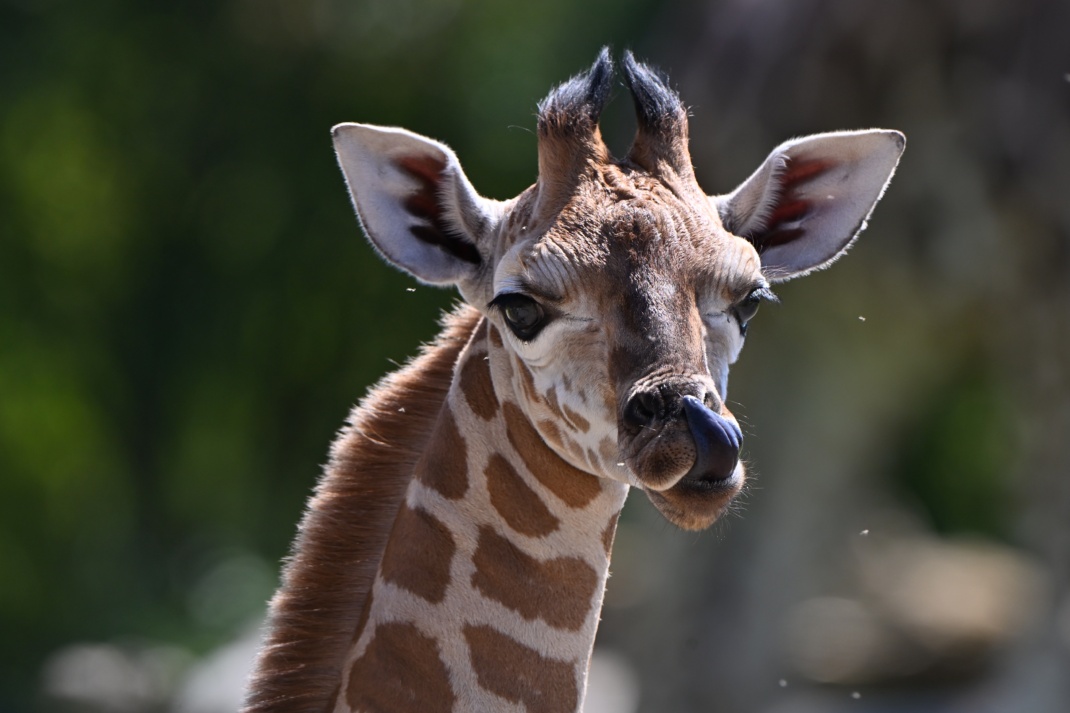
Life – one big wonder. At the end of July, five-year-old giraffe Tamika gave birth to a baby at Leipzig Zoo. And from the very beginning, there was one discovery after another for the newcomer to the herd. The little girl is Tamika’s second child. Back in January 2024, her son Kiano saw the light of day on the African savannah at Leipzig’s Rosental.
“We knew that Tamika had been mated and were expecting the birth any day now,” says division manager Jens Hirmer. “We are very happy that it went so quickly and smoothly and that the young animal seems to be in good health.”
But the adventure of life began for the newborn Rothschild giraffe with a deep fall from darkness.
Fall into the straw
After a gestation period of about 14 months, the time had come. The baby no longer wanted to be carried around, but wanted to experience for itself what it was like “outside.” A gentle birth? Unthinkable for giraffes. On July 25, it plopped down into fragrant straw from a height of a good two meters and opened its curious, wide eyes. The first thing it saw was… legs. Long legs. Straw and legs.
But then, surprise, a huge head gently appeared and began to lick the little giraffe’s body with a huge tongue. Tamika and her little one had survived the birth.
Since giraffes are savannah animals, they don’t spend much time building a nest or a cozy maternity room. After the exciting and successful landing, the next adventure follows. Stretch your legs, bend them again, stretch them again, put your hooves on the ground. Push up. What may seem a little like a human’s first attempts at roller skating at first is the most important exercise for giraffe calves. And it works. Less than two hours after birth, Tamika’s calf is on its feet.
Off outside
Two weeks later, a large sliding door opens. Until now, light only came in from above through the roof. The little giraffe girl has now met her father Matyas and brother Kiano. Matyas was born on February 13, 2019, in Prague and is the only breeding bull in Leipzig. The other animals in the herd have also accepted the new addition and eye it friendly.
With every crack that the huge brown wooden door rolls to the side, the sun tickles Giräffchen’s nose more and more. Following it, her deep brown eyes behold the Kiwara savannah. 2.5 hectares of grass, sand, bushes, trees… And strange creatures that look so different from mom, dad, and the other long-legged animals in the herd.
There are the black-and-white-striped zebras with their nimble and much shorter legs. The Thomson’s gazelles have even shorter legs, but rather pointed horns. Large and brown with long curved scythes on their heads: the antelopes. Why aren’t they called prolopes, as friendly as they are? The guinea fowls are a bit exhausting.
Always in a hurry, always hectic, always excited. The ostriches, on the other hand, are elegant. They stride majestically across the terrain, but you mustn’t tease them.... All in all, it’s a friendly community.
Endangered species
As with many other animals, the Rothschild giraffe is not doing well. The International Union for Conservation of Nature, founded in 1948, last estimated their number at around 1,500 animals. The population has experienced a dramatic decline in its range: From a once generous area across East Africa, the habitat of this subspecies of Giraffa camelopardalis is now limited to island populations protected by national parks in Kenya and Uganda.
It is nearly extinct in South Sudan and northern Uganda. As a member of the European Endangered Species Program (EEP), Leipzig Zoo is contributing to the survival of this species.
So können Sie die Berichterstattung der Leipziger Zeitung unterstützen:



There is one comment