Dieser Artikel ist auch in deutscher Sprache verfügbar: Zum deutschen Artikel.
Everyone’s talking about the baby boomers, even blaming them for everything that’s gone wrong in Germany. And at the same time, fears are being stoked about the time when these large cohorts will retire. And what then? The Berlin Institute for Population and Development is also giving serious thought to the baby boomers and their transition into retirement. If only that were all. For the question underlying it all is: why do Germans no longer want children? What impact does this have on the very soul of society?
One effect is already clear: the concerns of the elderly are shaping politics. And with that, the perspective of the researchers at the Berlin Institute: “The baby-boomer generation has shaped working life and German society for decades. It is now gradually entering retirement – with far-reaching consequences for society, the economy and the welfare state.”
This is demonstrated by the new analysis from the Berlin Institute for Population and Development, commissioned by the Konrad Adenauer Foundation. The analysis, ‘After the Baby Boomers: How demographic change will develop beyond 2030’, systematically looks beyond the current wave of retirements to the year 2060, revealing significant regional differences between federal states, districts and independent cities.
The East as a trailblazer – but what does this teach us?
Based on the latest population projections from the Federal Statistical Office and the Federal Institute for Research on Building, Urban Affairs and Spatial Development (BBSR), the analysis shows that the ageing of the baby-boom cohorts is proceeding in two opposing waves: Initially, the group of ‘active older people’ aged between 67 and 79 will grow noticeably, before the number of very elderly people aged 80 and over increases significantly in almost all regions from the mid-2030s onwards – with a corresponding rise in the need for care and support.
By 2039, 13 million people will retire
By 2039, more than 13 million people will reach the statutory retirement age of 67. “What at first glance appears to be a uniform trend is, on closer inspection, a bundle of very different demographic dynamics,” explains Dr Frederick Sixtus of the Berlin Institute. “Ageing is not proceeding at the same rate everywhere, nor does it have the same consequences everywhere.”
In 2024, the proportion of people of retirement age ranged from 16 per cent in Hamburg to 25.3 per cent in Saxony-Anhalt. This is primarily due to migration patterns over recent decades: younger people in particular have moved away from structurally weak regions – especially in eastern Germany – whilst economically strong regions and city-states continue to attract young people, thereby counteracting the effects of ageing to a greater extent.
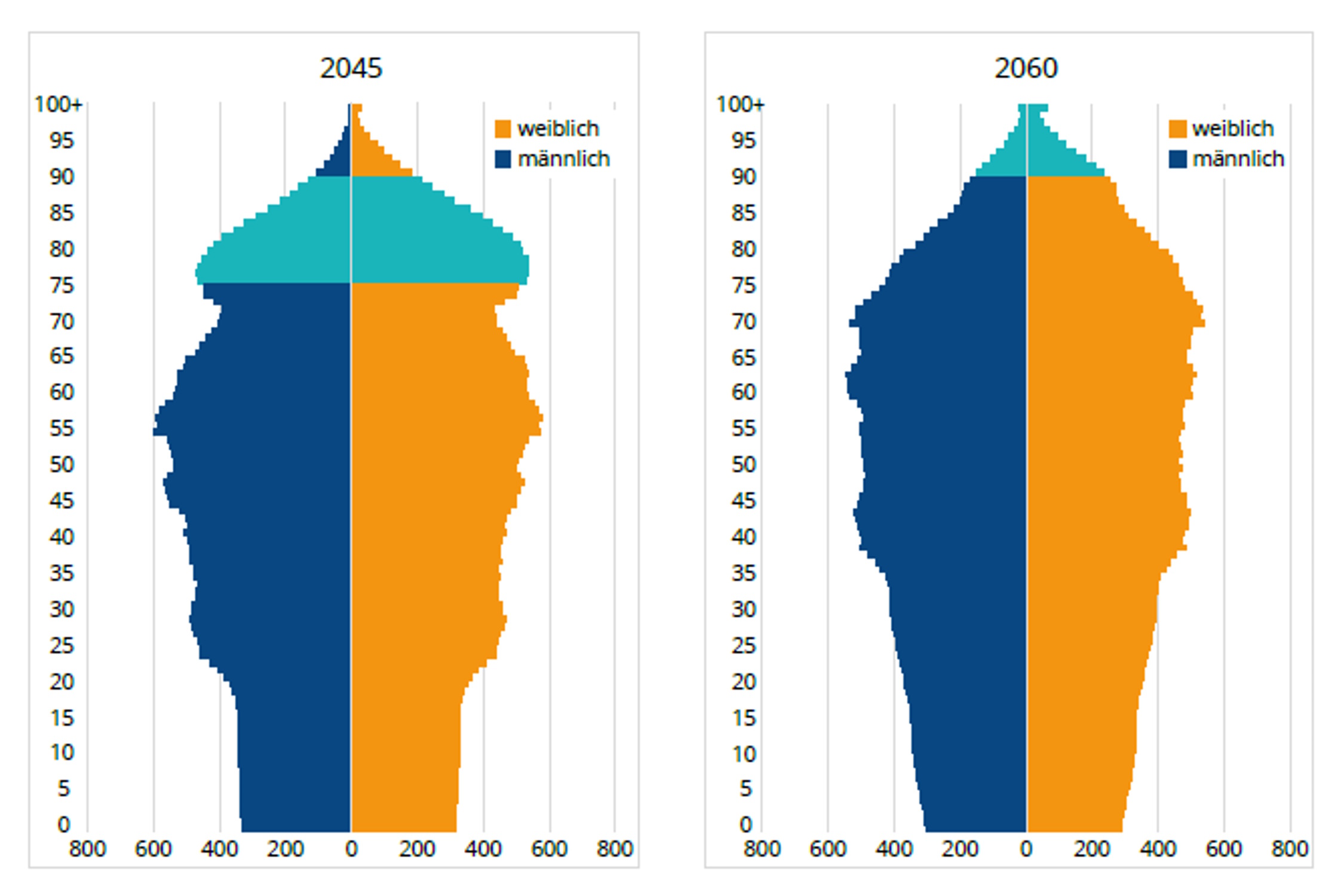
The German age pyramid in 2045 and 2060. The baby boomer cohorts are shown in blue. Graphic: Berlin Institute for Population and Development
Proportions of ‘active older people’ and the very elderly are moving in opposite directions
At district level, the differences become even more pronounced: in 2024, the proportion of ‘active older people’ – those aged over 66 – ranged from 14 per cent in Frankfurt am Main to 31.2 per cent in Suhl, Thuringia. By 2045, the districts of Greiz and Altenburger Land in Thuringia (31.9 per cent and 31.7 per cent respectively) and Spree-Neiße in Brandenburg (31.8 per cent) – whilst Offenbach and Frankfurt am Main will continue to have the lowest proportions, at 14.2 per cent and 14.6 per cent respectively.
Rural areas in eastern Germany are playing a pioneering role in this regard. “What many western German regions have yet to experience demographically, eastern German regions have, in some cases, already experienced,” says Dr Frederick Sixtus. In rural western Germany, the number of very elderly people is also likely to increase at roughly twice the rate of rural eastern Germany by the middle of the century, whilst in eastern German regions a more moderate rise in the number of older people is occurring against the backdrop of an already shrinking, younger population.
Planning ahead – but how?
And this is where things get interesting. After all, it was not without reason that the Konrad Adenauer Foundation commissioned the study. Since taking office in spring 2025, Chancellor Friedrich Merz (CDU) has had his sights set on one issue alone
: Germans do not work hard enough. And they retire too early. Surely we should be able to tap into the ‘active older generation’ and harness their potential for society. At least, that is the view of the Berlin Institute.
The authors of the analysis recommend that local authorities, the federal government and the Länder incorporate demographic trends into their planning at an early stage, whilst taking local circumstances into account.
Viewing active older people as a resource:
many future retirees are well-educated, competent and in good health. Local authorities should set up low-threshold contact points and networks for voluntary work to tap into this potential for volunteering and ‘silver work’ – ideally even before people reach retirement age.
Investing proactively in care and housing:
From the mid-2030s onwards, the need for care and support will rise significantly as the number of very elderly people increases.
Strengthen the exchange of experience between East and West: East German regions must safeguard existing care provision structures under more challenging demographic conditions, whilst West German regions still need to cope with growing demands. A targeted exchange of experience can help both sides.
Adapting framework conditions at federal level:
The federal and state governments are called upon to drive forward key tasks such as the reform of the pension, care and social security systems, as well as securing the workforce, labour market integration and labour migration.
The perspective of those affected – simply ignored
Which then effectively underpins the Chancellor’s wish. Yet the very last demand does not stem from the study’s findings. It is: wishful thinking. Just like the creation of housing suitable for older people. And the truly fundamental question remains: how does one actually organise an increasingly ageing society in which older people also determine the election results?
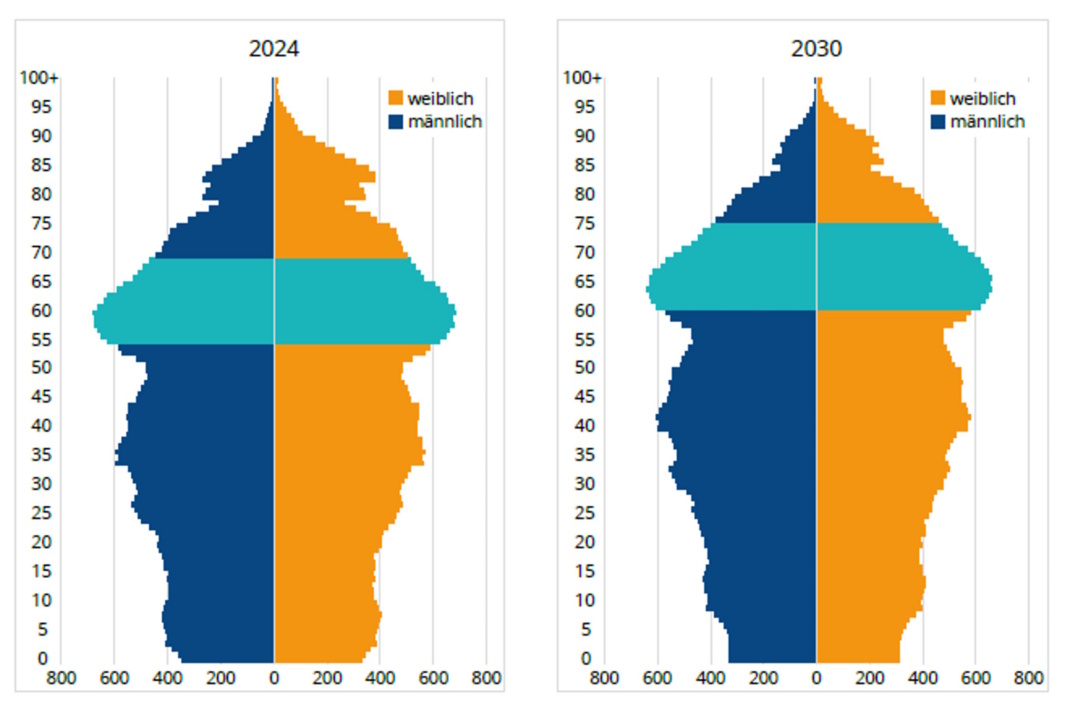
For it is also a fact that such a society has never existed before in human history. The age pyramid, in which the younger age groups normally form a broad base and the oldest a narrowing apex, has instead become something of a sausage shape, with the baby boomer generation protruding whilst the proportion of younger age groups grows ever narrower.
This inevitably changes the mindset of a society and its elected representatives, who – quite obviously – cannot imagine that people over 67 actually still want to remain in productive life. But this requires more than just more care home places – namely, adapted working conditions and programmes introduced at an early stage, so that people can maintain their health and fitness beyond the official retirement age.
If given the choice, they will get involved anyway. And if they are also mentally fit, they will not vote for politicians who simply pursue policies at the expense of younger people.
Unfortunately, however, the authors at the Berlin Institute did not take that step. And so, for the time being, we are left with the vague ideas of the CDU leadership as to how to somehow deal with the large number of baby boomers retiring without having to make any real changes to society.
Empfohlen auf LZ


So können Sie die Berichterstattung der Leipziger Zeitung unterstützen:




There is one comment