Dieser Artikel ist auch in deutscher Sprache verfügbar: Zum deutschen Artikel.
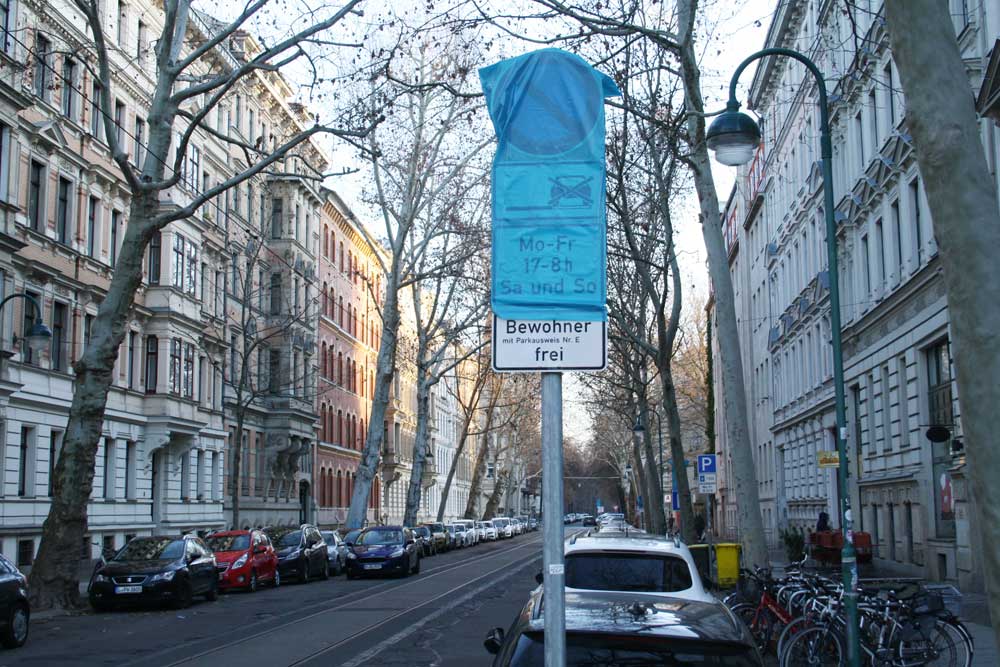
It appears that the Leipzig City Council is unable to draw up a legally compliant scheme for resident parking in designated areas. In 2018, after eight years of back-and-forth at the time, the proposal on resident parking in the Waldstraßenviertel finally reached the city council. It was due to come into force on 30 October 2019 and was ill-fated from the outset.
There are currently fresh challenges, once again affecting local
businesses in the area. But let’s first take a look at what
happened after 30 October 2019. 
A brief history of resident parking
Just one day before it was due to come into force, it was suspended once again. According to Mayor Jung: “The aim remains to make it easier for residents to find a parking space in the neighbourhood in future; at the same time, however, the neighbourhood’s positive economic development and quality of life must be maintained.” The new date was set for 1 January 2020. In the meantime, on 27 November 2019, Klaus Füßer, a specialist lawyer in administrative law, lodged an objection on behalf of Ulrich Holzenleiter’s tax consultancy firm and on his own behalf against the resident parking scheme introduced throughout the Waldstraßenviertel and the traffic signs that had since been unveiled, with the city. He also announced that he would be filing an application for summary proceedings with the Leipzig Administrative Court.
In Resolution VI-DS-03681-DS-07 ‘Resident Parking in the Waldstraßenviertel – Amendment of the Regulations’, the Lord Mayor stipulated on 3 December 2019, amongst other things:
(4) In resident parking zones E and F and the other resident parking zones in the city of Leipzig, business owners may, upon application and subject to the general criteria for granting such permits and proof of registration of their principal place of business in the trade register, be granted two fee-based exemptions in the resident parking zones in accordance with Section 46(1) of the Road Traffic Regulations (StVO).
All well and good? No. In January 2020, Mr Füßer, a solicitor, did in fact submit an urgent application to the Administrative Court for a provisional suspension of the regulation pending a final judicial review of the residents’ parking zone in proceedings on the merits. Reason: The regulations for self-employed professionals are still inadequate and the application process for a visitor’s permit is ‘extremely bureaucratic’.
This urgent application, along with another, was rejected by the Administrative Court, but in August 2020 the Saxon Higher Administrative Court ruled that at least Residents’ Parking Zone E was unlawful. On 16 September, the parking ticket machines and signage in Zone E were reinstated.
The resident parking area was reorganized, and resident parking came back into force on 1 October 2021.
That was a brief overview; there were further disputes surrounding the issue. You can find plenty of information on our website by searching for ‘resident parking’.
The next escalation
Now, in November 2026, business owners in the resident parking zone received a letter from the Leipzig Public Order Office. The letter informed them that point 4 (quoted above) of Resolution VI-DS-03681-DS-07 had been deemed unlawful by the Saxon Higher Administrative Court in the context of an appeal procedure, under reference number 6 A 138/23. Incidentally, the judgement dates from 11 August 2025; why the information is only being provided over a year later is something only the administration knows.
The letter states that the blanket exemptions granted will not be renewed. To reapply, proof of a ‘justified individual case that differs significantly from all other businesses with similar interests located within the respective resident parking zone’ is required, and this must be substantiated in detail.
This wording raises some questions. For one thing, one might ask: what are ‘businesses with similar interests’, as opposed to businesses in the same sector? The common, similar interests of all businesses in the residents’ parking zone are presumably their economic survival and the ability to park the vehicles required for this purpose.
Read in this light, every applicant must identify clear distinctions to justify their application, explaining why they need the parking space more urgently than all other businesses. Purely linguistically, this amounts to a writing competition for an available commercial parking space.
Amongst those affected is the photographer Martin Neuhof, who has his studio in the residents’ parking zone. He wrote to us: “Anyone who relies on a car – myself included – has practically no option left to park here. The florist, the photographer with his kit, and so on. This means I can practically no longer do my job. After all, how am I supposed to transport canvases, flash units and equipment to clients if I can no longer park in front of my studio (since 2013)?”
We have inquired with the Public Order Office; we are still awaiting a reply.
Conclusion: Over the many years, the Leipzig City Council has failed to ensure that all aspects of residents’ parking are legally sound. This is a damning indictment, particularly of the lawyers in the Legal Department. Unfortunately, the judgement of the Saxon Higher Administrative Court is not available online; as part of our enquiry, we have asked the Public Order Office to provide it to us.
The key questions, however, are:
Why are business owners being burdened with a very vaguely worded requirement to reapply?
Might there have been a way, in the year following the judgement, to bring the existing regulations into line with the law after all?
How do other cities actually handle this?
Empfohlen auf LZ


So können Sie die Berichterstattung der Leipziger Zeitung unterstützen:





There is one comment