Dieser Artikel ist auch in deutscher Sprache verfügbar: Zum deutschen Artikel.
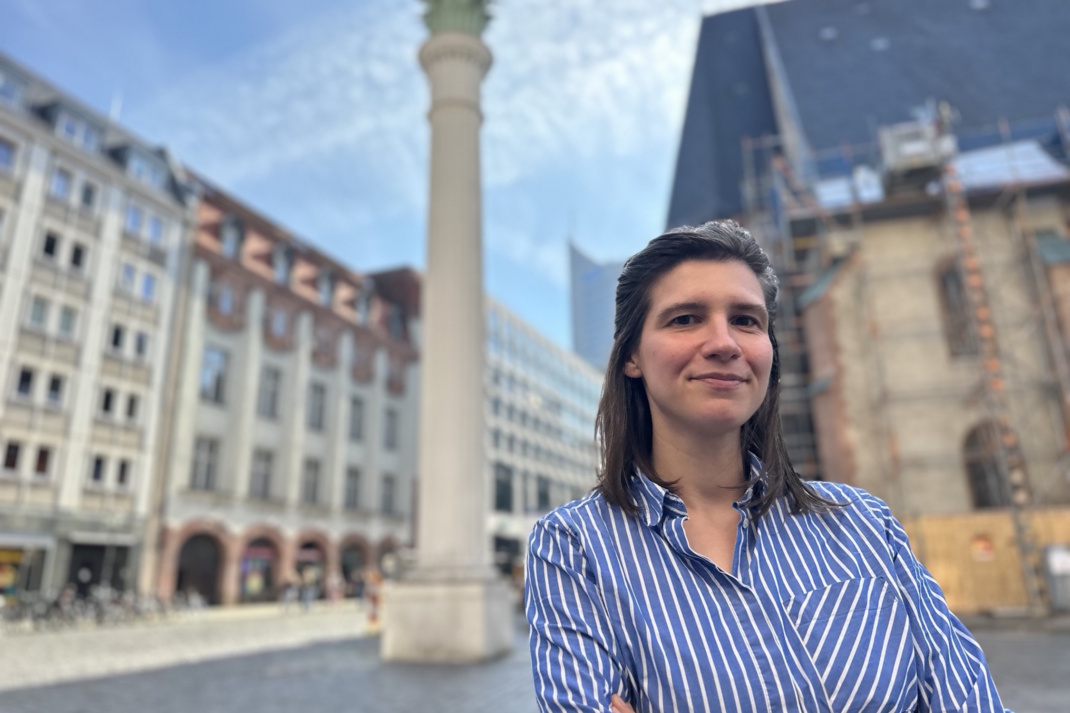
Starting today, Thursday 8 October, human rights defenders, journalists and civil society activists will be meeting in Leipzig for three days. The International Round Table of Revolutionaries runs from 8 to 10 October. According to the organisers, over 70 representatives will be taking part. Only the opening event on 8 October at 7.00 pm and the closing event on 10 October at 8.30 pm are open to the public, both taking place at the Beyerhaus. Admission is free. Marie Schwarz is leading the Peaceful Revolution Foundation’s project for the first time this year.
Imagine you have to explain to someone who has never heard of the Revolutionale what it is in just two sentences. What would you say?
The Revolutionale is a project for people who, under very different circumstances and conditions, fight for democracy, champion it and help shape it.
Revolutionale, International Round Table, Peaceful Revolution Foundation: how are they connected? What is a festival, what is a conference, and what is an ongoing project?
The Revolutionale is a project of the Peaceful Revolution Foundation, traditionally held around 9 October, in remembrance of the demonstrations of 1989 and of what civil society and the democratic movement achieved back then. It consists of the festival and the International Round Table, which alternate every two years. The festival is entirely open to the public.
At the Round Table, we bring together human rights defenders, civil society representatives and journalists in Leipzig and provide them with a safe space. There, they can discuss common ground, differences and challenges, and network with one another. Most of it is not open to the public, which is sometimes a shame. However, the opening and the public closing event provide an opportunity for the wider community to engage with the issues and enter into dialogue with the participants.
Over 70 people from Germany, Belarus, Ukraine, Armenia, Georgia and other countries come together. What do they gain from this meeting that they cannot get anywhere else?
The exchange is very trans-regional. We traditionally focus on Eastern and Central Eastern Europe, but this year participants are coming from 17 countries, including Venezuela, whose delegation is taking part for the third time.
Added to this is this safe space. We ask them in advance which issues are on their minds, and then say: ‘You now have this space; you can exchange views and engage in conversation within an organised, safe setting.’ That is what the International Round Table does, and it’s not something you find everywhere.
What does ‘safe space’ actually mean for the people you’ve invited?
It’s not open to the public, and their names aren’t made public. At conferences, the programme is usually posted online, accessible to everyone. Here, we place great importance on ensuring that people can make their voices heard and speak openly about their perspectives, even under difficult circumstances.
Do you mean the participants meet behind closed doors?
The participants don’t just sit at the round table in the Beyerhaus. On 10 October, they’ll be going on excursions: to Torgau, for a guided tour of the Memorial to Forced Labour, and to the Stasi Records Archive. We want to explore the sites of remembrance in Leipzig.
On 8 October, Felix Ekardt and Mascha Schädlich will be speaking about environmental activism. How will the audience’s perspective change as a result?
I believe the audience will come to see that democracy is about putting things into practice. It doesn’t always happen on a grand scale; environmental activism, in particular, often takes place on a small scale. Whether in 1989 or today with Fridays for Future: this commitment has brought about significant change, even in very everyday matters. We want cleaner rivers, lower CO₂ emissions and a greener city with more trees. A great deal can simply grow out of that.
To conclude, you ask: ‘Who do we listen to?’ In your view, whose voices are still missing from our culture of remembrance, and how do you intend to give them a platform?
Above all, the voices of marginalised groups are often still missing. We very often listen to established, mostly white men. In European historiography in particular, we fail to listen to many groups, and many memories fall by the wayside because they are not so well documented. Our aim is to address this plurality of history.
The Kolegium Europy Wschodniej from Wrocław and the artist Zlata Zhuravlova are organising the closing event. What do they bring to the table that is otherwise missing in Leipzig?
The Kolegium – known in English as the College of Eastern Europe – brings a very strong Polish, but also East Central European, perspective. This perspective is rarely heard in Germany, even though Poland and the Czech Republic are so close to Saxony. Even when it comes to our shared history, particularly in the 1980s, this is often overlooked. Without Solidarność, 1989 would never have happened.
This mutual exchange would be just as important today, and it’s often forgotten that it once existed. The artist Zlata Zhuravlova explores the situation in Ukraine and the question of what it means to live through war. This isn’t something abstract; it affects every aspect of people’s lives. That’s what makes it so moving.
How will you know, a year on, that the Round Table has made a difference?
When people stay in touch, when they want to come back, and when they take something away from the other participants. I’d never seen it quite like that before: they work under very different conditions, which are often not even comparable.
And yet there’s that moment: ‘Look, we’re in a similar situation. How do you manage it?’ That gives you great strength – the feeling of not being alone.
If you could make a wish without having to worry about funding or structure: what would ‘Die Revolutionale’ look like in five years’ time?
Bigger, I think, and even more international. We should be able to tell all participants, regardless of where they’re travelling from: ‘We’ll cover your travel costs.’ That’s what I’d wish for, because participation often falls through due to a lack of financial resources.
How would you entice someone who’s still hesitating to come to the opening event on 8 October?
There’s not just a panel discussion, but also a performance by Belarusian artists. They’re exploring what Chernobyl does to us and how much it’s still with us. This combination of discussion and performance is a reason to go. You can also get a taste of the topics, even if you’re not taking part in the round-table discussions.
Empfohlen auf LZ


So können Sie die Berichterstattung der Leipziger Zeitung unterstützen:


There is one comment