Dieser Artikel ist auch in deutscher Sprache verfügbar: Zum deutschen Artikel.
A global analysis of the ranges of 1,758 butterfly species – ten per cent of all known species – revealed that 80 per cent have expanded their ranges and that 79 per cent of all recorded shifts are linked to climate change and extreme weather. The new study, published in *Nature Ecology & Evolution*, also reports a reduction in range for 27 per cent of species; 22 per cent showed changes in their altitudinal distribution.
As species can exhibit different forms of range shifts simultaneously, the proportions for expansions, contractions and altitudinal shifts overlap.
The study is the largest of its kind to date. The researchers analysed 6,182 documented shifts from 105 countries, drawing on both English- and non-English-language scientific literature as well as 68 expert assessments. The study was led by researchers from Monash University, the German Centre for Integrative Biodiversity Research (iDiv), Friedrich Schiller University Jena and the Helmholtz Centre for Environmental Research (UFZ).
The analysis also reveals significant shifts in butterfly distribution. Horizontal expansions were observed on all continents, particularly frequently in tropical countries. Declines occurred more often in temperate regions such as Europe and North America. Altitudinal shifts were observed almost exclusively in the Northern Hemisphere.
“We have found that the ranges of butterfly species are shifting across all continents,” says lead author Dr Shawan Chowdhury. Chowdhury is an alumnus of iDiv, the University of Jena and the UFZ, and now works at Monash University in Melbourne. “The scale is astonishing – and the changes are not confined to the well-studied regions of Europe and North America.”
Butterflies are early indicators, adds Chowdhury: “When their ranges change so dramatically, it points to far-reaching changes in entire ecosystems.”
Monitoring with major gaps
The study also shows that countries document shifts in butterfly ranges to varying degrees. In the Czech Republic, Germany, Finland, Luxembourg, Spain and Sweden, data are available for more than half of the native species.
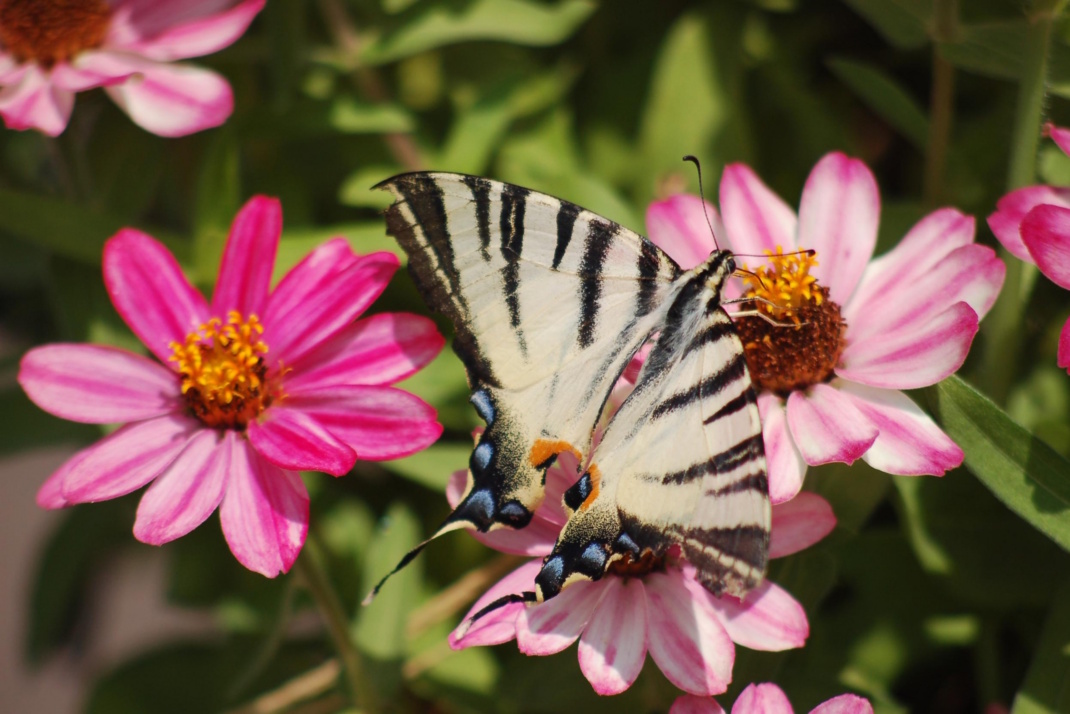
In these countries, heat-loving species such as the Karst white (Pieris mannii) and the scarce swallowtail (Iphiclides podalirius) are expanding their ranges as a result of climate change. Many are also producing more generations per year due to the longer warm season. At the same time, sensitive wetland species such as the northern pearl-bordered fritillary (Boloria aquilonaris) are under pressure due to the drainage of moors and intensive land use. These examples show that both climate change and the intensity of land use are altering the distribution of butterflies in Germany.
In most countries, however, potential shifts in distribution have been recorded for fewer than ten per cent of species, reflecting limited monitoring and a lack of data.
By incorporating non-English studies and expert knowledge, the authors were able to compile a comprehensive global dataset.
“The work of natural history societies and butterfly experts[waren]
is hugely important for better understanding global patterns of butterfly diversity,” says Prof. Aletta Bonn, research group leader at the UFZ, at iDiv and at the University of Jena.
Nevertheless, serious geographical data gaps remain – particularly in Central Africa, South-East Asia, New Guinea and the Amazon Basin, all of which are under-represented regions despite being global biodiversity hotspots.
“The study helps to fill in the gaps, but also highlights the urgent need for coordinated action to expand monitoring efforts worldwide,” explains senior author Dr Guy Pe’er of iDiv and the UFZ.
The authors emphasise that without standardised and multilingual biodiversity monitoring, nature conservation measures risk being based on an incomplete and distorted data set.
This text is based on a press release from Monash University –
original publication: Chowdhury, S., Aich, U., Antão, L. H., Pinkert, S., Akite, P., Almeida, G. S. S., Amano, T., Ambrus, A., Badon, J. A. T., Baek, S.-Y., Balalaikins, M., Barták, M., Barve, V., Bełcik, M., Bonebrake, T., Bonelli, S., Bowler, D. E., Braby, M. F., Caritg, R., Choi, S.-W., Chu, W.-C., Clain, E., Collins, S., Cumplido, J. H., Dapporto, L., Deme, G. G., Dolek, M., Dolezal, A., Firdaus, F. I., Franzén, M., Freitas, A. V. L., Fuller, R. A., Gensch, L., Grames, E., Guariento, E., Haywood, B., Hershcovich, S., Jantke, K., John, E., Kalivoda, H., Karimi, A., Katayose, R., Kawahara, A. Y., Khanal, S., Kunte, K., L’Hoste, L., Lenda, M., León‑Cortés, J. L., Lin, D.-L., Ling, Y. F., Lorini, M. L., Maes, D., Martins, D., Merckx, T., Mestdagh, X., Monasterio, Y., Nakamura, A., Oh, R. R. Y., Pettersson, L. B., Pippen, J. S., Pladevall, C., Pollet, I. L., Pottier, P., Rafi, M. A., Ramos, D. L., Ranasinghe, T., Rautenbach, F., Reith, M., Ringim, A. S., Riva, F., Roy, D. B., Ryrholm, N., Saastamoinen, M., Settele, J., Sidemo-Holm, W., Skorka, P., Stork, N. E., Suwal, S. P., Švitra, G., Swengel, A. B., Swengel, S. R., Titeux, N., Tropek, R., Tzortzakaki, O., van Swaay, C., Verovnik, R., Wiedmann, J. L., Wiemers, M., Yago, M., Yazdandad, H., Yehuda, O. B., Zografou, K., Bonn, A., Pe’er, G., Lenoir, J. (2026). Extensive climate-induced range shifts in butterflies across the globe. Nature Ecology & Evolution.
Empfohlen auf LZ


So können Sie die Berichterstattung der Leipziger Zeitung unterstützen:





There is one comment