Dieser Artikel ist auch in deutscher Sprache verfügbar: Zum deutschen Artikel.
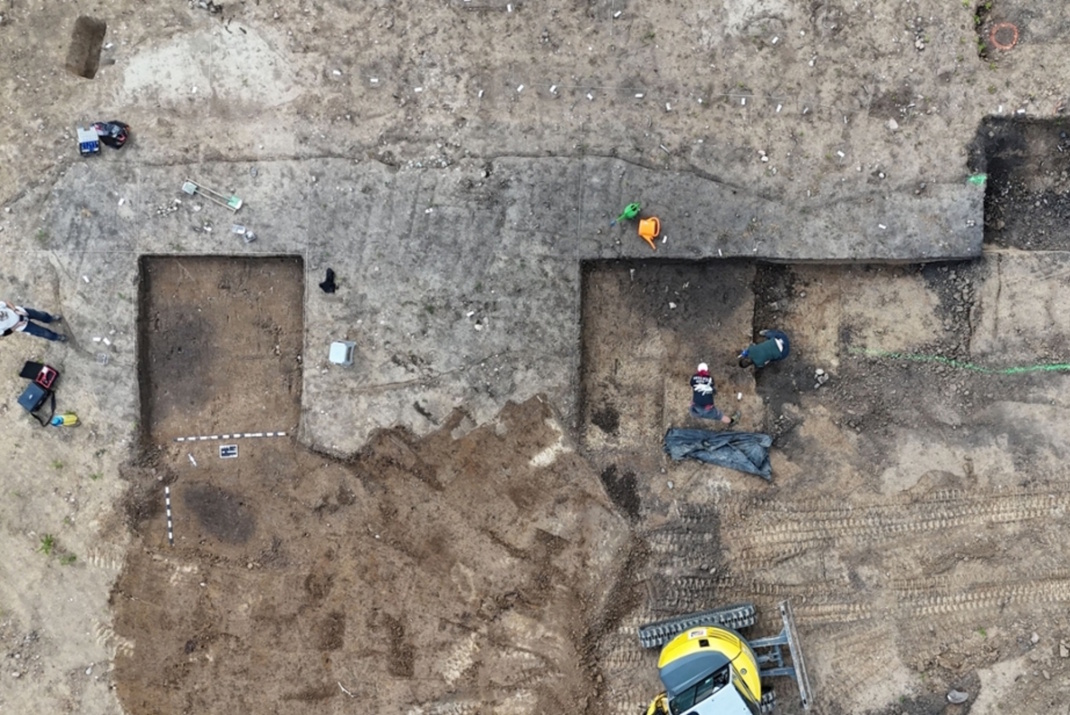
A new primary school complex is being built in Leipzig Möckern. Ahead of the planned construction work, the Saxony State Office for Archaeology is investigating the site, which covers more than 5,000 square metres. And – as expected – they have indeed made a discovery: On Wednesday, 30 September, the press were given the opportunity to visit the excavation site. The excavation became necessary as the development site lies in the immediate vicinity of a well-known Bronze Age site and has been classified as an area of archaeological significance.
However, even solely due to its location in the flood-free vicinity of the White Elster, prehistoric finds were to be expected in the exceptionally rich settlement area of the fertile Leipzig Lowlands.
A team of five archaeologists, led by Thomas Lukas, has been on site since July and will remain there until mid-October. They are supported by an intern and a participant in the Federal Voluntary Service (FSJ).
As the planned development would irrevocably destroy archaeological remains in the ground, the Saxony State Office for Archaeology is carrying out archaeological investigations in Leipzig Möckern ahead of the construction work, with the aim of shedding light on earlier phases of settlement in the area.
Although the site was previously occupied by a complex of buildings from the 1960s – which has since been demolished – the excavators have so far uncovered a surprisingly large number of well-preserved finds. These are defined as immovable traces of human activity in the ground, such as pits and post holes from former houses.
“Our investigations in Leipzig Möckern demonstrate very clearly how important the involvement of archaeology is, even in urban areas,” says State Archaeologist Dr Regina Smolnik. “Although the site has long been part of the urban landscape and has been built over for many years, important evidence of prehistoric and early historic settlement can still be documented there.”
What was found?
The remains of the settlement date back to the Neolithic period and belong to the so-called Linear Pottery Culture (5,500 to 4,500 BC). This period saw a transformation in way of life and economic practices, also known as ‘Neolithisation’. People became sedentary, lived in villages and practised agriculture and livestock farming.
The Linear Pottery Culture takes its name from the characteristic decorations on the pottery vessels, which consist of spiral or wavy bands. Vessels of this type are found from Hungary as far as the Paris Basin. Shards of rims and walls bearing these distinctive decorations have also been found in Leipzig-Möckern.
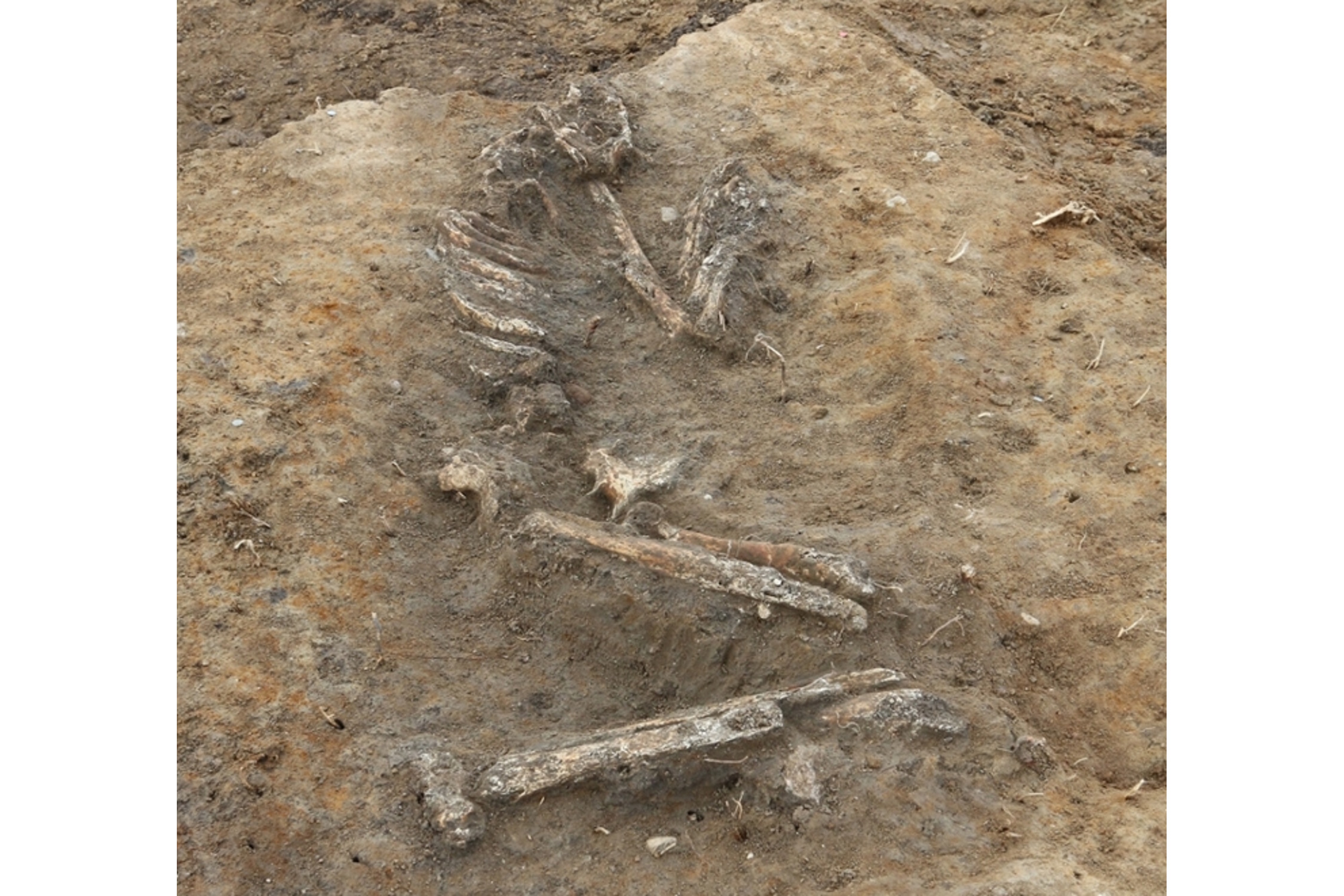
The cist grave at Leipzig-Möckern. Photo: Saxony State Office for Archaeology
The villages of the ‘Linear Pottery’ culture consisted of longhouses built of timber. This typical house form can still be recognised today by the discoloured post holes preserved in the ground, arranged in a pattern typical of the period. These pits originally held the wooden posts that supported the roof and wall structures. In Möckern, the complete ground plan of a house measuring an impressive 30 metres in length was identified, along with at least two further houses, parts of which have been uncovered.
The discovery of a burial site in the middle of the settlement came as a surprise. This is a rare stroke of luck, as in large parts of Saxony the preservation of bones is so poor that graves can only be identified as such on the basis of the objects placed in the grave and the shape of the pits. The unadorned cremation burial lay on its left side with drawn-up legs in a pit located next to, or within, the pit of a Linear Pottery house. Graves of this type are referred to as ‘squatting graves’.
In this case, the crouched position and the grave’s immediate stratigraphic relationship to the settlement and to one of the houses allow it to be dated to the Neolithic Linear Pottery culture, even in the absence of grave goods. This burial, dating back some 7,000 years, is therefore the oldest grave discovered to date within the Leipzig city limits.
The archaeological work will continue until mid-October. Areas that have already been investigated are gradually being released for the construction of the new primary school. Once the on-site excavation has concluded, the State Office for Archaeology in Saxony will begin the scientific analysis of the excavation findings.
Empfohlen auf LZ


So können Sie die Berichterstattung der Leipziger Zeitung unterstützen:





There is one comment