Dieser Artikel ist auch in deutscher Sprache verfügbar: Zum deutschen Artikel.
The Magdalene Flood of July 1342 has long been regarded as the most severe flood in Central Europe over the past millennium and as the greatest soil erosion event since the end of the last Ice Age. A new study published in the journal *Nature* now shows: This ‘flood of the century’ was not an isolated event, but merely the culmination of an unprecedented series of disasters. Between the winter of 1341/42 and the end of 1343, 16 major floods struck large parts of Europe.
Four of these events had statistical return periods of between 500 and 1,000 years, making them genuine ‘millennium floods’ – alongside the Magdalene Flood, these were the Candlemas Flood, the St James’s Flood and the St Bartholomew’s Flood, as named by the researchers. The year 1342 was thus the year with the most floods in the past 700 years; 1343 also ranks among the ten most extreme years of this period.
This is corroborated by more than 1,000 entries from original historical sources: chronicles, account books, deeds and letters. Dr Martin Bauch, a medieval specialist from the Leibniz Institute for the History and Culture of Eastern Europe (GWZO) in Leipzig, played a key role in reconstructing this data. The study was led by Andrea Kiss and Günter Blöschl (Vienna University of Technology) in collaboration with an interdisciplinary team of more than 30 researchers from across Europe.
“We can reconstruct, month by month, which regions of Europe were affected and when. This clearly shows that the floods stretch like a string of pearls through the years 1341 to 1343 – not all equally devastating, not all in the same place, but all clearly linked,” says Andrea Kiss, lead author of the study and a historian and geographer at the Vienna University of Technology. In 2025, she conducted research as a visiting scholar at the GWZO in Leipzig, where she also finalised the study.
Central Europe particularly affected
Central Germany and Eastern Central Europe were particularly hard hit by the series of floods. In Prague, the Vltava River swept away the famous stone Judith Bridge, the predecessor of today’s Charles Bridge. On the Elbe, the bridges in Dresden and Meissen collapsed; in Thuringia, the crossings over the Gera in Erfurt and over the Werra near Vacha, Meiningen and Eisenach were swept away; and in Lusatia, the Spree Bridge in Bautzen was destroyed.
Across Bohemia, the floods extended as far as the Carpathian region and into Hungary. Along the Danube, the chronicler Johann von Winterthur reported around 6,000 deaths; across Europe, the floods claimed many thousands of lives.
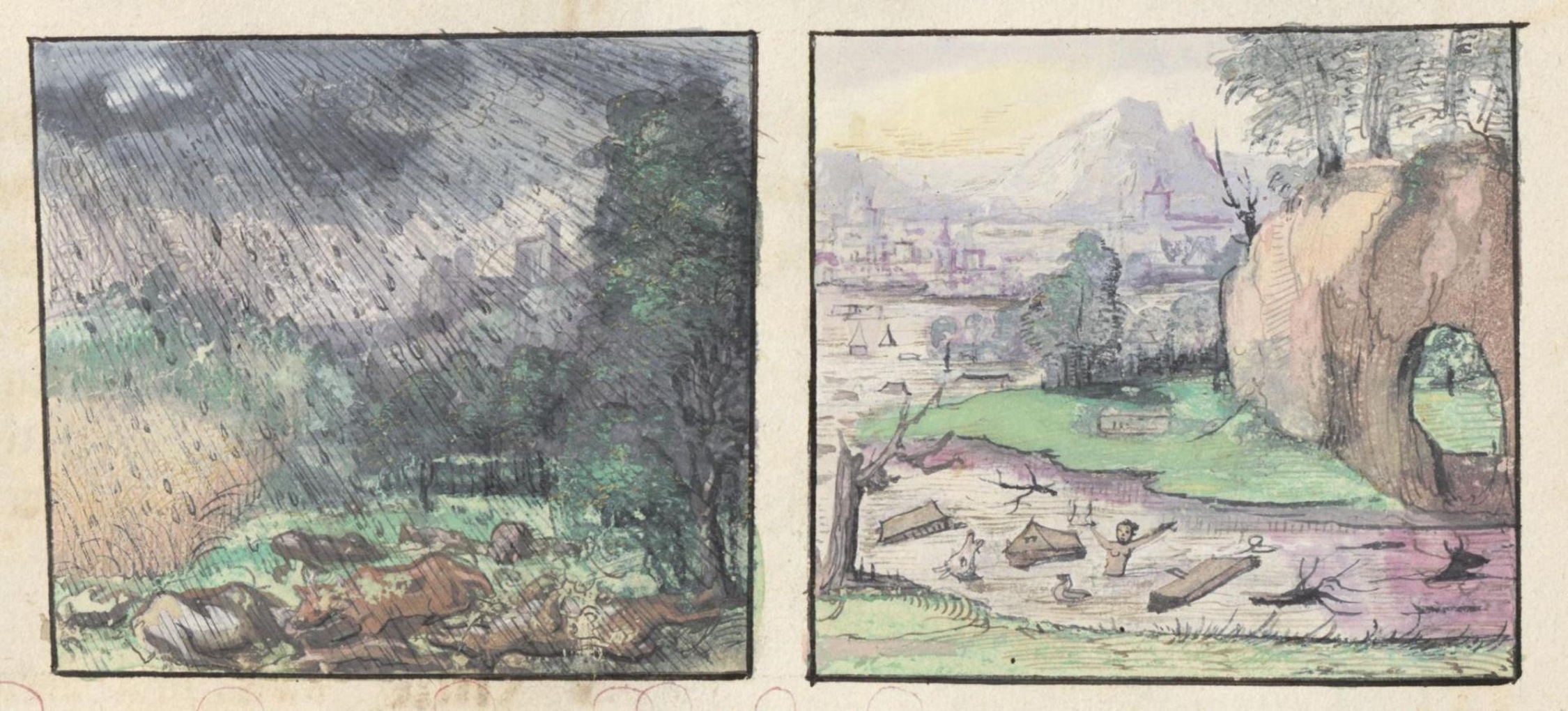
Illustration of extreme rainfall and floods of the 13th century in Jakob Fugger’s *Ehrenspiegel*. Photo: BSB Munich, CGM 895, fol. 133v. (Licence: Public Domain Mark 1.0 Universal)
The researchers believe that this unusual cluster of events was likely caused by a combination of several factors: a series of major volcanic eruptions around 1340 – including at least five tropical volcanoes and an eruption of Iceland’s Hekla – and a decline in Arctic sea ice that persisted over several years. Both of these factors altered the air currents over Europe and contributed to extreme, prolonged rainfall.
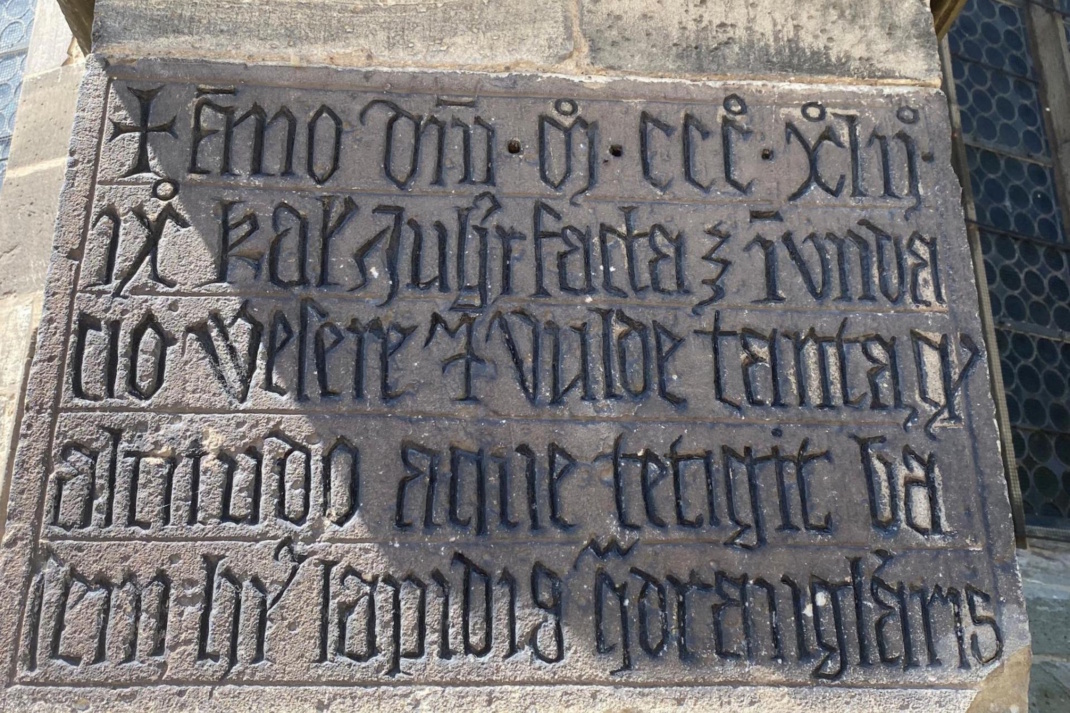
“The Magdalene Flood remains present in the collective memory to this day, not only because it was recorded through flood marks and commemorative plaques, but also through annual processions of supplication. The fact that it was just one event in a whole chain of disasters has been forgotten over the centuries. These years form part of the great crisis of the 14th century, which culminated a few years later in the Black Death. “Our findings show how closely environmental, climate and social history were intertwined during this period,” explains Martin Bauch.
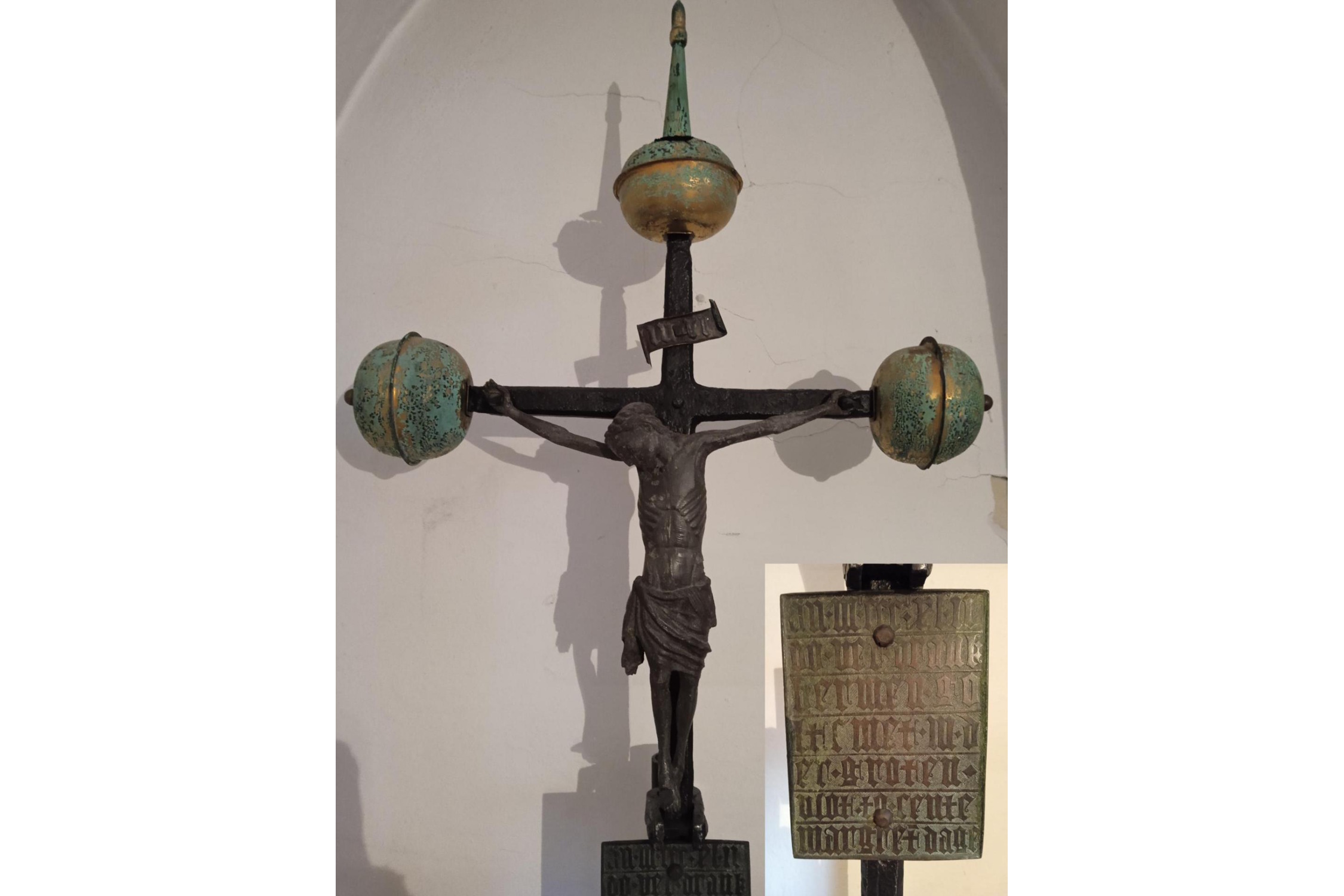
Inscription on a reliquary cross from the mid-14th century from the parish of St Albani in Göttingen: “In the year 1342, the goldsmith Hermann drowned in the flood on St Margaret’s Day”. Photo: Martin Bauch
Bauch, who led a ‘Freigeist’ junior research group on medieval climate history at the GWZO, funded by the Volkswagen Foundation, is regarded as one of the foremost experts on the Magdalene Flood. He had already published a seminal study on the subject back in 2019. For the Nature project, he drew primarily on historical records from Central Germany, Bohemia and Eastern Central Europe – chronicles, documents and account books, which he critically analysed and entered into historical databases.
For the team, the study’s relevance to the present day is clear. “Floods are not statistically independent of one another: they do not simply occur at random like lottery wins, but can be statistically and causally linked,” emphasises the Viennese hydrologist Günter Blöschl.
However, sequences of several extreme floods within a few months are scarcely taken into account in today’s risk management – even though climate change makes such clusters more likely in the future. The authors therefore advocate forward-looking, adaptive protection strategies that take into account not only individual ‘once-in-a-century’ floods, but entire chains of disasters.
Original publication: Kiss, A., Viglione, A., Barrientos, M., Enzi, S., Bauch, M. et al. (2026): Cascading continental-scale floods across Europe in 1342–1343. Nature.
Empfohlen auf LZ


So können Sie die Berichterstattung der Leipziger Zeitung unterstützen:




There is one comment