Dieser Artikel ist auch in deutscher Sprache verfügbar: Zum deutschen Artikel.
For almost 30 years, Germany too has been pursuing financial voodoo economics, loosely based on the trickle-down theory, which – without any statistical basis whatsoever – claims that the economy will flourish if taxes on the rich are cut. And some of the prosperity generated in this way would then ‘trickle down’ to those below.
However, this approach has now plunged all the major industrialised nations of the West deep into debt, and governments lack the funds for investment. Yet it is precisely public investment and government spending that stabilise the economy, as a new analysis by the DIW has now – once again – established.
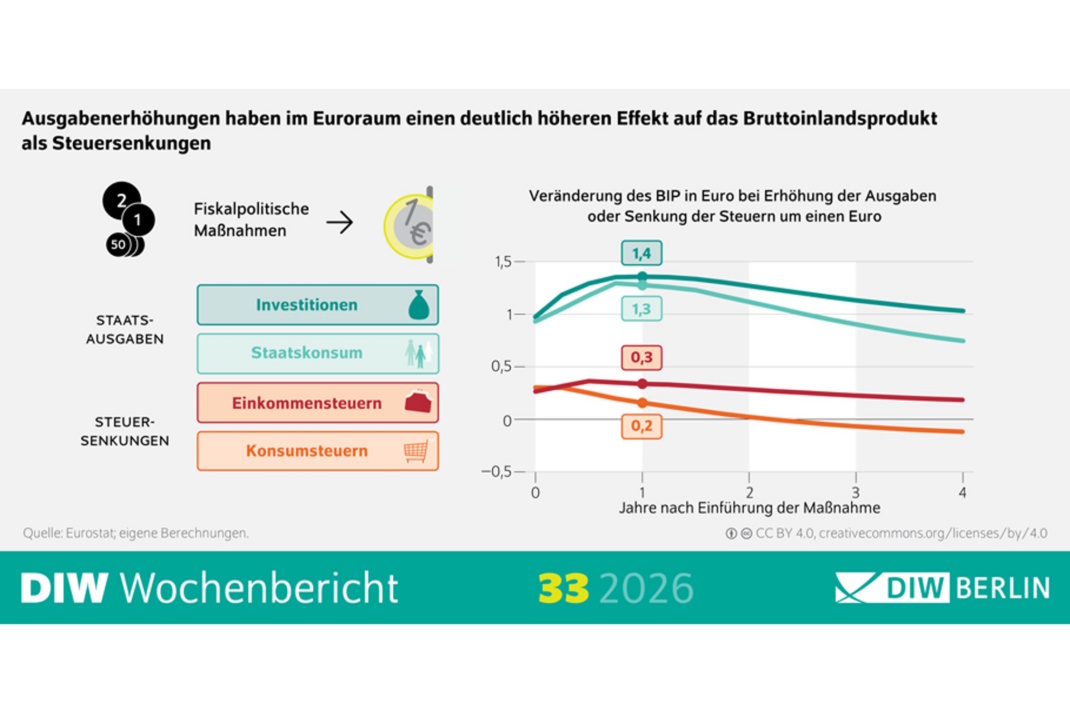
And in the short term, they do so much more effectively than tax cuts. And this holds true in every EU country. This is demonstrated by the new study from the German Institute for Economic Research (DIW Berlin):
the common monetary policy in the euro area amplifies the positive effects of individual countries’ fiscal measures. For their study, the authors Gökhan Ider and Malte Rieth from the Macroeconomics Department combine a model of a typical euro area economy with empirical analyses of the member states based on Eurostat data.
The result: every additional euro of government spending increases gross domestic product by up to 1.30 euros in the first year. Tax cuts, by contrast, achieve an effect of only up to 40 cents per euro.
“The single monetary policy changes the rules of the game for fiscal policy in the euro area. Because the European Central Bank does not usually react to fiscal measures taken by individual member states, national spending programmes are not curbed by interest rate rises,” explains study author Ider. At the same time, tax cuts – which tend to have a deflationary effect – do not benefit from any potential monetary easing that would further amplify their impact.
“In a monetary union such as the euro area, fiscal spending measures in particular have a much stronger impact than in countries with their own monetary policy, such as the US,” adds co-author Rieth.
Investment and government consumption work through different channels
Although public investment and government consumption both boost economic output more than tax cuts, they exert their effects in different ways. Public investment primarily stimulates private investment whilst simultaneously expanding the public capital stock – for example, through investment in infrastructure.
This enables them not only to boost demand in the short term, but also to strengthen the economy’s production capacity. Higher government consumption, on the other hand, stimulates private consumption in particular.
Tax cuts boost private demand much less significantly overall, and their effect is shorter-lived: after four years, their impact has almost completely faded, whilst the fiscal multiplier for government spending still stands at around one.
Weighing up short-term benefits against long-term risks
“Well-designed spending measures are the more effective tool, particularly for stabilising the economy in the short term,” says Ider. “At the same time, governments must keep an eye on the long-term consequences for public finances and growth.”
According to the DIW, higher public spending or lower tax revenues can undermine the sustainability of public finances and weaken long-term economic growth. At the same time, the authors point out that the findings apply primarily to fiscal policy measures taken by individual Member States. If many euro area countries were to expand their spending simultaneously, this could trigger a monetary policy response from the European Central Bank and dampen the impact of the spending measures.
No meaningful investment policy without a robust tax policy
But this also means that taxes should not be cut; rather, it is precisely the taxes on the rich and the wealthy that would need to rise so that EU Member States can secure the necessary leeway for economic stimulus programmes in the first place. For the myth surrounding the effectiveness of tax cuts has now reached the point where European governments can no longer take countermeasures during economic downturns, and even a ‘heavy’ special fund of 500 billion euros in the German budget, for example, simply fizzles out because it is used to plug funding gaps. Increased investment is simply out of the question within the normal budget.
It is the state alone that could trigger a wave of investment – if it had not been manoeuvred to the brink of inaction by tax cuts over the past 30 years.
Empfohlen auf LZ


So können Sie die Berichterstattung der Leipziger Zeitung unterstützen:



There is one comment