Dieser Artikel ist auch in deutscher Sprache verfügbar: Zum deutschen Artikel.
If you want to plan development in a city like Leipzig, you need reasonably reliable figures on population trends. Every three years, therefore, Leipzig’s Office for Statistics and Elections publishes an updated population forecast. And not just as a figure, but as a concise, 70-page analysis.
On Friday, 25 September, Mayor Ulrich Hörning presented the new forecast together with Dr Christian Schmitt and Dr Andrea Schultz. And the surprising thing is: Leipzig is set to continue growing.
Which is actually not as self-evident as it might seem. Even the statisticians at the Office for Statistics and Elections have had a rude awakening in recent years. There was one thing they hadn’t anticipated in their last projection for 2023: that the birth rate in Leipzig could plummet even further.
Or, to quote the objective tone of the analysis presented: “As the comparison of the expected and actual age structure suggests, the number of births in the 2023 Leipzig population forecast was significantly overestimated. The primary reason for this is that a higher future total fertility rate (TFR) was assumed when compiling the population forecast than actually materialised.”
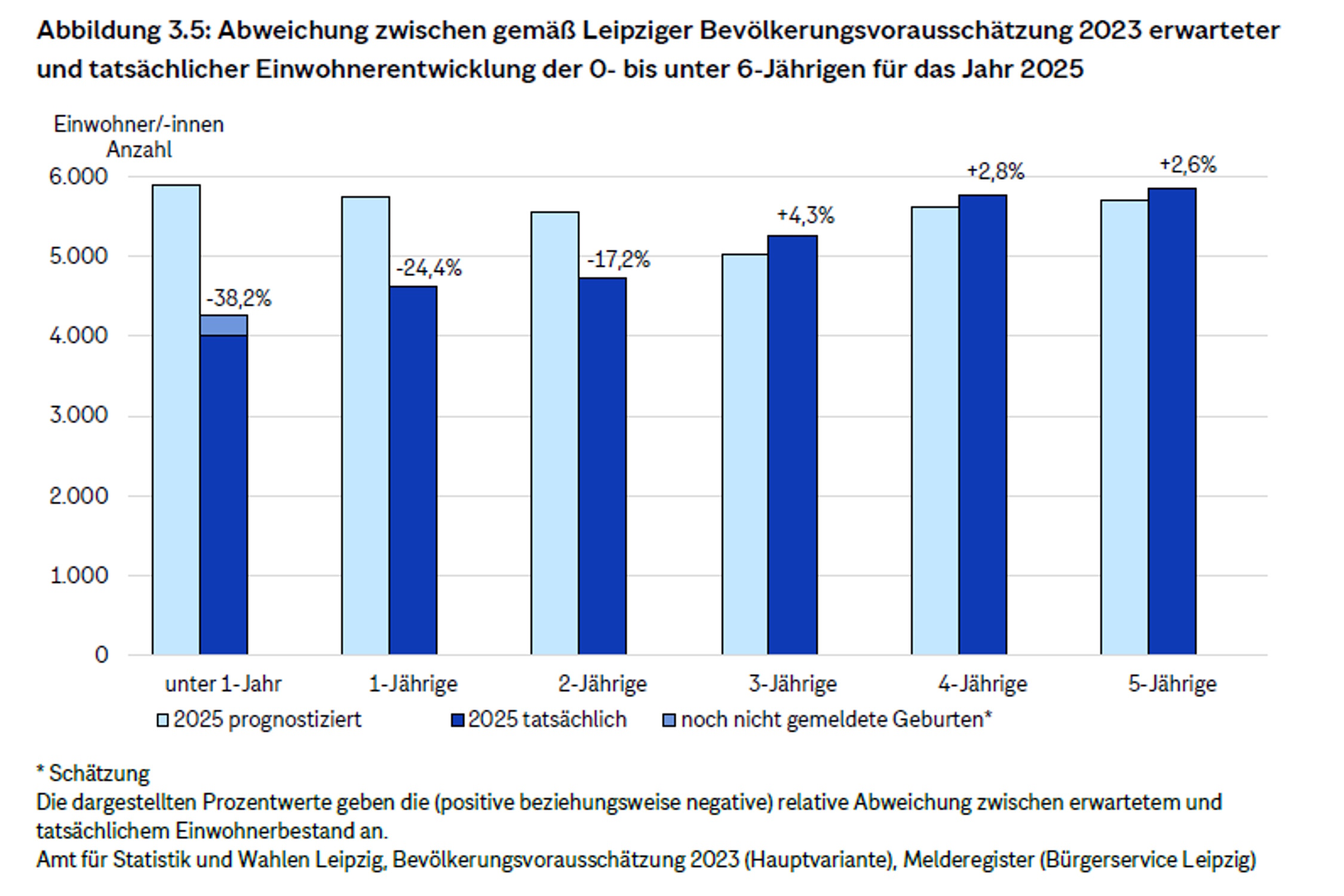
The gap between the expected number of young children and the actual number of births. Graphic: City of Leipzig, City of Leipzig Population Projection
2026
After all, back in 2023, it was still possible to assume that the falling birth rates might have been a consequence of the Covid-19 pandemic. But then they continued to fall.
Why were there so few births?
“Since peaking in 2016, the TFR in Leipzig has fallen continuously in the years that followed,” note Leipzig’s statisticians.
“Whilst the TFR stood at 1.47 children per woman in 2016, a sustained decline set in during the following years. The 2023 projection assumed that the figure for 2022 – shaped by the crises prevailing at the time, such as the COVID-19 pandemic, Russia’s war of aggression against Ukraine in breach of international law, and high inflation – would mark a low point and that the TFR would stabilise slightly again in future. In reality, however, the trend continued to decline: the TFR fell to 0.99 in 2023, to 0.97 in 2024 and to 0.90 children per woman in 2025.”
This brought back memories of another time of crisis: “The dynamics of this decline resemble the slump following German reunification in the early 1990s.”
And ever since then, people – not just in Leipzig – have been puzzling over why the birth rate has plummeted so dramatically.
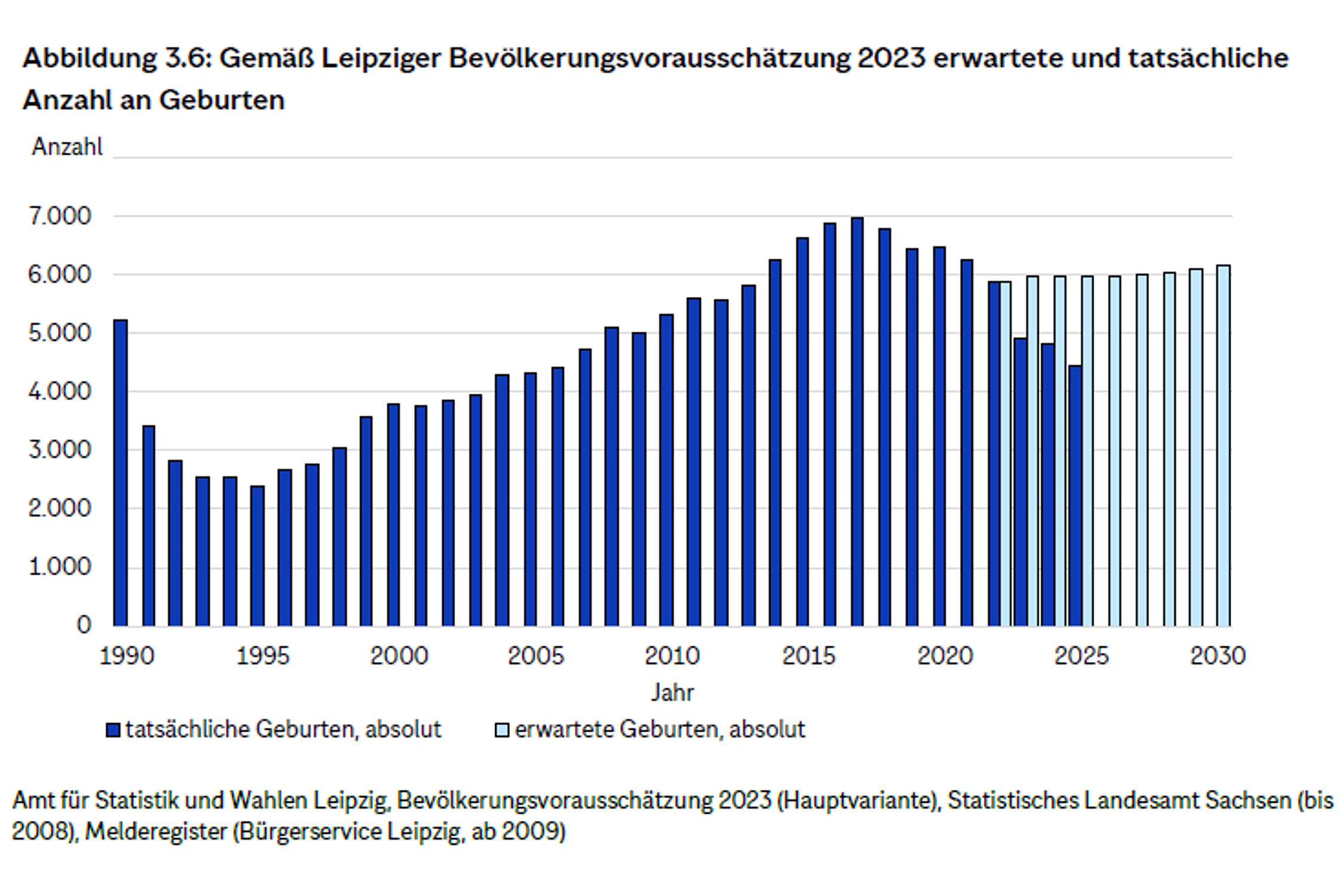
Expected and actual births in Leipzig. Chart: City of Leipzig, City of Leipzig Population Projection
2026
The statisticians’ sober assessment: “A complex interplay of political, economic and psychological factors is being discussed as the reason for the decline in births. According to a study by C. Friedrich and Bujard (2025a), the decline in births since 2020 can be explained by the uncertainties associated with the multiple crises. Such uncertainties can encourage people to postpone having children until later in life, a phenomenon known in demographic research as the ‘tempo effect’ (see Luy, 2010).
Pötzsch (2025) makes a similar argument, citing as causes for the current decline in births the ‘waning effects of the family policy measures of the 2000s, particularly in the area of early-years childcare, the after-effects of the pandemic years, the deterioration in the economic situation, climate change [sowie]
and fears for peace in Europe’.
Furthermore, Bujard (2026) demonstrates, based on analyses of data from the Family Demographic Panel (FReDA), that the desire to have children among men and women in Germany has been declining since the 2022/2023 survey year. Savelieva et al. (2021), on the other hand, see a link between the decline in births and a rise in the ideal of remaining childless. They interpret this as an expression of changing attitudes towards parenthood and the growing importance of other life goals.”
A complex issue, as one can see. Nevertheless, Leipzig’s statisticians assume that the birth rate will not remain at this rock-bottom level, but will recover in the coming years. At least to a TFR of around 1.50 children per woman.
How is one supposed to plan in such circumstances?
Nevertheless, this naturally affects future population figures, as the analysis also emphasises: “In the short term, fertility patterns have only a minor impact on the total population. For the newly emerging cohorts (i.e. the youngest age groups in the future), however, birth rates are the key determining factor. In 2025, the effects of the overestimated birth rates will affect only the cohorts of children aged 0 to under 3.
However, the effect will continue in the coming years: in 2025, the overestimated birth rates in the 2023 Leipzig population projection will lead to an overestimation of the cohort of 0-year-olds by 38 per cent. As these young age groups play a key role in planning for educational and social infrastructure, Schultz et al. (2025) – in an analysis of Leipzig’s population register data up to and including 2024 – that a recalculation of the population projection is necessary.”
Well then: that’s a real conundrum for Leipzig’s Councillor for Schools and Youth, Vicki Felthaus. How can one still make sound plans for the capacity of nurseries and schools under these circumstances?
Leipzig continues to grow nonetheless
But Leipzig continues to grow, as Ulrich Hörning, Mayor and Deputy Mayor for General Administration, Dr Christian Schmitt, Head of the Office for Statistics and Elections, and Dr Andrea Schultz, Head of the Urban Research Department at the Office for Statistics and Elections, noted on Friday. This is because Leipzig continues to benefit from immigration – particularly from abroad. The former source of new residents, eastern Germany, has virtually dried up. Very few young people are now coming from there in search of good jobs and good education in Leipzig.
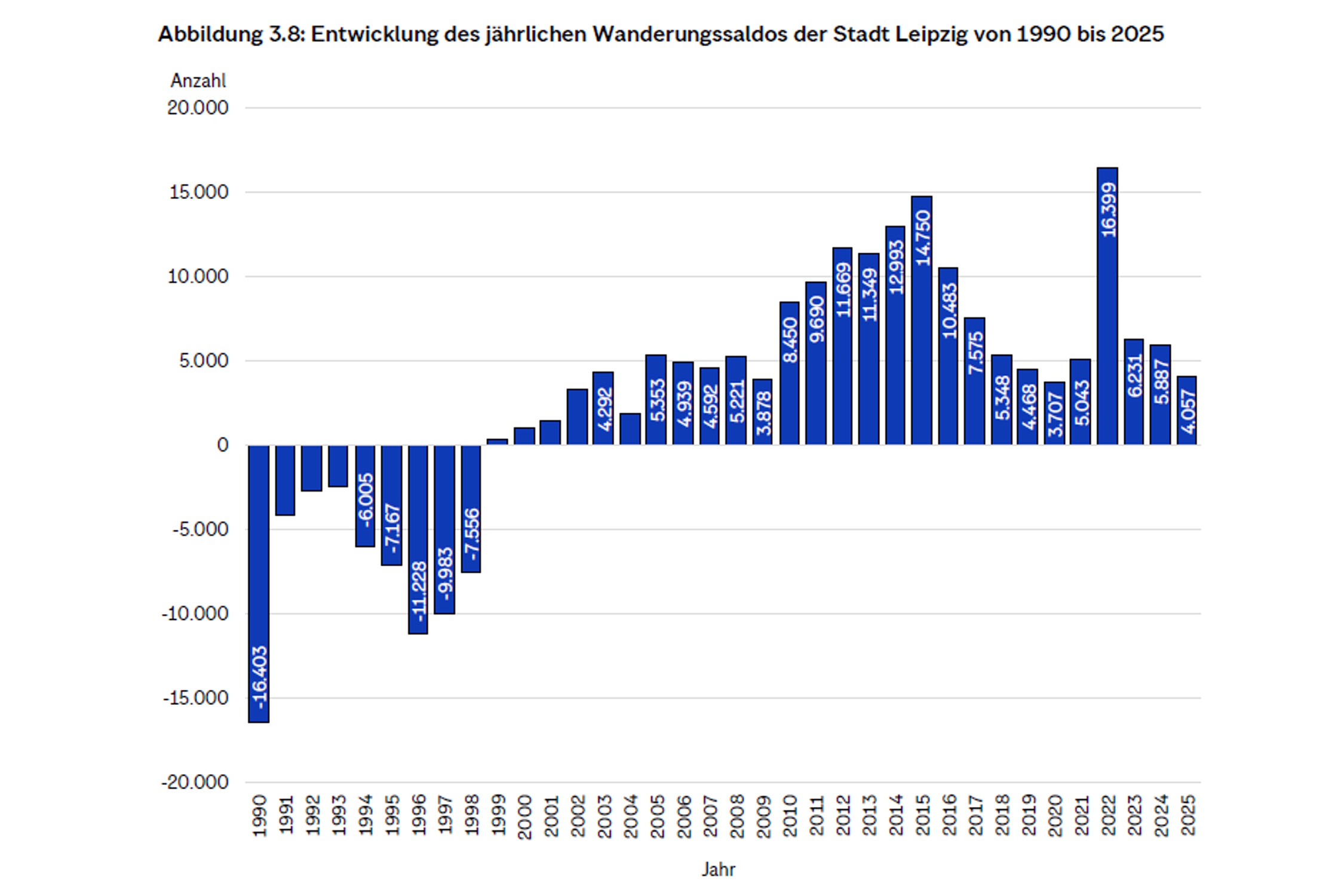
The net migration of the city of Leipzig since the 1990s. Graphic: City of Leipzig, 2026 Population Projection
for the City of Leipzig
“When examining the net migration figures by region of origin or destination, the significance of immigration from abroad for the population development of the city of Leipzig in recent years becomes clear: For years, the net migration with other countries has exceeded that with western and eastern Germany, and thus contributes most significantly to the population growth of the city of Leipzig,” the analysis notes.
And what about out-migration to the surrounding area, which is a recurring topic of discussion in the city council? This continues to occur, the report notes. But now at a lower level.
“In contrast, the city of Leipzig has shown a negative net migration balance with the two surrounding Saxon districts for several years; in other words, more people are moving from Leipzig to Northern Saxony or the Leipzig district than the other way round. Out-migration to the two surrounding Saxon districts initially increased significantly between 2018 and 2022, eventually exceeding the 4,000-person mark. After 2022, however, this trend reversed, and the net migration loss from the city of Leipzig to these areas fell to around 2,600 people in 2024 and 2025.”
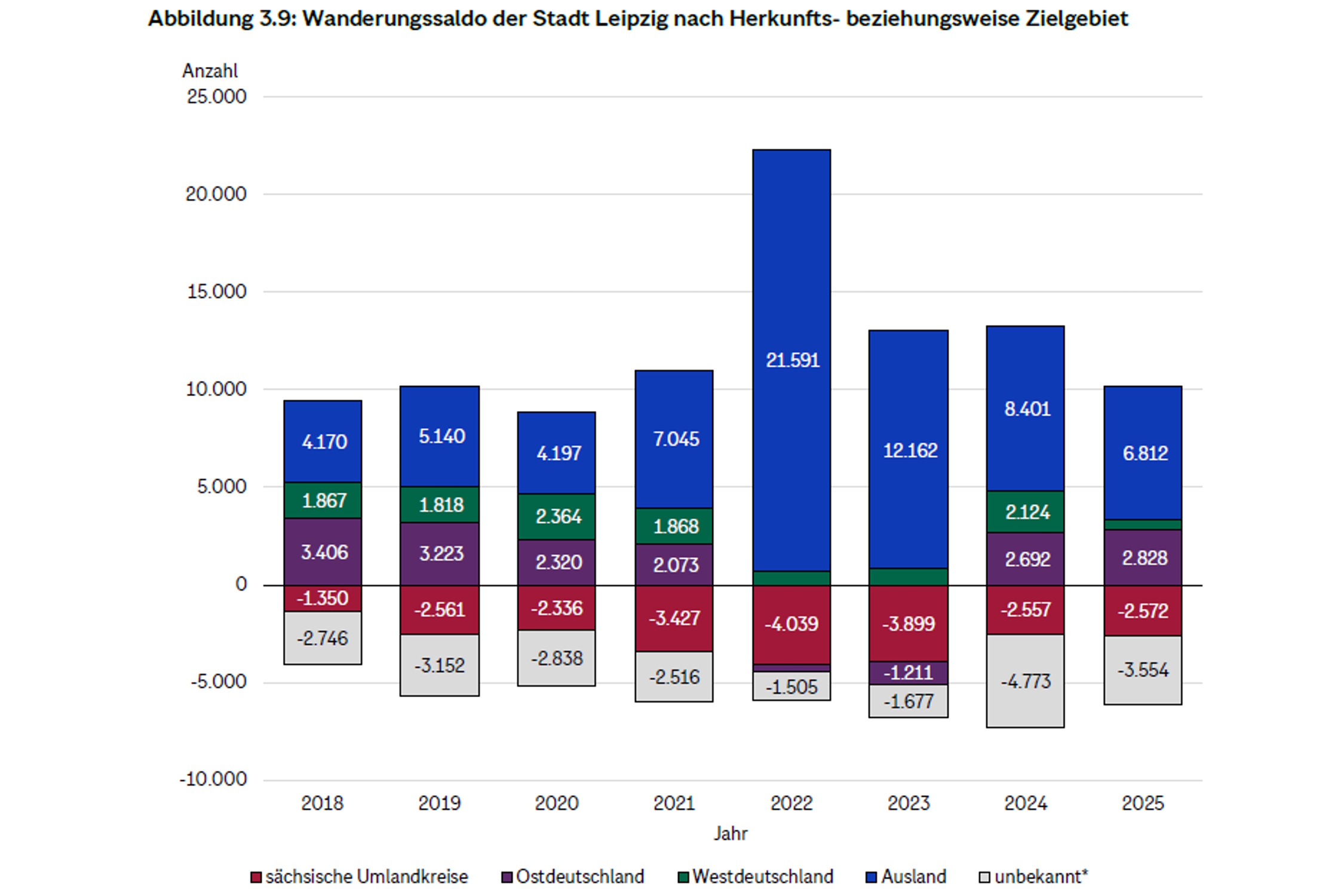
The net migration of the City of Leipzig by region. Graphic: City of Leipzig, 2026 Population Projection for the City of Leipzig
These are the key factors that will influence the projection of the likely population in Leipzig over the coming years.
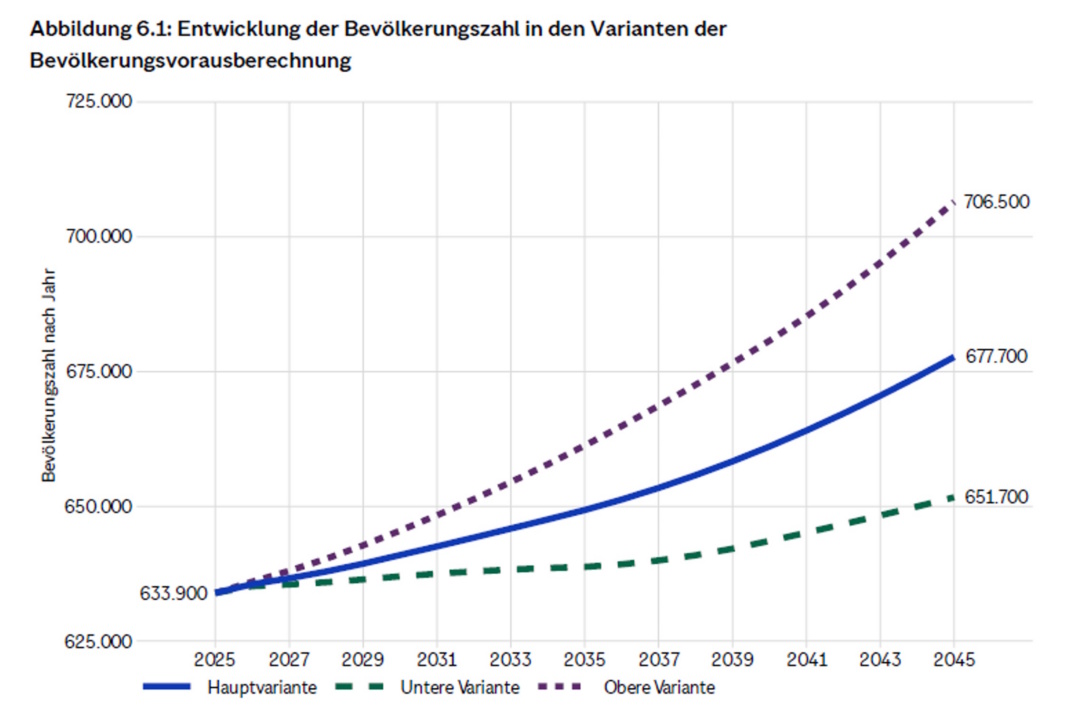
“The number of residents in the city of Leipzig will rise in all three scenarios of the population projection up to the year 2045,” the report emphasises.
“In all scenarios, the trend is steady and not characterised by abrupt changes. However, the scenarios differ in terms of the scale and timeline of the trend. In the main scenario, the population initially rises steadily by around 1,500 people per year; by around 2035, the annual growth rate increases to 2,800 people. The figure of 677,700 residents of the city of Leipzig in 2045, as calculated in this scenario, represents an increase of approximately 7 per cent compared with 2025.
In the lower scenario of the projection, the population of the city of Leipzig will increase by just under 500 people per year until 2035, but will rise to 1,300 people per year in the subsequent years. The calculated increase in the number of residents by 2045 (651,700) corresponds to approximately 3 per cent. In the high-growth scenario, the population rises fairly linearly by around 3,600 people annually, resulting in a population of approximately 706,500 in the city of Leipzig by 2045; an increase of more than 11 per cent.”
The role of a major city
Leipzig will therefore continue to grow and will continue to need new housing to be built. Even under the lowest-growth scenario. And this is simply down to the role of modern cities in an economy where modern jobs are created primarily in central clusters and depend on dense urban structures.
And on infrastructure, which has been progressively scaled back in recent years, even in Saxony’s rural regions, with the result that young people there find fewer and fewer opportunities for the future and are moving away. This is a trend that has shaped population trends in Saxony since 1999 and has been driving population growth in Leipzig ever since.
Empfohlen auf LZ


So können Sie die Berichterstattung der Leipziger Zeitung unterstützen:




There is one comment