Dieser Artikel ist auch in deutscher Sprache verfügbar: Zum deutschen Artikel.
Satisfaction with democracy in Germany has reached an all-time low. At the same time, the past is being idealised and there is a growing yearning for an apocalyptic break with the present. Furthermore, there is a rising authoritarian desire for a strong party, and anti-Semitic statements are meeting with a high level of approval.
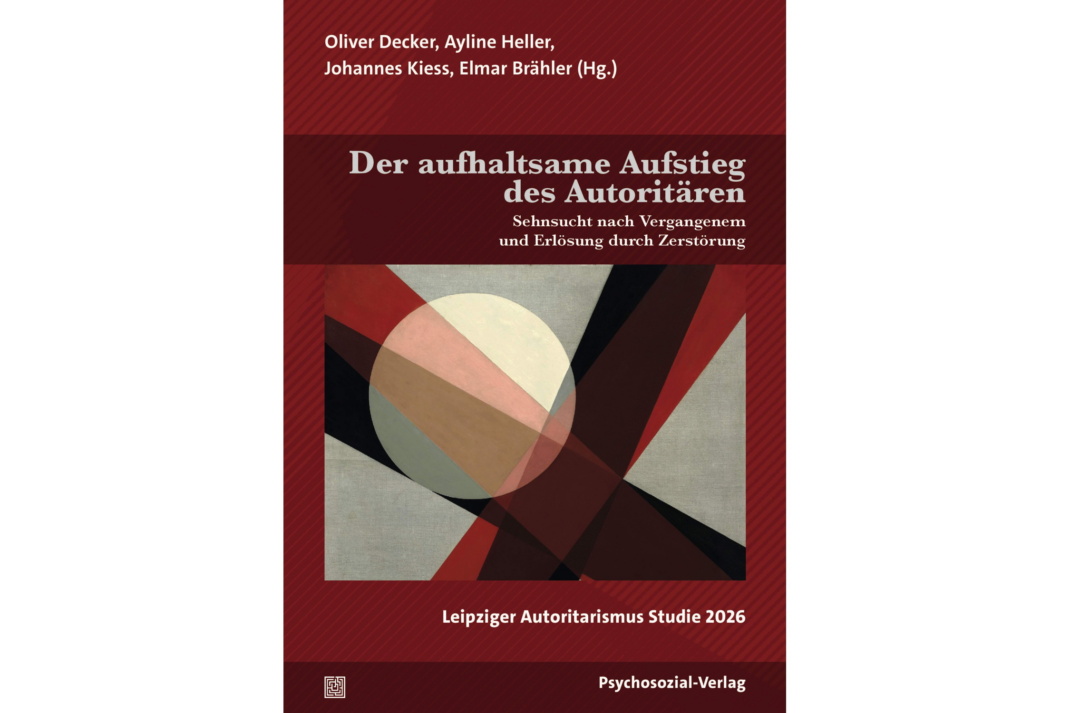
These are key findings of the 2026 Leipzig Authoritarianism Study, which was presented on Wednesday, 11 November, under the title ‘The Unstoppable Rise of Authoritarianism’ by Prof. Dr Oliver Decker (University of Leipzig) and Dr Ayline Heller (GESIS Leibniz Institute for the Social Sciences) at the Federal Press Conference in Berlin.
The study was conducted in cooperation with the Heinrich Böll Foundation and the Otto Brenner Foundation.
For the first time since the study series began in 2002, support for democracy as an idea has fallen below 90 per cent (89.3 per cent). This is primarily attributable to a massive loss of trust among East German respondents (85.7 per cent). Satisfaction with constitutional democracy, which stands at just 65.2 per cent across Germany in 2026, has also reached a new low. Here, too, the decline is most pronounced in eastern Germany (2024: 81.2 per cent; 2026: 59.8 per cent).
The decline in approval of democracy as experienced in everyday life is even more severe: nationwide, barely a third of respondents are satisfied with the way democracy is practised in Germany, with figures having fallen sharply in both eastern and western Germany. Whilst approval in the West stands at just 36 per cent, it has fallen to as low as 22.8 per cent in eastern Germany.
“Our democracy is under immense pressure. It has lost acceptance amongst the general population,” notes the study’s lead researcher, Prof. Dr Oliver Decker. “It is alarming to see the extent to which a yearning for authoritarianism is taking its place.” The social psychologist published the study together with Prof. Dr Elmar Brähler, Dr Johannes Kiess and Dr Ayline Heller.
Far-right attitudes: a rise in national pride and the desire for a strong party
Democracy’s poor showing is reflected in the desire for a right-wing authoritarian dictatorship as a form of government: at 23.2 per cent, just under a quarter of the population explicitly expresses a desire for “a single strong party that embodies the national community as a whole”. In the east, the figure is even higher at 30.9 per cent.
Furthermore, a quarter of the population partly agrees with this statement, meaning that just under half of the German population supports this demand – in the east, the figure is as high as just under 60 per cent.
For the second year running, levels of support for far-right attitudes have risen both overall and across almost all sub-dimensions. Of particular note is national pride in the form of chauvinism, which, with 19.9 per cent explicitly agreeing, has reached its highest level since the series of studies began.
More than half of the German population agrees, at least in part, with individual statements in this dimension. For example, 28.5 per cent expressly believe that there is a need for “the firm and vigorous assertion of German interests vis-à-vis other countries”; a further 25.8 per cent agree to some extent. In eastern Germany, agreement with this statement is around 6 percentage points higher still. The proportion of people with a consistently far-right worldview has reached 6.9 per cent, the highest figure since 2014.
Longing for the past and redemption through destruction
The low level of trust in democracy and the high levels of agreement with far-right statements are closely associated with regressive nostalgia and a desire for apocalyptic destruction. 33.5 per cent expressly long for a past in which ‘people like them were treated with more respect and esteem’.
In the east, around 40 per cent in total, and in the west 32 per cent, idealise the past in this way. In addition, one in four people in both the east and west partly agree with this statement.
14.7 per cent of the population explicitly believe that ‘everything has to be destroyed so that something new can emerge’; a further 20 per cent can see some merit in this to some extent. At 30.4 per cent, almost one in three respondents explicitly believes that ‘something radical is needed for the current situation to change’. A further 29.1 per cent agree with this to some extent. Those who share this apocalyptic longing display significantly higher levels of anti-Semitic sentiment.
Both dimensions are linked to party preference: the more pronounced the regressive nostalgia and ‘longing for the apocalypse’ are, the more likely respondents are to favour the AfD and the Free Voters. The AfD, in particular, taps into these longings with its crisis rhetoric.
“This turn away from the present, fuelled in this way, must be countered by convincing democratic alternatives and the capacity for political action in the here and now,” emphasises Dr Johannes Kiess.
A rise in anti-Semitic attitudes can be observed nationwide
The study examines various forms of anti-Semitism: in addition to traditional anti-Semitism, it covers Israel-related anti-Semitism, guilt-denial anti-Semitism and post-colonial anti-Semitism. An increase can be observed across all these forms of anti-Semitism.
For the second year running, support for traditional anti-Semitism has risen: in 2024, the figure stood at 4.0 per cent; by 2026, 6.2 per cent of respondents expressly agreed with the relevant statements. Israel-related anti-Semitism is explicitly endorsed by 16 per cent of respondents – in 2022 the figure was 6.2 per cent, and by 2024 it had already risen to 9.1 per cent. Explicitly expressed blame-shifting anti-Semitism was found among 30.7 per cent of respondents in 2026, representing an increase of three percentage points compared with 2024.
In light of developments following 7 October 2023, the 2024 survey also examined postcolonial anti-Semitism for the first time. Here, too, explicit agreement with all statements increased: 17.6 per cent of respondents believe that the ‘German guilt complex […] hinders the Palestinians’ struggle for freedom’; 15.8 per cent believe that Israel was founded solely “so that Europeans do not have a guilty conscience”, and 17.7 per cent view the Middle East conflict as a conflict between “white colonialism and oppressed minorities”. A further 25.5 to 32.5 per cent agree with these statements to some extent.
“In this year’s study, we were able to show that we significantly underestimate the level of agreement, particularly with regard to traditional anti-Semitism,” explains co-editor Dr Ayline Heller. “Due to social sanctions, we must therefore regard the measured levels of agreement with anti-Semitism as a lower limit.”
The unstoppable rise of authoritarianism
According to the researchers, the results of this year’s study are alarming – particularly with regard to trust in democracy and agreement with far-right and anti-Semitic statements. However, long-term trends show that a reversal of this trend is certainly possible.
In earlier surveys, far-right statements had already achieved high levels of support, which subsequently fell again in the following years. Alongside the influence of societal crises, political action and its perception by society are of central importance.
“We see that the often-cited claim that there is no alternative leads to a capacity for action. Paradoxically, this currently strengthens those who are further exacerbating the crisis through their rhetoric,” explains Professor Elmar Brähler.
The Leipzig Authoritarianism Study
The Leipzig Authoritarianism Study has been conducted since 2002 and records the population’s attitudes towards authoritarian and anti-democratic tendencies. For this representative survey, 2,507 people in eastern and western Germany were randomly selected between 16 March and 3 June 2026. The participants are visited at home by interviewers.
Respondents are given the questionnaire containing the political attitude questions, complete it themselves and then hand it back to the interviewers – in an envelope if they wish. Using this approach, the study succeeded in recruiting participants from around 40 per cent of the households visited.
For the statements and dimensions listed here, respondents were given a five-point response scale. This comprises the response options (1) ‘strongly disagree’, (2) ‘mostly disagree’, (3) ‘partly agree, partly disagree’, (4) ‘mostly agree’ and (5) ‘agree completely’. The term ‘explicit agreement’ used here combines response options (4) and (5).
Publication
The study’s analysis volume is published under the title ‘The Unstoppable Rise of Authoritarianism’ by Psychosozial-Verlag and is available in print and as an e-book (open access).
Oliver Decker, Ayline Heller, Johannes Kiess & Elmar Brähler (eds.) ‘The Unstoppable Rise of Authoritarianism: Longing for the Past and Redemption through Destruction’, Leipzig Authoritarianism Study 2026, Psychosozial-Verlag, Gießen 2026, ISBN: 978-3-8379-3574-5.
Empfohlen auf LZ


So können Sie die Berichterstattung der Leipziger Zeitung unterstützen:




There is one comment