Dieser Artikel ist auch in deutscher Sprache verfügbar: Zum deutschen Artikel.
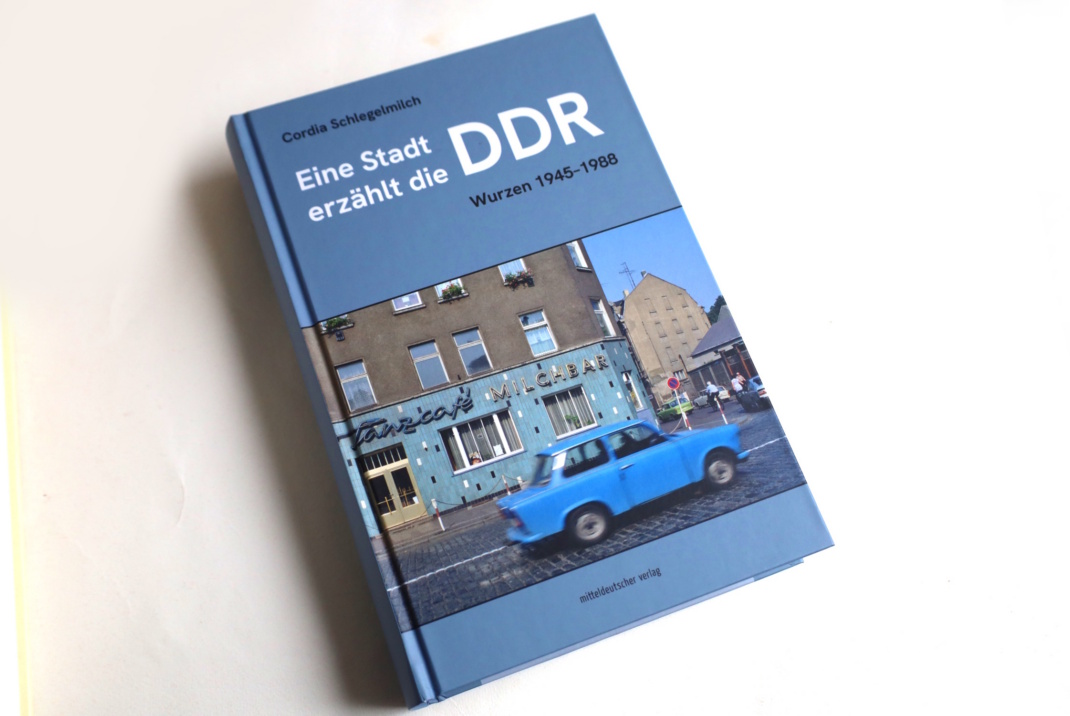
It was a special moment when, back in 1990, the sociologist Cordia Schlegelmilch packed her bag and set off for a small town in the GDR, which at that time had only six weeks left to exist. Her main motivation was: “I wanted to find out how the residents of a small town were coming to terms with the fall of the Berlin Wall and how this was changing the way they lived together.” And although the focus was on the years 1989–1990 – the upheaval she experienced first-hand – the conversations recorded on tape also captured something that, at the time, seemed to be nothing more than a side dish.
For the sociologist was concerned from the outset with people’s individual fates – something that historians, with their broad, overarching perspective, usually fail to see. But whilst celebrations and the signing of treaties are taking place elsewhere, people even in the remotest corners of a country experience history first-hand. With all its consequences.
This was also the case in the small district town of Wurzen, where Cordia Schlegelmilch lived and made contacts in 1990 and 1991. Her interviewees were not selected by a computer programme. Very few private households had a telephone with which she could have made an appointment.
So she had to rely on recommendations, approached people directly, and even sought out the officials who had shaped the town’s fortunes until 1989. And almost all of them were willing to talk. Not always on tape. But even mayors, senior city and district officials, company directors, police chiefs and Stasi staff agreed to speak.
Partly because Schlegelmilch did not judge or categorise anyone. For that is the greatest virtue of sociology: it accepts people as they are – their life experiences, their motives, their reasons. All those things that politics and the media usually gloss over, ignore or dismiss, as if they had no right to be acknowledged.
In the afterword, Schlegelmilch emphasises something else: all the conversations with the 175 residents of Wurzen who gave her their time were conversations with those who had stayed behind. Even though many had thought about leaving at some point in their lives. Yet practically all of them were deeply connected to their home town, down-to-earth and deeply attached to their roots.
Hometown Wurzen
One senses something that has been all but lost in all the awkward inter-German discussions since 1990: that people almost never define themselves by the prevailing power structures, but rather by their sense of belonging – to their town, their region, their neighbours, colleagues and families. For many of Schlegelmilch’s interviewees, this meant that they cancelled even plans they had made in their minds to leave, stayed put and tried to make the best of it. Against all odds.
And something else becomes clear, particularly among the officials Schlegelmilch was able to interview: they, too, thought in the same way. Even during those turbulent years of 1990–1991, when practically all of them were caught in the fierce crossfire of criticism. That said, the year in which the interviews took place had one advantage: the people of Wurzen remembered the past years well (and without romanticising them), knew who had really stood up for the town, who had run the agricultural production cooperatives (LPGs) and the enterprises, and who had genuinely done something for the workforce.
And that is how one gradually gains a better understanding of the structures of the GDR. It is precisely the officials at city and district level who report on this. And it is not without reason that Cordia Schlegelmilch has divided the book into two stages – first, the period of perceived progress under Walter Ulbricht from 1945 to 1971, which even the older interviewees described as a time of hope and tangible improvements. And the Honecker era from 1971 to 1989, which in the 1980s led to a stagnation felt by everyone – against a backdrop of ageing production facilities and a city in visible decline.
The big ‘why’
And Wurzen was a beautiful town with a town centre dating back centuries. It was just that, for 50 years, nothing had been done to maintain or renovate it. Row upon row of houses fell into a state where they were in danger of collapsing. It broke the town architect’s heart, as he could do nothing but watch the decay.
But why had it come to this?
Was it solely down to the dysfunctionality of ‘real existing socialism’? Were the dreams of a more humane, peaceful society misguided? A utopia shared even by some interviewees who were critical of the state and the party.
The more one reads the short interview snippets on the various overarching themes – such as agriculture, reconstruction, skilled trades, commerce and education – the clearer it becomes that those interviewed were well aware of what had gone wrong in the GDR. The break with the past between Ulbricht and Honecker was striking for this reason too.
For whilst Ulbricht used the 1960s, following the construction of the Wall, to allow for a little more competition in the country, the Honecker government – which had even begun with considerable expectations of greater freedoms – stifled precisely this process. And this government dealt the heaviest blow to the GDR economy when, in 1972, it not only expropriated the last remaining small and medium-sized private enterprises, but also integrated them into the combine system, which was systematically expanded until 1976.
The tragedy of centralism
With this, the last vestiges of free competition and individual initiative vanished from the GDR economy; management structures became increasingly centralised, until almost all economic decisions were taken solely at central level in East Berlin or at district level. The small towns and districts experienced this not only as a loss of power. They were also deprived of vast sums of money that had previously been available for investment in local infrastructure. And virtually none of the people interviewed by Schlegelmilch fail to mention the growing frustration of the 1980s, when paralysis spread across the entire country.
And the shift of decision-making authority to the centre had another effect: no one could really identify with their work or the enterprise they worked for any more. For with the centralisation of all decisions, there was practically no longer any scope at local level to make decisions for themselves. Slackness and a lack of responsibility became rife. With the introduction of ‘Exquisit’ shops and ‘Intershops’, a two-tier society also emerged.
Those who had Deutschmarks or ‘Forum’ cheques were able to take advantage of these offerings. Everyone else was faced with increasing shortages. What’s more, in the Wurzen district, there was no combine headquarters, nor were there any key enterprises deemed important by the central planners. Consequently, less money was channelled to Wurzen that could have been invested in infrastructure.
Controlled life paths
And yet there was a palpable sense of loss, which the interviewees expressed from 1990/1991 onwards. For a hierarchical system, such as that created by the SED, also provided a sense of relief. Cordia Schlegelmilch also discusses this topic in the afterword. People did not have to worry about either their income or their job; everything was regulated by the state. And those who conformed and did not speak out led a peaceful life; they did not have to worry about their livelihood.
This is a factor that must not be underestimated. And it played a fundamental role from 1990 onwards, when almost everything changed for those who remained. Some were able to cope well with this because – like the younger generation – they were still flexible, or – like the older people in these interviews – had already learnt during the war, the post-war period, the years of hunger and the reconstruction years to persevere and grit their teeth. In other words, to deal with very basic crises.
Whereas those born later had often grown up in the GDR, benefiting from opportunities for social advancement in the 1950s and 1960s – and now, all too often, found themselves facing the shambles of their lives. And thus faced with the question of the value of their lives. Whether it had all been for nothing.
Precisely because Schlegelmilch specifically analyses the different age cohorts, it becomes even clearer that there was no single shared memory of the GDR. And why it was precisely the younger generation who, by the 1980s at the latest, had distanced themselves from SED rule. And who no longer believed the old fairy tales that socialism would prove it could do things better.
Regulations and frustration
That said, quite a few interviewees raise the legitimate question of whether what had been practised there for 40 years was actually socialism at all, or simply a botched model of rule based on the Soviet example, which, under the visibly ageing leadership of the SED Central Committee, was increasingly becoming ossified, no longer tolerated any dissent and ultimately became an empty shell that was still being managed in some way, but no longer inspired anyone.
On the contrary: one after another, Schlegelmilch’s interviewees recount how their lives were regimented, how they were denied their chosen professions and courses of study because ‘the Party’ itself centrally administered the allocation of jobs and university places, thereby promoting conformity and yes-men behaviour.
And that is precisely what hollows out a country – and its economy even more so. There is, admittedly, frequent talk of competition. But it is precisely those interviewees who were responsible for this within the VEBs who describe just how much the competition initiated within the ‘socialist collectives’ had degenerated and was accompanied by lies and deceit.
Seen in this light, the absurd notion of a centrally planned economy also served to strip the administered VEBs of any capacity for innovation and modernisation. Plans were only met on paper, whilst the machinery became increasingly worn out and the whole country lost its competitiveness by 1976 (the ‘Biermann year’) at the latest.
This then – unsurprisingly – increasingly frustrated the officials in the town and district of Wurzen, turning them into mere administrators of shortages who could no longer even prevent cinemas and cultural centres from having to close due to a lack of funds.
Life on the River
Cordia Schlegelmilch knows what a treasure trove she possesses in the interviews she conducted between 1990 and 1996. After 1991, she travelled to Wurzen several more times to meet her interviewees. What has become of them? How well did they cope with the ‘Wende’? The fact that most of them were still, in 1996, in the midst of the gruelling process of seeking a secure livelihood came as something of a surprise to the sociologist, even though she knew from comparable studies in other countries that cities are in a state of flux, and that there is no single point at which a historical chapter is ‘complete’.
This, too, was an important insight that the rigid apparatus of the SED administration had ignored right up to the very end: that regions and cities thrive on tangible change, and that people simply cannot endure standstill, stagnation and rigid systems without suffering psychological breakdown.
Not to mention the fact that slogans based on the principle of ‘Work with us, govern with us’ were displayed all over the country. Empty phrases that had absolutely no intention of handing responsibility back to the people, let alone allowing the very kind of personal initiative that made progress – which everyone could experience – possible in the first place.
Seen in this light, the memories of all those interviewed are also accounts of a centrally imposed failure and an ageing party that was no longer capable of correcting itself. On the contrary: the Honecker government reacted with outright hostility to Gorbachev’s reforms.
And the state apparatuses of the Stasi and the police reacted just as rigidly to even the slightest movement through which people expressed their dissent and independence, whether it was a painter unwilling to submit to socialist state art, the ‘Swords to Ploughshares’ movement, or the very vibrant jazz scene in Wurzen.
History on tape
That is how trust is systematically squandered. Even though some of the officials in 1990 actually had the nerve to face public debate and take the brunt of the justified discontent of the people of Wurzen, who, after all the fine words, simply felt betrayed.
And all these stories are still there, stored on 424 90-minute audio tapes, which Cordia Schlegelmilch has since had digitised. The author has now transcribed the majority of them. She was able to draw on this material when compiling this book and letting the people of Wurzen recount their views on the GDR and their lives there.
Some did so at great length, glad that someone was actually willing to listen to their life stories. Whereas officials, in particular, often kept their comments brief or asked for the tape to be switched off.
Not a rosy picture
And yet this book paints a very complex picture of Wurzen during the GDR era and of the workings of a centralised system that ultimately disenfranchised not only the people themselves, but even local authorities and towns, which could barely get anything done with the meagre funds allocated to them.
The picture that emerges is not a cosy one of the GDR. Rather, it is one of great hopes, rigid centralised control and, ultimately, a self-inflicted failure, because the SED’s conception of the state simply left no room for shared responsibility or personal initiative. Seen in this light, it is also a harrowing book which – through the dismay of all those interviewed by Schlegelmilch – recounts how an entire country’s desire for change can be quashed. And ultimately, it fuels the very frustration that erupted in 1989 and which Cordia Schlegelmilch brought to life in her 2019 book *Eine Stadt erzählt die Wende* (*A Town Tells the Story of the Fall of the Wall*).
Schlegelmilch’s social investigations in Wurzen are unique in German sociology. No other town has been studied so intensively at such a defining historical moment and encouraged to speak out. And even though Wurzen is completely different from cities such as Dresden and Leipzig, the workings of the GDR and the SED state become clear here too.
And this is done on a very personal level and so concretely that even the interviewees were able to note time and again: the way it was organised, it couldn’t possibly have gone well.
Cordia Schlegelmilch, *A Town Tells the Story of the GDR: ‘Wurzen 1945–1989’*, Mitteldeutscher Verlag, Halle 2026, 40 euros.
Empfohlen auf LZ


So können Sie die Berichterstattung der Leipziger Zeitung unterstützen:



There is one comment