
Dieser Artikel ist auch in deutscher Sprache verfügbar: Zum deutschen Artikel.
Deportations are back in political vogue. Whether the people affected are in legitimate employment or may ultimately face execution at the end of their journey seems to be of little concern to political decision-makers and their compliant civil servants. Viewed as a political trend, daily deportations are simply part of the routine: a signature on a piece of paper, a stamp in the designated box, a few prepared remarks to the press – that’s it.
Before long, thoughts turn back to the next buffet and the question of whether there’ll be hot mustard to go with the bratwurst. You’re sure to be able to get a second helping…
Leipzig/Halle Airport is also regularly involved in today’s deportation procedures. We, as the City of Leipzig, therefore bear shared responsibility for a practice that should be limited to serious criminals and repeat offenders, yet is now increasingly being applied even to children, young people and people who are well integrated into society.
Nevertheless, I shall spare you the usual talking points, ranging from ‘inhumanity’ to ‘helping the right wing in the election campaign’, and approach the issue from a different angle. After all, much has already been written politically about the Home Office’s deportation drive. Things get interesting when we look at the context of human behaviour patterns – a perspective our society regularly shies away from.
You’ve got problems. I’ve got problems. Your neighbour on the third floor has problems. Problems don’t feel good; quite the opposite, in fact. But if we take a closer look, it is not the problems themselves that make life so much harder; rather, it is their symptoms. Depression would be easy to bear without self-doubt and listlessness; a hangover without a headache would not weigh on a Sunday morning; and so on and so forth.
Symptoms make problems tangible; without them, there would be no psychological distress and therefore no motivation to face up to the problems and tackle them. Because that’s what symptoms are for: signposts for analysing the problem.
Structurally, we can illustrate how to deal with the pressure of problems relatively simply:
➜ Problem pressure can be tackled through an internal approach (e.g. ‘I’ll help myself!’)
➜ Problem pressure can be tackled through an external approach (e.g. ‘You help me!’)
➜ Problem pressure can be suppressed (e.g. ‘I’ll distract myself with Netflix!’)
➜ Problem pressure can be resolved (e.g. by changing one’s behaviour)
These four approaches form a flexible system (see diagram). Problems can thus be suppressed both internally and externally, and resolved both internally (“I’ll help myself!”) and externally (“You help me!”). By ‘The Zone of Fuck!’, I mean to describe that area in which the problem is displaced outwards and this ‘outside’ is no longer of a private nature. So, if a Home Secretary, for example, offloads his pathological misanthropy onto migrants and launches a deportation drive to this end, then that Home Secretary finds himself in the “Zone of Fuck!”
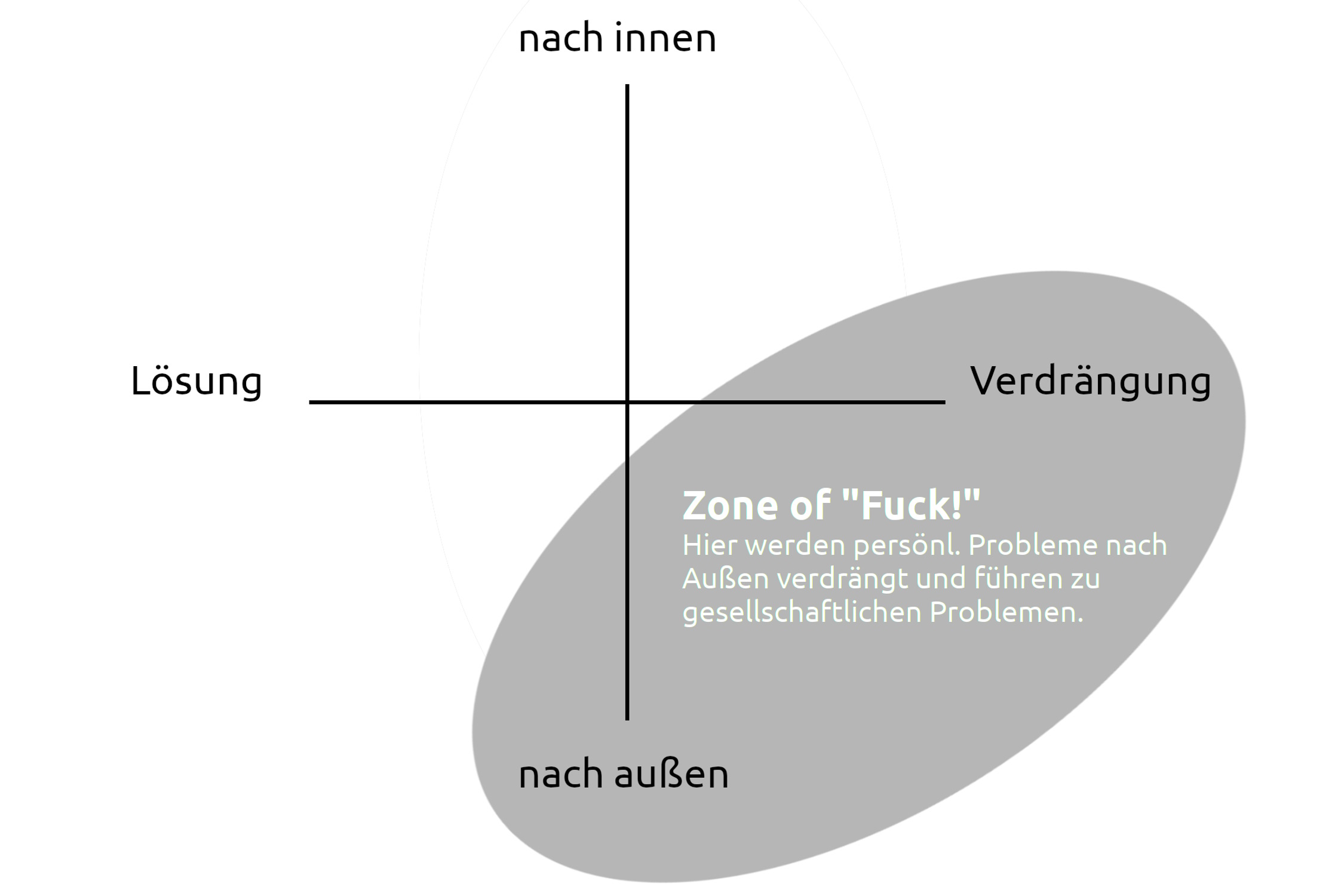
It is therefore not a question of recognising or solving a potential problem, but simply of no longer experiencing unpleasant feelings. When it comes to methods of repression, we come across two errors that play a (far too) significant role, particularly in the political arena:
1. Attribution error
This refers to the practice of decoupling symptoms from the actual problem, and attributing the symptoms to a different problem. Put simply: “I didn’t drink too much, but that last beer was off.”
Politicians often deliberately exploit this confusion. The AfD is a prime example of this when it attempts to address every problem with the refrain ‘It’s the foreigners’ fault!’. Similar misinterpretations also emerge from the Chancellor’s Office and the Home Office, always in the same formulaic manner: ‘The [migrants] are sitting at the dentist having their teeth treated, whilst the German citizens next to them can’t get an appointment.’
This is textbook framing, whilst the problem (e.g. the crisis in healthcare provision) is broadly – and wrongly! – attributed to migration.
2. Shifting the focus to symptoms
Analysis is followed by treatment – and this should, of course, address the problem itself, rather than simply pushing the ‘ouch!’ of the symptoms aside. If only the symptoms are pushed out of view, the problem will find another way to draw attention to itself: the symptom has shifted. In political discourse, therefore, based on the flawed analysis that migration is harming our country, easily recognisable skin colour is treated as a symptom: ‘Get rid of them, and we’ll be fine again!’
What follows, then, is the shift of the symptom of this flawed analysis to the foot – the Home Secretary and the little ‘Sauerland Pasha’ are right at the forefront of this.
Incidentally, this shifting of symptoms is also a behaviour we observe in ourselves in our everyday lives. A symptom is suppressed (e.g. by distracting ourselves with Netflix), it disappears and then pops up again elsewhere: different symptom, same cause, increased intensity.
And what about the deportations?
Of course, there are individual cases where deportation is justified. However, the fundamental approach behind today’s deportation drive is precisely this mixture of attribution errors (“Migrants are to blame for everything!”) and symptom displacement (“I don’t want to see any migrants in the cityscape!”). That may be completely off the mark from a human perspective, but on a societal level this strategy works. Because it taps into a core aspect of human behaviour: when unpleasant feelings arise – for example, the artificially generated fear of dark skin and guttural speech – the simplest solution is also the most appealing. Symptom gone, all’s well, heart emoji.
The AfD has recognised this and uses such mechanisms deliberately and successfully, whilst figures like Dobrindt and Merz seem more instinct-driven – one could, by analogy, speak of ‘cold-blooded killers’ (AfD) and ‘impulsive criminals’ (Dobrindt, Merz). The real solution – addressing the antisocial patterns in the minds of these political arsonists, and above all keeping such characters out of positions of power – is a talking point that is, however, rarely raised. But as long as we discuss antisocial behaviour in leadership positions only behind the fig leaf of ‘bad politics’, we too are merely tinkering with a symptom.
So when pathologically anti-social characters hold high office, project their own compulsions onto groups of people and seek to render these groups as invisible as possible, someone is always going to be deported. Yet migration is here to stay – and the climate crisis will intensify it massively.
And then people like our Home Secretary will react just as an alcoholic does when his stomach pains become unbearable: he escalates! The alcoholic, seeking to suppress his pain, moves from beer to spirits. The Home Secretary, unable to tolerate the free-spirited lives of people from other cultures, moves from deportation to detention centres.
Such decisions are made by politicians who have no control over their own mental state and who ‘see’ symptoms in our society that need to be swept under the carpet: you, me, queer people, climate activists, democratic institutions and the brown-bearded kebab seller on Eisenbahnstraße … It’s always the same principle.
Dominic Memmel, born in Würzburg in 1980 and living in Leipzig since 2014, works as an activist, communications consultant and podcaster. Visit the author’s page.
Empfohlen auf LZ


So können Sie die Berichterstattung der Leipziger Zeitung unterstützen:





There is one comment