Dieser Artikel ist auch in deutscher Sprache verfügbar: Zum deutschen Artikel.
It wasn’t just 20th-century science fiction that depicted the dawn of the 21st century as a technological miracle. Space would have been conquered long ago, and humanity would have set off for the stars. And we would all be living in gleaming cities with futuristic modes of transport and helpful robots. School textbooks painted similar pictures. And even in newspapers and magazines, a future was depicted in which technology would have solved all of humanity’s problems. It is high time to ask some questions. What do today’s authors have to say about this?
The reason is clear: a quarter of a century has passed since that New Year’s Eve when everyone waited with bated breath for computer programmes to crash one after the other. It was actually a really typical New Year’s Eve: instead of celebrating and being glad to have enjoyed another happy year, people frowned, looking out for the next disaster. And the disasters were not long in coming.
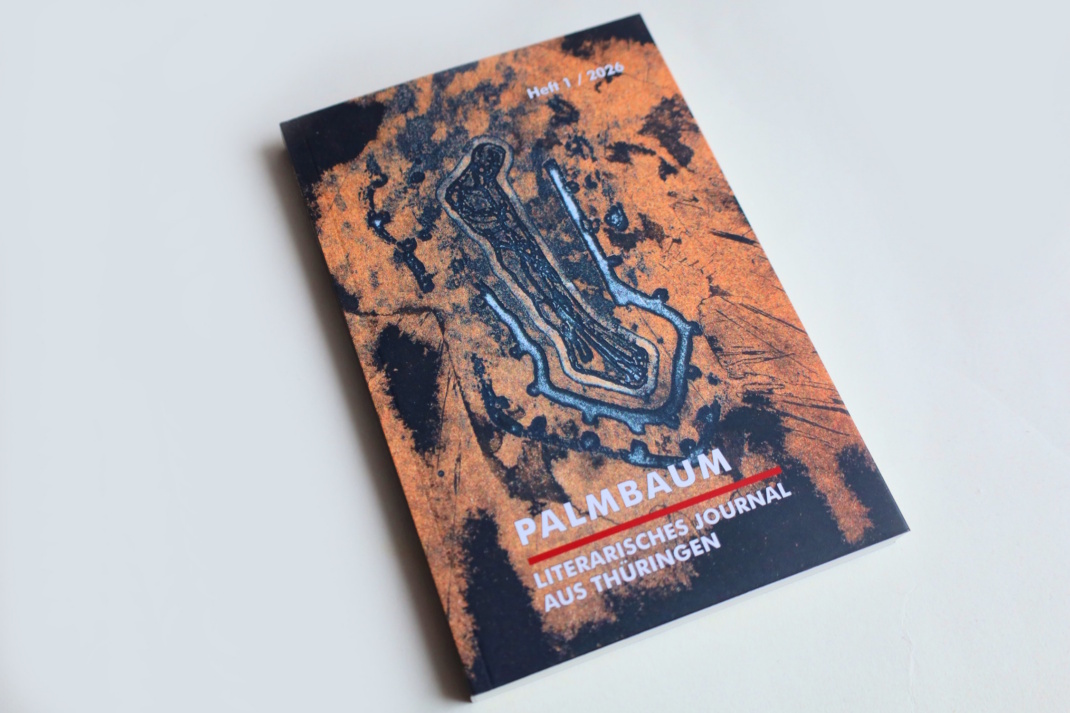
That is more or less the general tone of most of the articles on the cover story in *Palmbaum*, in which the authors interviewed reflect on what has actually become of the dawn of the third millennium.
The end of history?
Rolf Schneider, for example, examines a myth that was put into circulation immediately after the Peaceful Revolutions of 1989–1990: the myth of the ‘end of history’. The American philosopher Francis Fukuyama hadn’t quite meant it that way. But the quote was powerful. Particularly amongst politicians, who now genuinely believed that the confrontation between the blocs was over for good, and that capitalism had triumphed across the board. Now, they thought, they could disarm, because there was no longer any adversary.
What a mistake.
But that is actually what almost all these texts are about: people’s willingness to chase after myths and pipe dreams, whilst completely losing sight of reality. Until reality catches up with them in the form of terrorist attacks, wars, storm surges and heatwaves. Or tech bosses who are trying with all their might to actually bring the craziest utopias of the 20th century to life and make a fortune in the process. With collateral damage that, of course, doesn’t feature in the science fiction books of the GDR.
Should not feature. As Heidrun Jänchen reminds us, as she reflects on her childhood reading experiences and rekindles our fascination with utopian literature. A literature which, after all, essentially captured the country’s own utopia in images – the world of victorious communism would be so beautiful.
Dreams that people could certainly still share in the 1960s. But as early as the 1970s, this utopia began to show deep cracks. And some non-conformist authors then went on to write novels that questioned this socialist idyll of the future – Franz Fühmann, for example, or the Steinmüllers. They wrote their defiant books at a time when the mood in the West – at least amongst science fiction authors – had already shifted.
For there, dystopias had long since come to dominate new science fiction output. Which, incidentally, serves as a reminder that both camps had set out with wild hopes of a glorious future filled with fascinating technology. Both camps ignored the collateral damage caused by their reckless consumption of resources. And the irrationality of power, of course.
Acting without a future
Yet anyone who reads the science fiction of that era knows this: the prescient science fiction authors saw what was coming. They analysed the developments of their time and carried them through to their catastrophic conclusion. And here, too, one can only say: we could all have known. Yet politicians played dumb, pretending that their actions had just as little impact on the future as the behaviour of completely unchecked mega-corporations.
Congratulations.
Just how stupid can a species actually be?
But essentially, as Rolf Schneider points out in his essay ‘Myth of Time’: most people are only too happy to believe when a dazzling myth is made palatable to them. And when things turn out differently, the utopias disappear without a trace. What remains – as the philosopher Jürgen Große sees it – is sheer cynicism. In both East and West. Although Große accuses governments in the East of governing cynically by their very nature. For they knew the state the country was in. And yet they continued to peddle images of a utopia that had long since been consigned to history.
Politics without a future
Nancy Hünger, who did not grow up with the romantic rocket-age novels of the 1950s, highlights just how much visions of the future differ across generations: “I had no expectations of the 21st century, except for the end of the world…”
Naturally, people lose their visions of the future when even politics and the media no longer recognise such visions, when we are merely muddling through and desperately patching up the status quo. This produces not only disappointment, but also a sense of powerlessness. “I have no expectations,” says Nany Hünger, summing up this feeling, “I just hope that we all manage to get through it somehow before the past swallows us up completely.”
But giving up is not an option, notes Steffen Mensching, who, with the benefit of hindsight, can now understand his father’s fatalism – a view he struggled with as a young man because he still hoped that Rosa Luxemburg might have been right. In a way, she was: The crises of our time can certainly be interpreted as a ‘relapse into barbarism’. And Wilhelm Bartsch, too, has his doubts as to whether humanity is even capable of a future at all: ‘Humanity and good manners seem to be melting away before our very eyes even faster than the glaciers.’
But his view is similar to Mensching’s: anyone who puts up with all this has understood nothing at all. He quotes Margot Friedländer: “Do not be indifferent!”
In the age of the obsession with control
This also applies to the state and politics, which are transforming before our very eyes into feudal constructs in which there is simply no empathy and no future left. Instead – as Kathrin Schmidt notes – “the war on terror, dragnet investigations, the anti-terrorism database, the Air Security Act, biometric passports”.
The control freaks have taken the helm and are embedding mistrust of people deep within the law and society. Here we are now. Yet even Lutz Rathenow, like Hoffnng, expresses the hope that all this old rubbish will somehow fade away and that various futures will still be possible for us, even if we do not know which ones.
Wolfgang Haak reflects on the hope that this will not be a future in which AI takes the reins, reminding readers that it is not artificial intelligence that is capable of new and creative thinking, but natural intelligence. The kind that each of us carries in our minds – it’s just that most of us are all too willing not to use it at all.
And Jens-Fietje Dwars reminds us that there are still positive visions of the future today, paying tribute to Sibylle Berg’s novels, in which she depicts a new revolution aimed at enabling every person to lead a comfortable life. That is the unthinkable – something that is so shamelessly marginalised in politics today.
Life without a future?
These articles on the cover story of the current issue of *Palmbaum* encourage us to reflect on something we have somehow completely lost sight of: our future. We are stuck in a world that bears no resemblance to what science fiction authors of the mid-20th century imagined. Disillusioned, demotivated and disheartened. But perhaps we need to go through this very process in order to learn now just how devastating the technological dreams of the 20th century were. And how the myths of the ‘end of history’ have led to an inability to even conceive of history as something we can still shape.
Ouch. Of course that’s forbidden.
After all, Dax would call the status quo into question. And perhaps once again put us humans, with our actual dreams, at the centre. It’s hard to imagine what sort of politics that would entail.
That this has something to do with the ‘defence of culture’ is a point Friedrich Dieckmann explores in his essay ‘On the Question of National Culture’ – in which he traces a broad arc back to the Enlightenment and the repeatedly stifled efforts of top-class authors to remind this country that it is not about colours, slogans and stilted anthems, but about people. And a human conception of ‘nation’.
But the word ‘nation’ haunts the debate so devoid of meaning that it is no wonder we do not perceive ourselves as a nation. For that would presuppose a sense of commonality and community, which is being virtually torn to shreds in the frenzied discussions about values and ‘dominant culture’. Our political actors have already internalised the fact that one can govern well by ‘divide and rule’.
But in the end, all you’re left with is a pile of mincemeat: a host of isolated individuals and a clientelist politics that simply causes frustration. Yet it has no future. Just a shabby ‘business as usual’. Food for thought, handy, thought-provoking. Supplemented – as always – with new poems, short prose pieces and a wealth of reviews of contemporary literature.
‘Palmbaum. Literary Journal from Thuringia’, Issue 1/2026, quartusa Verlag, Bucha near Jena 2026, 13 euros.
Empfohlen auf LZ


So können Sie die Berichterstattung der Leipziger Zeitung unterstützen:





There is one comment