Dieser Artikel ist auch in deutscher Sprache verfügbar: Zum deutschen Artikel.
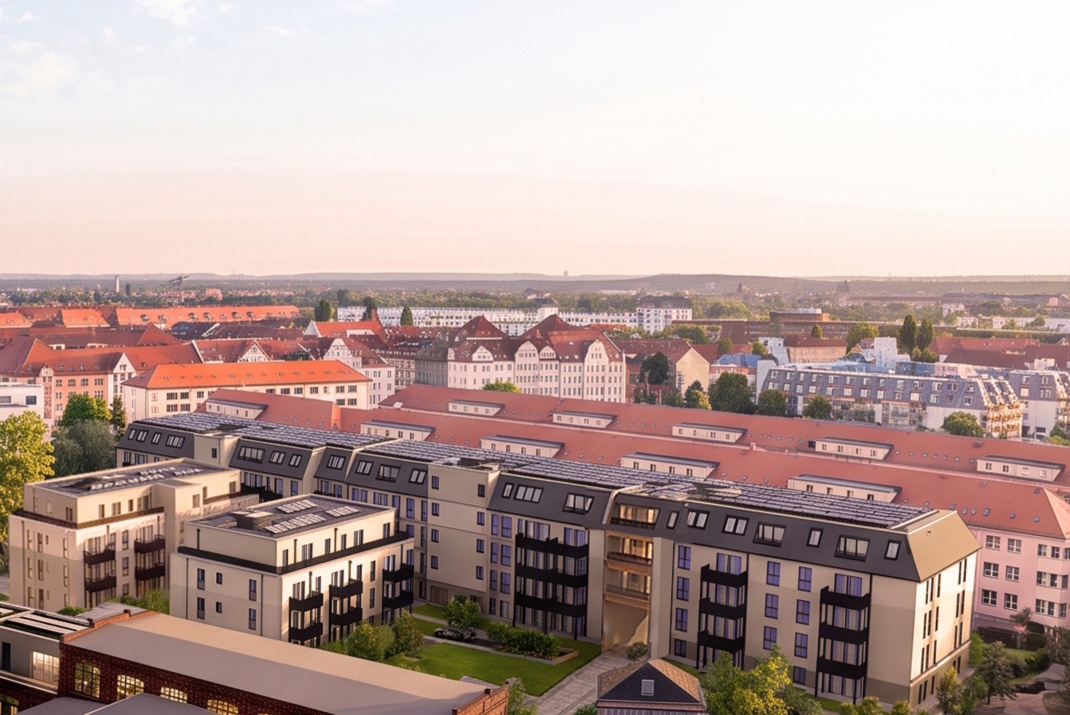
LEWO AG, which is developing the site of the former jute mill on Lützner Straße, now also intends to build social housing there. As part of the HAFENWERK² project, the company is developing 85 rent-controlled flats in the west of Leipzig for households holding a housing eligibility certificate. The company emphasises that the project complements the existing neighbourhood along the Karl-Heine Canal and also marks a strategic step: in future, publicly subsidised housing is to become an integral part of its project portfolio.
This is because something significant has changed in Leipzig’s housing market.
“The Leipzig housing market is now developing in a much more balanced way than it was a few years ago. At the same time, demand is shifting. Whilst privately funded new-builds often require high rents due to increased construction and financing costs, the need for permanently rent-controlled flats is growing. This is precisely where we see our role,” says Stephan Praus, CEO of LEWO AG.
Leipzig continues to grow
Leipzig remains one of the few major German cities with a growing population. According to the city’s figures, the population had grown to 633,592 by the end of 2025, marking yet another year-on-year increase despite an overall slowdown in growth. The Free State of Saxony’s latest population projections also identify Leipzig as one of the few growing regions in the state by 2045. Whilst numerous districts and independent towns are set to lose residents, Leipzig is expected – depending on the scenario – to see further population growth of between 1.7 and 5.8 per cent. For the housing market, this means sustained high demand, particularly in the affordable segment.
With HAFENWERK², LEWO AG is responding to this trend. The flats are being built for people with a housing eligibility certificate and will supplement the existing neighbourhood with a supply of permanently affordable housing. The plan is to offer a mix of different flat sizes to cater for various household types. The specific breakdown will be finalised in consultation with the Housing Authority as planning progresses.
HAFENWERK
The location on the Karl-Heine Canal in Plagwitz
combines living close to the city centre with a well-established infrastructure. Schools, shopping facilities, leisure activities and public transport are all in the immediate vicinity. At the same time, future residents will benefit from the established neighbourhood of the existing HAFENWERK district.
For LEWO AG, entering the subsidised housing sector is part of a long-term corporate strategy. “Neighbourhoods can only function sustainably if they appeal to different income groups. Subsidised housing is therefore not a separate business area for us, but an integral part of modern neighbourhood development,” explains Stephan Praus.
At the same time, LEWO AG sees room for improvement in the political framework. High construction and financing costs make economic implementation difficult, as do complex funding requirements and lengthy approval processes.
“The funding instruments are fundamentally sound, but their implementation is often too cumbersome. Too much time often elapses between the funding application, approval and the start of construction. At the same time, costs continue to rise. If we are to create more subsidised housing, we need faster procedures, less bureaucracy and more practical requirements – for example, regarding the parking space allocation ratio. In social housing, parking spaces often have to be provided even though many households do not own a car at all,” says Stephan Praus.
Empfohlen auf LZ


So können Sie die Berichterstattung der Leipziger Zeitung unterstützen:


There is one comment