Dieser Artikel ist auch in deutscher Sprache verfügbar: Zum deutschen Artikel.
No one will be able to say in future that they didn’t know. That they lacked the facts about the 2026 elections. Because the facts are out there, live and available to anyone who’s even slightly curious about their own reality. And all presented with a touch of humour, too. Because that’s exactly what the ‘Fun Facts’ programme has been doing for some time now, with enthusiasm and good humour. But as there are now a few rather important elections coming up in the east, ‘Fun Facts’ is touring the country and will be stopping off in Halle (on the Saale) today, Monday 10 August.
And it’s tackling a topic that should also give the people of Leipzig cause for concern. Because the ‘Fun Facts’ event, hosted by Sebastian Krumbiegel, is all about debt. And the highly contentious issue of the wealth tax.
Halle’s financial problems
A targeted tax on large fortunes of 100 million euros or more could significantly improve the financial situation in Halle (Saale). This is shown by a new study by the Forum for Ecological and Social Market Economy, commissioned by Greenpeace. As is currently the case in many other local authorities, the city’s strained financial situation is holding back urgent investment in schools, local transport, roads and climate adaptation.
According to a model calculation, a wealth tax based on Greenpeace’s tax concept could generate around 68 million euros in additional annual revenue for Halle. This would, in theory, offset just under half of the budget deficit expected for 2026.
The Greenpeace study on the finances of the city of Halle.
“Halle illustrates what municipal financial hardship means in everyday life: school refurbishments are being postponed, bus and tram services are being cut back, and investments in heat protection and climate adaptation cannot be made,” says Barbara Happe, Greenpeace spokesperson for tax justice.
“A tax on very large fortunes could provide Halle with the necessary funds to renovate schools, make transport future-proof and better protect the city against extreme weather. When local authorities can reliably fulfil their responsibilities, people’s trust in democracy also grows.”
The new case study on Halle expands on the Greenpeace study
published in June on the financial crisis facing local authorities in Germany.
The tax proposal envisages a wealth tax of two per cent on net assets exceeding 100 million euros. It would affect just under 5,000 households across Germany. As a state tax, the wealth tax would initially flow to the state of Saxony-Anhalt. The model calculation takes into account both the financial equalisation between the federal states and the municipal financial equalisation scheme.
Halle and Leipzig in the debt trap
Halle is forecasting a budget deficit of around 138.2 million euros for 2026. The investment backlog is particularly evident at the Südstadt primary school: the refurbishment, estimated at 17.4 million euros, has already been postponed several times. Even after assessing just half of the roads, more than 100 million euros are required for the renewal of the road network.
Despite cutbacks to transport services, Hallesche Verkehrs-AG is forecasting a deficit of around 31 million euros for 2026. Added to this are necessary investments in heatwave and flood protection.
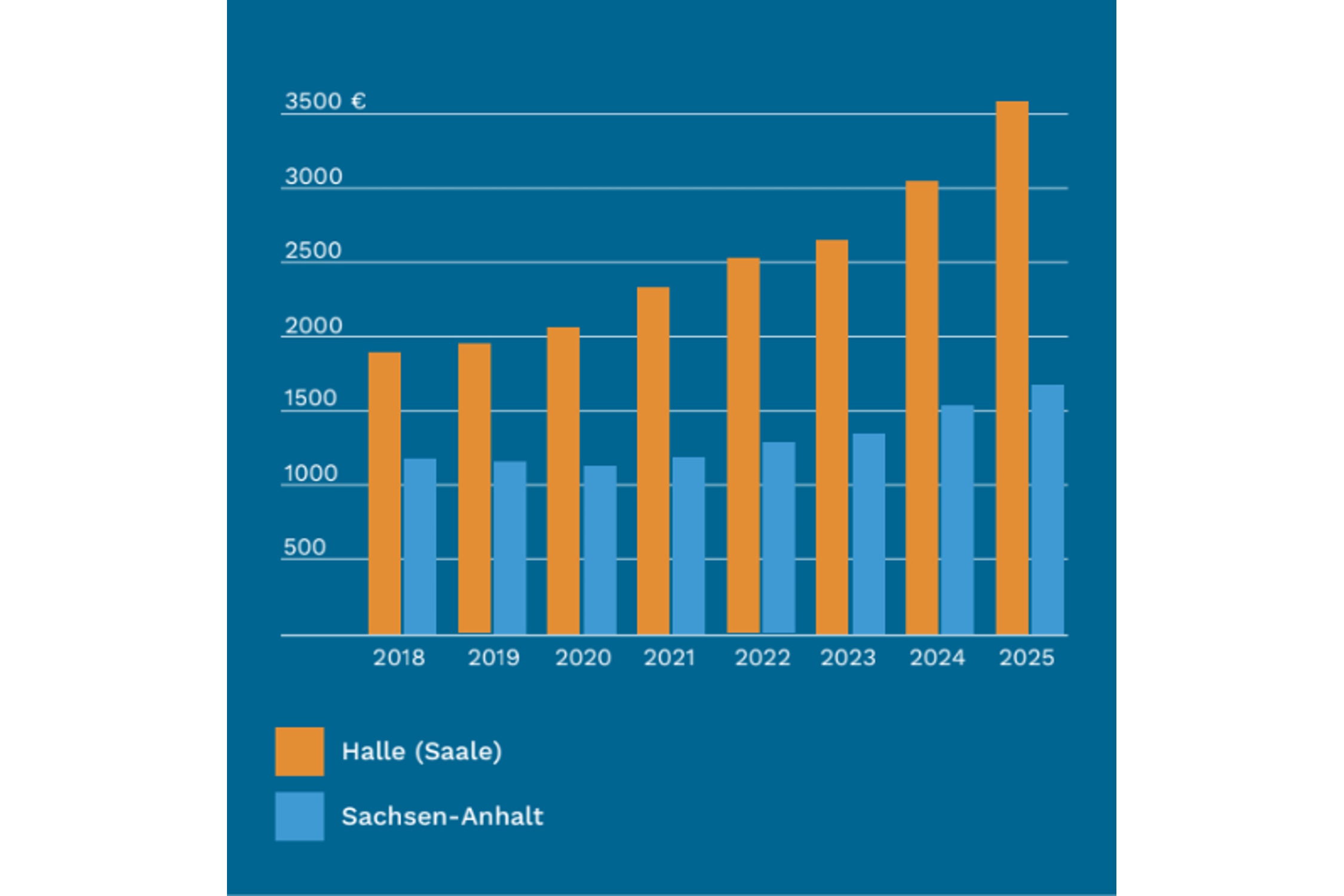
Trend in per capita debt in Halle and Saxony-Anhalt. Graphic: Greenpeace
By the end of 2025, Halle was in debt to the tune of 811 million euros, which amounted to over 3,500 euros per inhabitant.
Leipzig is now in a situation not much better than Halle’s, facing an annual deficit of around 300 million euros. Per capita debt, which had previously been reduced with great difficulty over many years, now stands at around 1,800 euros per inhabitant. And it will continue to rise in the coming years unless federal policymakers manage to put the German tax system back on track, after years in which taxes – particularly for the rich and wealthy – were cut or, as in the case of the wealth tax, suspended.
This is why, alongside ‘Fun Facts’
, there is also the ‘Vergnügt’
campaign, which advocates for the reinstatement of the wealth tax in Germany, which was suspended in 1997 by the then Kohl government. But not because levying a tax on large fortunes would be unfair or even unconstitutional.
Wikipedia states
: “In 1995, the Federal Constitutional Court ruled that a difference in the tax burden between real estate and other assets under the wealth tax was incompatible with the principle of equality (Article 3(1) of the Basic Law).” The main issue, therefore, was that different types of wealth – financial assets and property – were taxed differently or not at all.
With the interests of their wealthy voter base in mind, the CDU and FDP shelved the tax, and even subsequent federal governments lacked the nerve to reintroduce it – even in a revised form. The same applies to the many exemptions from inheritance tax, which in practice allow particularly large fortunes to be passed on almost tax-free, meaning that the wealth of the top 1 per cent continues to grow, whilst the federal, state and local governments sink ever deeper into debt.
Greenpeace group at the ‘Fun Facts’ event in the Turm in the evening
On 10 August, Greenpeace will be presenting the new case study at the ‘Fun Facts’ event in Halle, hosted by Sebastian Krumbiegel. Visitors can write on symbolic million-mark notes what the city urgently needs more money for. The collected wishes for the future are to be handed over to Lord Mayor Alexander Vogt.
Empfohlen auf LZ


So können Sie die Berichterstattung der Leipziger Zeitung unterstützen:




There is one comment