Dieser Artikel ist auch in deutscher Sprache verfügbar: Zum deutschen Artikel.
Meanwhile, the fourth major heatwave of 2026 is sweeping across Germany and Europe, with temperatures exceeding 40 °C – levels never before recorded at local weather stations in the past 150 years. What is particularly worrying and critical is the increasing number of consecutive tropical nights with temperatures of over 20, 25 or even 30 degrees Celsius, which are taking a heavy toll on people as they are unable to sleep properly and cannot cool their homes.
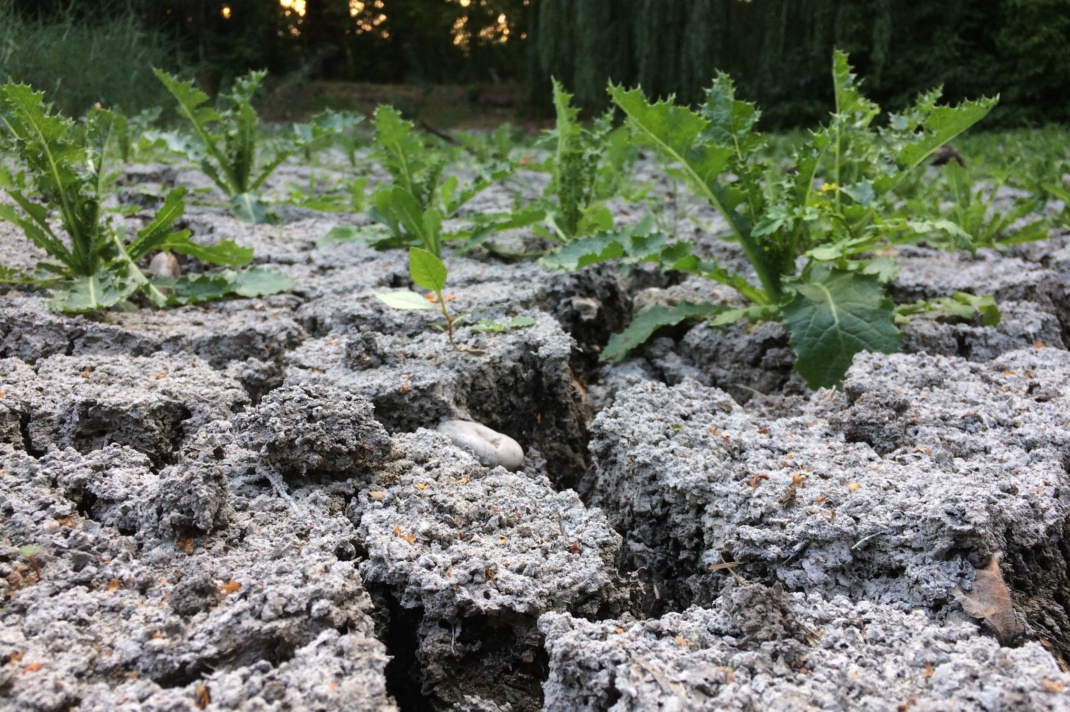
Furthermore, during the summer months, Central and Southern Europe no longer receive sufficient rainfall, resulting in increasing and more deeply affecting drought; rivers and streams are drying up, and rainwater is barely seeping into the ground. The agricultural sector must learn to cope with the increasing drought in spring and summer. The deeper soil layers are too dry over the long term. The groundwater is not being replenished. As a result, shrubs and trees are dying off. This is particularly evident in the Leipzig floodplain forest.
These increasing heatwaves and periods of drought are effects of climate change. What is needed are policy initiatives and strategies to combat the effects of climate change, to reduce greenhouse gas emissions, to transform the energy system towards the use of renewable energies, a different approach to nature and the environment, including retaining rainfall across the landscape, implementing heat action plans, expanding the ‘heat transition’, and transforming cities into ‘sponge cities’…
Who will pay for heat protection?
The seriousness of these changes appears to be either overlooked, downplayed or simply ignored by current federal policy.
Example: Heat protection
The Federal Minister for the Environment, Carsten Schneider of the SPD, now wants to have heat protection enshrined in the Basic Law. Whether it makes sense for this to be a federal responsibility remains to be seen. In any case, the key issue is that local authorities are provided with sufficient funding to finance heat protection measures in their communities. Local authorities, in consultation with residents, know best where specific measures are most likely to be effective. The federal government can make the funds available through programmes. However, these funds should also reach the local level, where decisions on their use should be made in consultation with residents.
Measures to combat solar radiation, hot days and nights – particularly in larger cities – are urgently needed and should be set out in heat action plans. The one in Leipzig is due to come into effect in 2025.
The number of tropical nights is steadily increasing
For the years 1960 to 1990, I was unable to find any recorded night-time temperatures from the Leipzig Meteorological Service; therefore, here are the highest daytime temperatures for each decade, as measured in Leipzig-Holzhausen:
1960s – 1969 at 33.7°C,
1970s – 1976 at 35.5°C,
1980s – 1984 at 35.9°C
1990s – 1992 at 37.5°C,
2000s – 2006 at 36.8°C,
2010s – 2018 at 37.3°C,
2020s to date – 2022 at 37.8°C, on 27 June 2026 at 40°C,
It should be noted that, in a densely built-up city like Leipzig, the heat gets trapped between the buildings due to the many sealed surfaces. Even during the day, when temperatures exceed 33 degrees Celsius, it feels like being in an oven. The hot air becomes trapped between the buildings, as it is precisely these buildings and sealed surfaces made of asphalt and concrete that absorb the heat during the day and release it into the environment at night. Even the Elster reservoir acts as a source of heat at night, as the almost still water heats up significantly during the day.
The number of nights with temperatures above 18 °C and above 20 °C is steadily increasing, and the night-time lows are rising (these are the nights when the temperature remains above 18 or 20 degrees and does not drop any further).
On hot nights, air circulation via corridors of cool air does not work. Often there is no wind at all; not even a breath of air moves through the streets and rooms. And when this heat lingers in the city and on the streets for several days, it becomes far too warm, humid and uncomfortable inside homes, particularly at night, making it difficult to sleep and relax.
The hot air remains trapped inside the rooms. This leads to overheating, collapse and even death among more vulnerable people and many older people.
According to information from Deutschlandfunk on 13 August 2026, based on research by the Robert Koch Institute, there is an excess mortality of around 12,500 people due to the hot days and nights – meaning that these people died as a result of the heat in addition to the ‘usual’ mortality rate in June and July 2026. (The figure for Leipzig is from 2025.
)
People can only cope with these periods of overheating in the city and tropical nights if they have air conditioning in their homes. But who in central Germany actually has air conditioning? And who can afford it? After all, these air conditioning units require electricity to operate and generate cooling. Not every tenant can install an air-conditioning unit in their flat and mount it on the outside wall without disturbing their neighbours with the noise.
And not every tenant can fit a balcony solar panel system to generate electricity on their balcony or roof. Energy sharing might then be of some help. The shared use of self-generated electricity from renewable energy sources has been legally permitted since 1 June 2026 under Section 42c of the Energy Industry Act (EnWG), but the regulations are cumbersome and unnecessarily overcomplicated.
Measures under the heat protection plans
Further drinking water dispensers and air-conditioned rooms for people to rest in should be provided in the city districts.
The city needs fresh-air corridors so that the slightly cooler air from the less built-up surroundings and from the floodplain forest can flow into the city centre. These designated fresh-air corridors must not be obstructed by buildings or other structures.
It is essential that the floodplain forest be preserved as a local recreational area, a natural habitat and a source of fresh air. To this end, the floodplain forest must once again be flooded annually.
The city needs more green spaces, ‘tiny forests’ and parks, as well as areas for rainwater ponds. Through ‘sponge city’ redevelopment, rainwater can seep away into basins and swales and evaporate, thereby lowering air temperatures so that a slightly cooler microclimate can develop in the city’s districts on peak summer days.
The city needs green roofs, green facades, more street trees, the restoration of old watercourses, fountains and drinking fountains to reduce the heat build-up in residential areas.
Part 2 will follow shortly on this page.
Empfohlen auf LZ


So können Sie die Berichterstattung der Leipziger Zeitung unterstützen:





There is one comment