Dieser Artikel ist auch in deutscher Sprache verfügbar: Zum deutschen Artikel.
There are people who are remembered not only for the positions they held, but above all for what we were able to achieve together with them. Henry Aulich was one such person to me. The news of his death has affected me deeply. Henry died far too young. He was only 38 years old. My sympathies go out to his family, his loved ones, his friends and all those who were close to him.
I would like to take this opportunity to remember a man with whom we shared a common cause: keeping alive the history of the anti-fascist resistance in Leipzig and ensuring that those who lost their lives in the fight against National Socialism are given a place of honour in the public memory.
The return of Georg Schwarz to Leutzsch
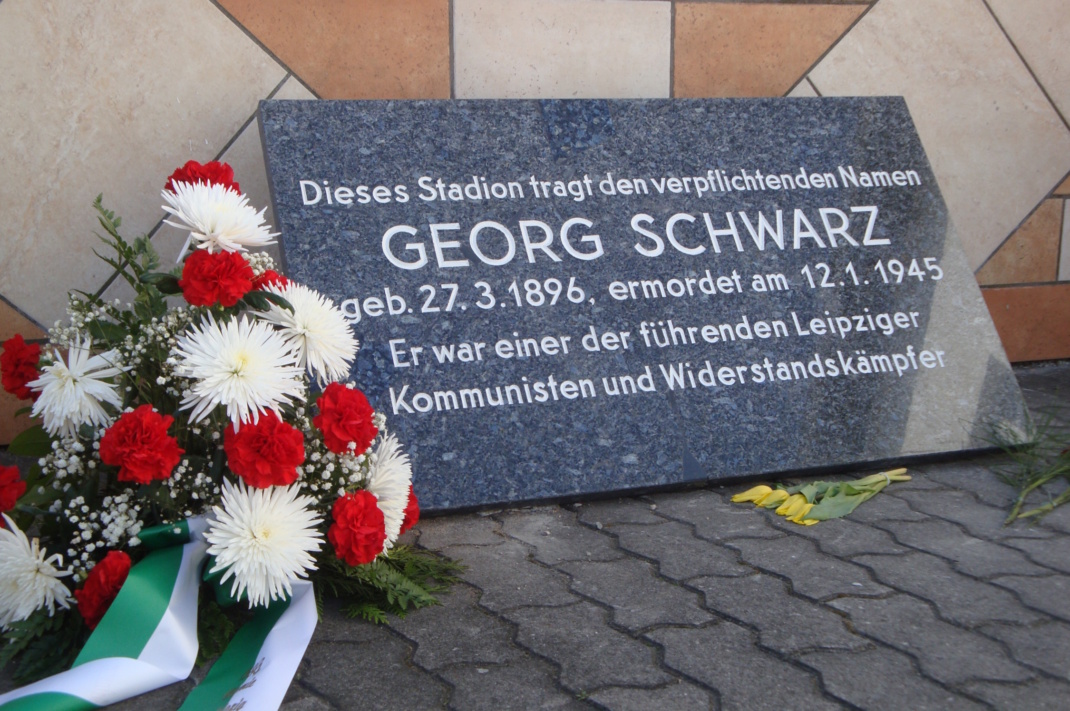
A particular highlight of this collaboration was the re-erection of the commemorative plaque for Georg Schwarz in the Alfred-Kunze-Sportpark.
Georg Schwarz, a communist politician and resistance fighter against National Socialism, was executed in Dresden on 12 January 1945. His name is closely linked to the history of western Leipzig. A street is named after him, and between 1949 and 1992, the Leutzsch Stadium was also named in his honour. It was all the more painful, then, that the commemorative plaque, which had honoured his memory at the sports park since 1966, was removed and destroyed in the 1990s.
The fact that the memory was not lost for good is also thanks to Joachim Wenning, a fan of the Chemie football club. He kept the broken pieces of the memorial stone safe. This preserved the possibility of restoring the destroyed memorial. Because for him, too, looking the other way is not an option!
For us in the Gedenkmarsch Leipzig group, it was clear: this stone must not simply be forgotten. It was not just about a piece of stone, but about the question of how a city, a neighbourhood and a football club deal with their history. It was about the dignity of a man who had paid with his life for his convictions and his resistance to the Nazi dictatorship.
In February 2013, the board of BSG Chemie Leipzig decided to have the plaque reinstalled. Henry Aulich, then the club’s managing director, informed me of this decision. For me, this was an important step. A cause we had been campaigning for had turned into a concrete opportunity to achieve something together.
On 14 April 2013, the commemorative plaque returned to its place in Leutzscher Sportpark. The stonemason Steffen Wegener from Köhra had pieced the surviving fragments back together. The broken edge remained visible. It was not to be concealed, for the destruction and disappearance of the plaque were also part of the history that needed to be remembered.
For me, this moment was more than simply the re-erection of a memorial stone. It showed that remembrance remains possible when people take responsibility and are prepared to act together.
Henry Aulich and the responsibilities of a football club
From 2011 onwards, Henry Aulich was initially a member of the supervisory board of BSG Chemie Leipzig and served on the club’s executive committee from 2012 to 2015. As managing director, he was familiar with the practical and organisational challenges of a club whose history extends far beyond football.
BSG Chemie is part of Leutzsch’s history. This history includes sporting successes and defeats, the people of the neighbourhood, generations of fans – but also the political and social experiences that have shaped this place.
The re-erection of the commemorative plaque was therefore no trivial matter. It was a sign that the memory of anti-fascist resistance must retain its place in the present. A football stadium is not just a place for ninety minutes. It is also a place for people to come together, to identify with a community and to pass on history.
Henry helped ensure that the re-erection did not falter due to organisational hurdles. His contribution was not merely to be the sole initiator of this project. The impetus came from the group Gedenkmarsch Leipzig. But an initiative needs people to take it on board, to facilitate decisions and to create the conditions for its implementation. Henry was one of our key points of contact throughout this process.
For that, I am grateful to him.
A collaboration characterised by trust
Equally important was the collaboration with Dr Harald Fuchs, then Chairman of the Supervisory Board of BSG Chemie Leipzig. Harald Fuchs passed away several years ago. I, too, think of him with gratitude at this time.
We were united by the conviction that the story of Georg Schwarz must not fade from public consciousness. Fuchs made it clear publicly that the removal of the commemorative plaque had been a bitter chapter in the club’s history and that its return also represented a matter of principle for the club.
The joint statement that Harald Fuchs and I issued in connection with the plaque’s reinstallation summed up our aim: we wanted to honour the memory of Georg Schwarz and his fellow campaigners and pass on this remembrance to younger generations through projects run by the Gedenkmarsch group and the Outlaw fan project.
For me, this collaboration was an example of what is possible when people from different backgrounds pursue a common goal. It required the initiative from the remembrance work, the club’s willingness to confront its history, and people who breathed life into this connection.
Henry Aulich and Harald Fuchs had different roles and responsibilities. Yet in this endeavour, we came together for a common cause. The fact that the commemorative plaque was able to return to its rightful place in 2013 was the result of this collaboration.
I shall also associate both of them with this chapter in Leipzig’s history of remembrance.
Remembrance is not a finished task
The work on the commemorative plaque represented a cause that has always been important to us as the Gedenkmarsch Leipzig group: not merely preserving history in books and archives, but making it visible in the very places where people live, work, play sport and meet one another.
In this regard, our collaboration with the Association of Victims of the Nazi Regime – Federation of Anti-Fascists (VVN-BdA) Leipzig has been, and remains, an important part of this remembrance work. Commemorating the victims of National Socialism and those who resisted requires continuity. It needs people and initiatives that convey historical contexts, preserve places of remembrance and prevent the experiences of the past from becoming mere names on plaques.
Georg Schwarz was one such name – and at the same time a person with a life story, political convictions, a sense of responsibility for others and the courage to stand up to a criminal regime. Remembering him also means understanding the circumstances under which resistance became necessary, and taking the importance of democratic responsibility in our own time seriously.
The visible fracture line on the restored commemorative plaque is a telling image of this. History cannot be undone. Destruction cannot simply be erased. But people can choose not to give up on what has been lost and to restore damaged connections.
A farewell and a word of thanks
With the passing of Henry Aulich, we have lost a man with whom I share a significant chapter of collaborative work. I do not wish to reduce him to a single role, nor to pretend that an entire life can be conclusively assessed in a few paragraphs. A person is always more than what others can write about them.
I am left with the memory of our collaboration on the return of the commemorative plaque for Georg Schwarz. It stands as a symbol of a moment when a shared cause became a tangible reality. Henry played his part in this. For that, he deserves recognition.
My thoughts also go to Harald Fuchs, with whom we jointly championed this project, and to all those who preserved the memorial stone, restored it and made its return possible. Remembrance is rarely the work of a single individual. It arises when people take responsibility for one another and for history.
Henry Aulich died far too young.
I wish his family strength and the support of those who will stand by them in their grief.
I shall remember Henry with gratitude – not least for what we were able to achieve together in honouring the memory of Georg Schwarz.
Empfohlen auf LZ

So können Sie die Berichterstattung der Leipziger Zeitung unterstützen:




There is one comment