Dieser Artikel ist auch in deutscher Sprache verfügbar: Zum deutschen Artikel.
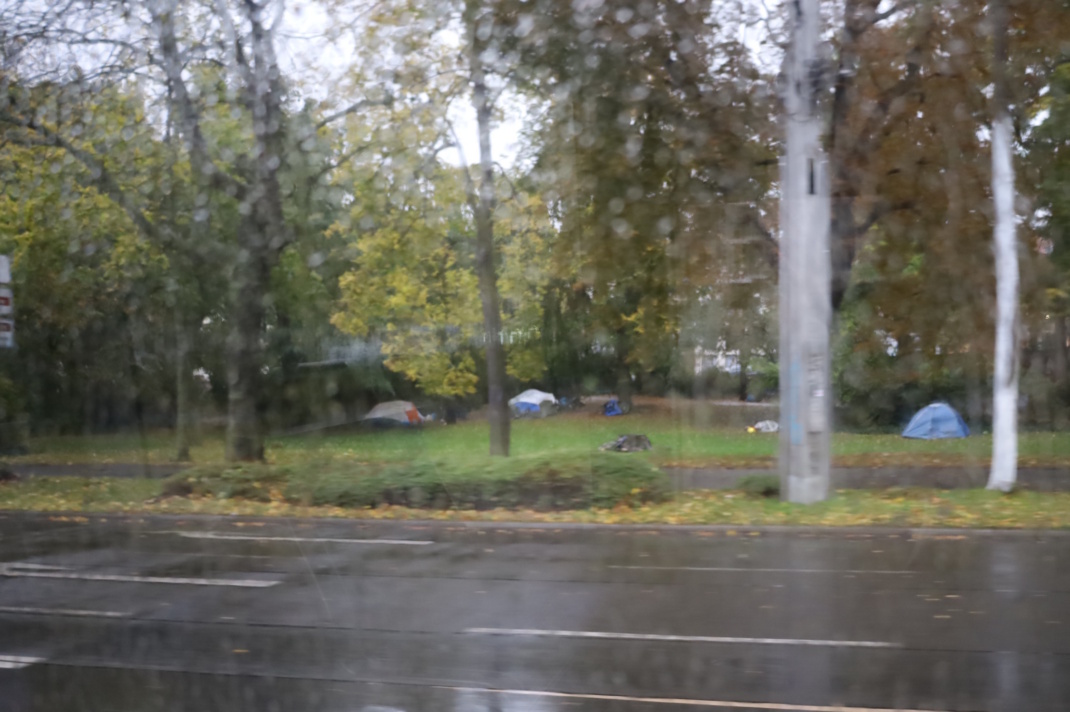
In Leipzig, too, the housing crisis is hitting hardest those who are least able to defend themselves. For years, the rise in homelessness was barely noticeable to the people of Leipzig. But that has changed. Over the summer, people who had become homeless were increasingly seen spending the night in Leipzig’s parks. With the onset of the harsh season, tents are now appearing in the parks as well, with which those affected are trying to protect themselves as best they can against the inclement weather. But this is now annoying the CDU group on Leipzig City Council.
And their voters. For the sight clearly offends the middle-class sense of order and cleanliness. It was so pleasant when homelessness was still almost invisible. Can’t the city just tidy it up?
That is exactly how it sounded when the CDU group raised the issue in the city council.
“Over the past few weeks, the CDU group has repeatedly received photographs from concerned citizens. These showed tents erected illegally on public land. In some cases, these are not actually tents, but merely tarpaulins that have been laid out or stretched across the ground. The concern stems not only from the fact that wild camping is strictly prohibited, but also from the fact that a rubbish and sanitation problem is becoming apparent around these sites.
Thanks to reports from members of the public, we are aware of illegal wild camps in the park around the Wagner monument, at the excavator site in Thekla, on Nürnberger Straße in front of the homeless drop-in centre, and also temporarily on the green space next to the Elsternest nursery.
Setting up illegal wild camps constitutes at least a breach of Section 3(4), if not Section 10, of the Police Regulations. These breaches constitute an administrative offence within the meaning of Section 24(1)(3) and (17) of the Police Regulations. Pursuant to Sections 24(1)(3), 17 of the Police Regulations (PolVO) in conjunction with Section 39(1), (2) of the Saxon Police Act (SächsPBG), a fine of up to €5,000 may be imposed for contravening the requirements and prohibitions of the Police Regulations.”
Targeted measures?
Strong stuff. And quite clearly, no understanding whatsoever for people who are forced to eke out a living under the open sky. Is ruthlessness once again becoming the benchmark for policy? The CDU parliamentary group quite clearly wants tough measures against ‘illegal’ campers: “Is the administration taking active steps against the establishment of unauthorised campsites or pursuing their dismantling through targeted measures? If not, why not?”
The fact that one cannot simply respond here with draconian eviction is something of which the Leipzig Public Order Office, at least, is well aware: “Measures under public order law, like other measures relating to law enforcement and the prevention of danger, must comply with the principle of proportionality. Among other things, such measures must be suitable for averting a danger. Ordering the clearance of such accommodation or places for sleeping and staying can only be a last resort, as this displacement effect does not put an end to homelessness, but merely shifts its public manifestation elsewhere,” the Public Order Office states as a matter of course in its response.
“When implemented in isolation, these measures carry the risk of subjecting those affected to psychological pressure, which, amongst other things, can make them harder to reach for outreach social work and hinder contact with existing support services. Therefore, from a holistic perspective, these measures are unsuitable for ensuring, in the long term, the resolution of circumstances classified as a disturbance under police law.
The city administration therefore aims to improve the situation sustainably by establishing the identities of the individuals and implementing social support measures. The Social Housing Support Department addresses the situation of homeless people through, amongst other things, outreach social work, establishing contact and providing advice on site, offering specific support services, and referring them to suitable overnight accommodation and support facilities. The aim is to facilitate access to support and, together with those affected, to develop strategies for overcoming their homelessness.”
However, it is precisely the search for available accommodation for those affected in Leipzig that proves difficult. The city authorities are well aware of this.
Formal framework
Nevertheless, the fact that homeless people are now camping in the city centre’s parks is viewed with concern: “At the same time, clear expectations regarding the behaviour of those encountered on site are articulated. If these requests are not complied with, an order to leave the premises and eviction will be issued in accordance with public safety legislation. The formal framework must be adhered to in this regard.
Within the existing working groups, such as the Adult Streetwork Quality Circle or the Drug Report, there is a regular, cross-departmental exchange of information regarding locations where people without a fixed abode are present in public spaces. Joint operational strategies are also agreed upon in this context.”
Fines for homeless people?
The question posed by the CDU parliamentary group, however, sounded downright out of touch: “Does the administration currently impose, or has it in the past imposed, fines for camping (in accordance with Section 3(4) of the PolVO) or for erecting unauthorised tents (in accordance with Section 10 of the PolVO)? a. If so: What was the amount (total sum as well as the sum of each individual measure taken to date)?”
As if one could, of all people, collect fines from those camping outdoors, as though they were well-off people who’d parked illegally. Or owners of motorhomes who park their vehicles haphazardly off-road.
The Public Order Office puts it as follows: “The imposition of fines on homeless people, whose legal misconduct falls within the discretionary scope of the Administrative Offences Act, is not suitable for bringing about a change in behaviour. In the case of homelessness, the individual is simply unable to cease precisely this offence subject to a fine, as the causes of homelessness are manifold and addressing them requires a long-term, societal effort involving referral and support services such as ‘Housing First’.
Furthermore, the imposition of fines does not appear to be suitable or proportionate in this context when applying the principle of proportionality (necessary, suitable and appropriate). Those affected are mostly destitute and survive on only the bare essentials. It cannot be assumed that fines will be paid, insofar as they can even be served in the first place due to the lack of a registered address. Further steps, such as coercive detention (Section 96 of the German Administrative Offences Act (OWiG)), are likely to fail simply because of the obvious inability of those affected to pay.”
Are homeless people a nuisance?
And the CDU’s proposal to report the ‘illegal’ tents of homeless people via the city’s defects reporting system also – according to the Public Order Office – completely fails to recognise the reality of these people’s lives: “Only categories that occur ‘on a massive and recurring scale’ in the city of Leipzig have been included in the defects reporting system. This is not the case with so-called wild camping.”
The people who are somehow protecting themselves from the increasingly inclement weather with tents and tarpaulins are simply not rubbish or waste. They are, rather, the victims of a growing housing crisis in Leipzig. And if nothing really changes in this regard, many more people will be forced to somehow get through the winter out there in Leipzig’s parks.
Empfohlen auf LZ


So können Sie die Berichterstattung der Leipziger Zeitung unterstützen:





There is one comment