In September 2026, Saxony-Anhalt will elect a new state parliament. The AfD stands a good chance of becoming the largest party there. But what would less Europe, less immigration and lower levels of public investment mean for the people? A brief study by the German Institute for Economic Research (DIW) highlights a now well-known AfD paradox: regions that vote disproportionately strongly for the AfD would also suffer significantly more under AfD policies than others.
Although much of the dissatisfaction felt by people in strong AfD regions is understandable, they would actually harm themselves the most by voting for the AfD, according to the DIW.
The paradox stems primarily from a misidentification of the root causes. No other party tries as insistently as the AfD to convince voters that migration is the ‘mother of all problems’ (even if the phrase originates from the former CSU chairman, Horst Seehofer). But the problems that virtually all eastern German federal states are actually grappling with are quite different.
Essentially, this is the key finding of the DIW study, even though it simply calculated what the key demands from the AfD’s election manifesto would mean in practical terms for the people of Saxony-Anhalt.
And the result comes as no surprise: those who identify the wrong causes also offer the wrong solutions.
Loss of income and job losses
Leaving the euro and the EU, closing the borders and halting immigration, as well as massive cuts to state benefits – all of this would cost people in Saxony-Anhalt an average of around 1,600 euros per capita in income each year.
In addition, around 10,000 jobs could be lost. The loss of income resulting from AfD policies could be up to twice as high in Saxony-Anhalt as the national average. The DIW estimates that there is a high risk of a downward spiral.
And what about foreigners?
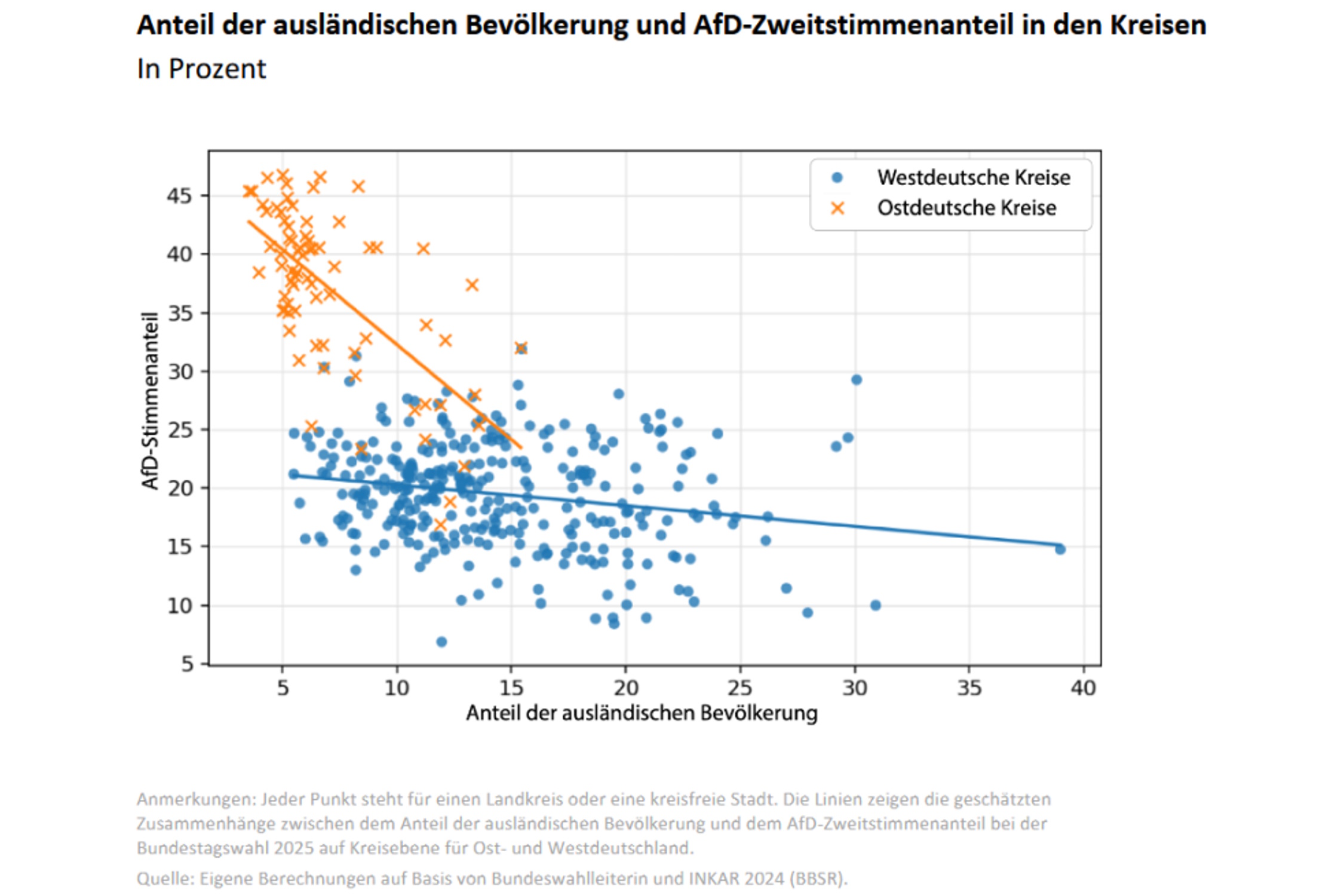
“The analysis of the link between the AfD’s electoral success and migration yields a particular finding,” states the DIW in its study: “The proportion of foreign nationals and the influx of asylum seekers are either irrelevant to the AfD’s strength or even show an inverse correlation. In eastern Germany, the AfD performed particularly strongly in the 2025 federal election precisely in those areas where the proportion of foreign nationals was unusually low. Secondly, there are significant differences between eastern and western Germany. The structural variables cannot explain the entire gap between east and west. Why the AfD is so much stronger in the east than in the west is therefore likely to be linked to historical factors as well.”
And with the demographic trend that began in 1990, characterised by a massive exodus of young, well-educated workers from the East to the West – a consequence of the widespread dismantling of industries that were no longer competitive and the loss of millions of jobs.
It’s demographics, demographics, demographics
But this has direct demographic consequences: many young people either started families in the West, did so much later than expected, or not at all. In the 1990s, birth rates in the East fell to a historic low. The direct consequence was that, 20 years later, not only had the number of young people in education halved, but so too had the birth rates. Put simply: there were fewer and fewer children in the East.
This has not only had severe psychological effects on an increasingly ageing population. It has also had dramatic economic consequences, as the economy is consequently lacking young workers. The only reason this is not so noticeable is that the East, from 2015 at the latest, also benefited from immigration from abroad. Immigrants filled the gaps in many sectors where there had long been a shortage of young workers – right through to the care sector and hospital operations.
Wrong cause, wrong solutions
It bears repeating: anyone who singles out migration as the cause of the problems in the east, or in Saxony-Anhalt in particular, is not only offering the wrong explanation, but also the wrong solutions.
And yet it is plain to see that the AfD’s election results are directly linked to structural weaknesses, not only in eastern German regions.
The DIW states in its study on this: “Another key finding concerns political polarisation. This has increased significantly between the 2021 and 2025 federal elections: many of the structural factors have since grown in importance, and their effect has, in some cases, doubled.
This means that structural differences between regions have a significantly greater influence on people’s voting behaviour than was the case in 2021. Structural upheavals and the shocks of globalisation also favour right-wing populist voting choices in other countries; at the heart of the matter lies a relative loss of social status and concerns about the future.”
And then the DIW makes its point very clear in its analysis – and this is not merely an appeal to the AfD: “The implication for policymakers is that they are setting the wrong priorities if they narrow their focus too much on migration and economic factors in an attempt to win back protest voters and voters from the anti-democratic AfD.
At the same time, it is true that structural changes are much more difficult to bring about. A shrinking population cannot easily be transformed into a growing one – certainly not if one fights immigration tooth and nail. Intolerance and the attack on an open society not only result in people from abroad not coming or leaving again, but also in many well-qualified, young Germans without a migration background leaving the affected regions.”
An ageing country
This means that the AfD’s anti-immigration policies would further exacerbate the exodus of young people from Saxony-Anhalt and worsen the state’s economic problems.
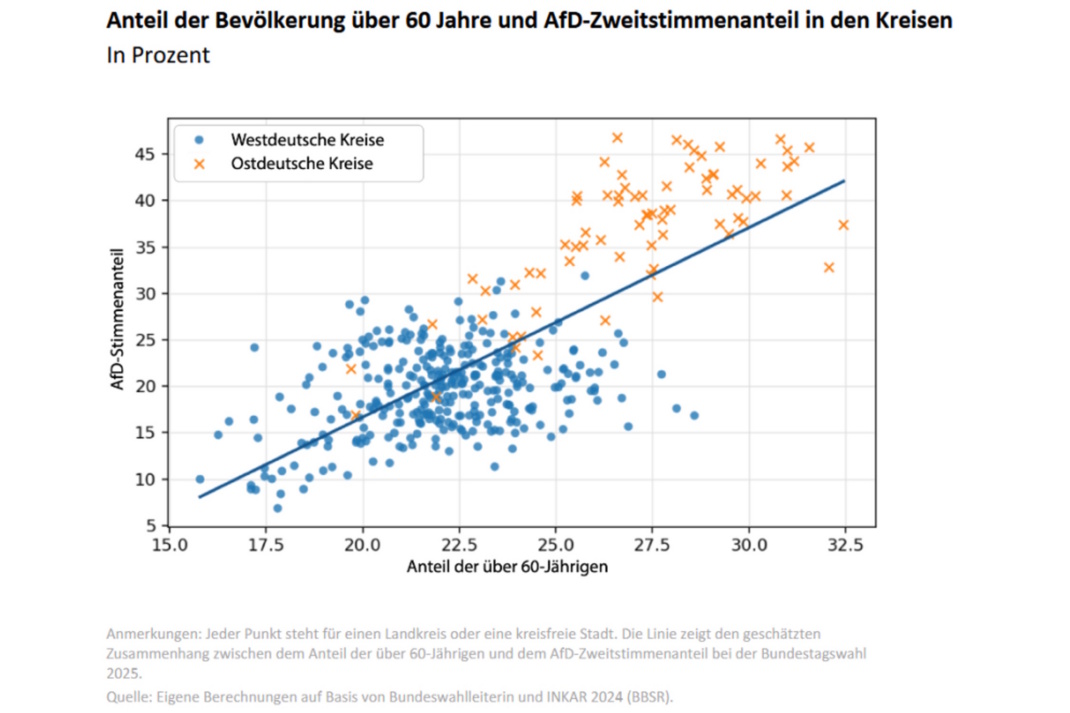
And as the DIW also emphasises: “By far the most important variable is demography. In areas where there are particularly large numbers of people over the age of 60 and where young, well-educated people are moving away – which also leads to a significant drop in the proportion of those remaining who have passed their A-levels – the AfD secures significantly more votes. This is a key explanation for the AfD’s strength, particularly in many structurally weaker regions of eastern Germany. Added to this is a high density of small craft and trade businesses – an indication of the vulnerability and job insecurity faced by a relatively high proportion of the workforce.”
And what is alarming about the study is that the very strategies the AfD uses to win over its voters would actually serve to exacerbate these effects. Saxony-Anhalt would lose even more ground when compared with other federal states. Frustration would continue to grow. And the paradox is that this would then likely play into the hands of the AfD once again, as it is this very frustration that fuels its electoral success.
The DIW’s brief study can be found here.
Empfohlen auf LZ


So können Sie die Berichterstattung der Leipziger Zeitung unterstützen:



There is one comment