Dieser Artikel ist auch in deutscher Sprache verfügbar: Zum deutschen Artikel.
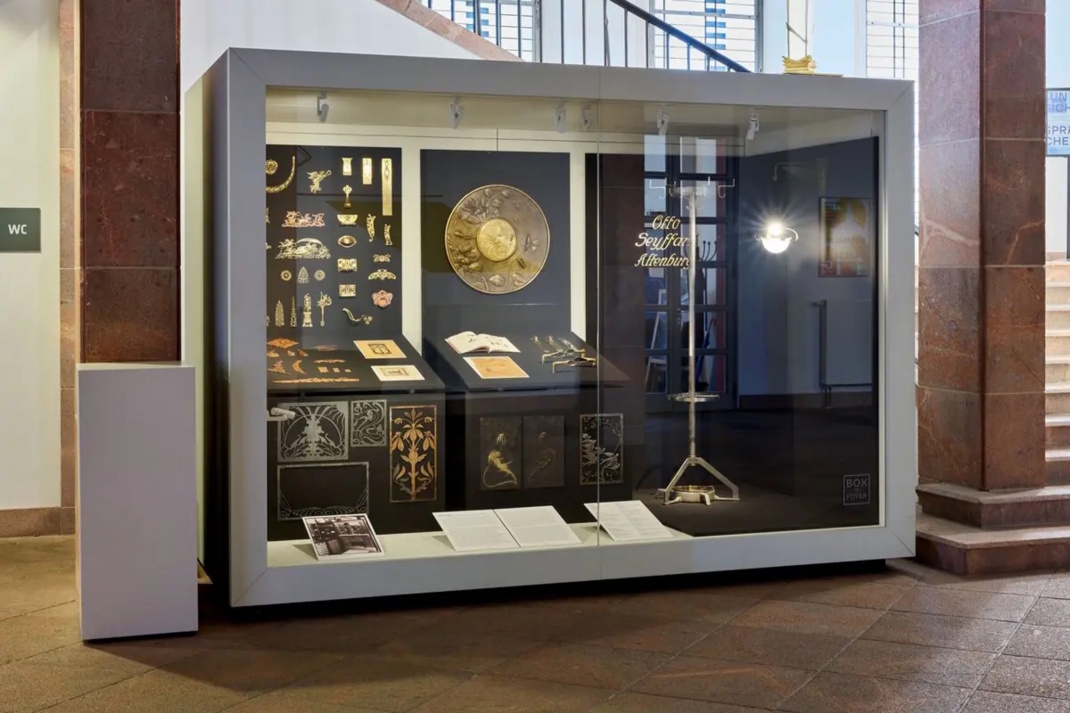
At the Grassi Museum of Applied Arts, visitors can regularly admire treasures of historical craftsmanship from the Leipzig region. Since 19 July, for example, the museum has been hosting the special exhibition ‘Metalwork! The Otto Seyffart Company, Altenburg’. It runs until 4 October. The Altenburg-based company Otto Seyffart was one of the major players in the Central German metal goods industry.
The craft enterprise, which employed only a few journeymen when it was founded in 1851/52, initially specialised in hinges, tin tins and purse clasps. Now organised as a metal goods factory, the Seyffart company expanded its product range by the turn of the century to include furniture fittings, home accessories, lighting fixtures and architectural decorations. At its peak, with up to 350 employees, production expanded across several sites in Altenburg and an export business reaching as far as North America.
The extensive range catered to a broad spectrum of middle-class tastes and income brackets. It encompassed both mass-produced industrial goods and unique pieces, and, alongside the ever-popular historicist styles, also featured designs representative of modernism. In the years around 1900, the Seyffart company made a name for itself with lighting fixtures and door fittings of a high artistic standard, the designs for which were provided by Henry van de Velde, Ernst Barlach, Otto Pech and Karl Krebs, amongst others. There is no doubt that this collaboration contributed to the company’s reputation.
Now run by Walter Seyffart in its third generation under the name ‘Otto Seyffart. Workshops for Artistic Metalwork’, the Seyffart company had been a regular exhibitor at the Grassi fairs since 1927. During the GDR era, the company was initially able to continue operating as a private enterprise, but following the death of its last managing director in 1975, it was transferred to the State-Owned Trade Organisation for Fine Arts and Antiques and became one of ten workshops within the State Art Trade.
Following its liquidation in 1991, the Seyffart firm largely faded into obscurity. The research carried out by Harald Wetzel and the meticulous preservation of the family history by Walter Seyffart’s grandson, Dirk Adena, are particularly commendable. Thanks to his extensive donations, the museum possesses a representative collection of the range of metalware, as well as significant objects from various stages of production, such as stencils, raw materials, casting moulds and drawings. It also houses parts of the company archive, product catalogues, order books, photographs and correspondence.
‘Fittings! The Otto Seyffart Company, Altenburg’, a special exhibition at the Grassi Museum of Applied Arts, 19 July to 4 October. Admission is free.
Empfohlen auf LZ

So können Sie die Berichterstattung der Leipziger Zeitung unterstützen:


There is one comment