
Dear young people, dear Gen Z – or whatever you call yourselves – our coalition government has passed a law that is certainly in your best interests. In recent years, there has been much talk about the unspeakable Academic Fixed-Term Contracts Act (WissZeitVG) and the chain of fixed-term contracts that have become untenable for young academics. That discussion is now over; we have a new one.
The debate about the WissZeitVG is now obsolete!
In its wisdom, on 18 November 2026 the Federal Cabinet adopted a
draft bill which, whilst not reforming the WissZeitVG, is intended to incorporate the
practice of successive fixed-term contracts – its defining feature
– into general labour law. 
What does the ‘Act Amending Certain Provisions of Labour Law and on the Protection of Co-determination in Companies’ say? The text states the following regarding fixed-term contracts: ‘The scope for fixed-term employment contracts without objective grounds is to be temporarily expanded. Furthermore, in future, a written form will suffice for agreeing a fixed term.’ Strictly speaking, a WhatsApp message will be sufficient for this in future. There is more, but nothing favourable for employees in the draft bill.
In concrete terms, this means that the regulations governing fixed-term contracts without objective grounds are being relaxed; strictly speaking, one could almost say they are being abolished. Nikola Elke Brenner, a solicitor specializing in individual and collective labour law at the Hamburg law firm Möhrle Happ Luther, describes this in her article.
“Fixed-term contracts without objective grounds are to be permitted for up to 48 months, with up to six extensions, for employees hired up to 31 December 2030. Previously, the maximum was 24 months with three extensions. The ban on prior employment is also set to be lifted for this group. Furthermore, the requirement for written form is to be abolished upon the new regulations coming into force and replaced by the text form.”
Admittedly, this isn’t exactly the provision in the WissZeitVG, where the limit is six years, but what isn’t in place now can still be changed through an amendment by the end of 2030. So, dear postdocs and others in the academic sector, you are no longer alone with this problem.
Why is Gen Z angry?
The situation described above is probably just one of the reasons. Young people are expected to enter the workforce earlier, whilst at the same time they are expected to work longer and, when starting their careers or changing jobs, to accept the uncertainty of a four-year chain of fixed-term contracts. They are rightly sceptical whether, at the end of the day, after 50 years of work, they’ll still be able to live with dignity on any sort of retirement provision (the word ‘pension’ will probably no longer be found in the Duden dictionary by then). And, as if that weren’t enough, young people are expected to defend this future.
If things go wrong and someone doesn’t find a job straight away after the four years (note: this applies to other generations too!), they’ll be mocked by the current Chancellor, GTA VI-style. Take that – there’s no more basic income!
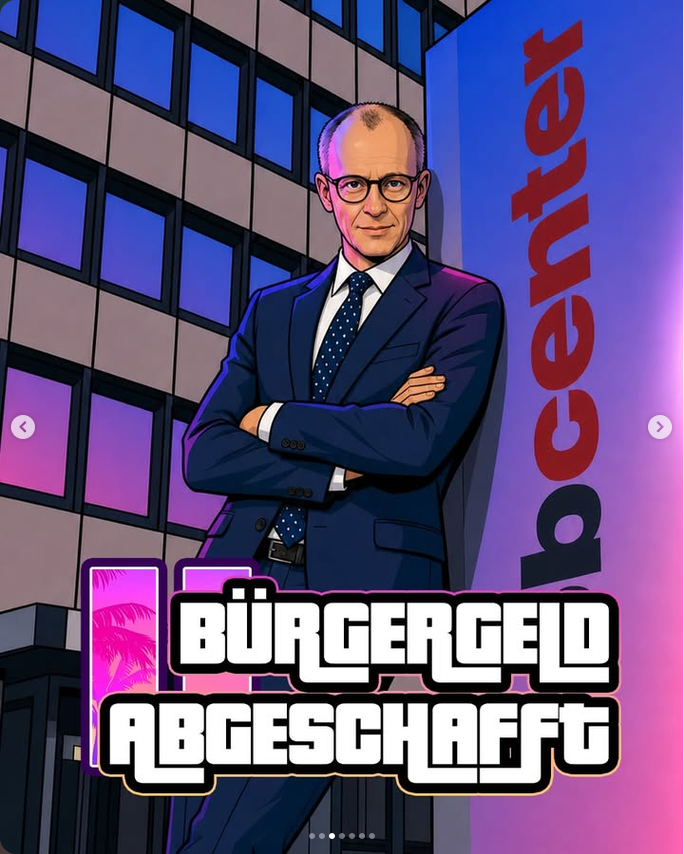
So if it takes a while to find a job, you have to take whatever you can get. Very much in the spirit of Schröder’s SPD-led Agenda 2010, which led to a huge low-wage sector in Germany. People took jobs that were far below their qualifications and were paid so little that they still had to beg the benefits’ office for top-up payments. The SPD’s approval in the Federal Cabinet thus follows a tradition.
Be glad you’ve got (any) job at all
Perhaps the younger generation – and indeed some older generation – don’t want to hear that again. Especially at a time when the wealth gap between the poor and the super-rich is widening ever further. At a time when managers are still paying themselves bonuses running into millions, despite economic missteps that can already be described as historic. At a time when a government is relying on ‘tried-and-tested’ technologies, on products that can no longer be sold internationally, and on production methods that harm the environment and the climate. Yes, there is also ‘cutting-edge technology’, known as AI; you’ll then be allowed to train it in a series of fixed-term contracts, so that it can possibly replace you.
Is it a desirable goal for young people to have any job at all in this broken economy? From a material point of view, for most people there is no alternative, but it does not bring satisfaction or happiness.
By the way, just as an aside: the self-proclaimed political alternative doesn’t even have a clue how to solve these problems. Just like the parties they call the ‘old guard’, they rely on a work ethic in the sense implied by the article’s headline.
Do boomers understand Gen Z?
It’s a difficult question to answer; Friedrich Merz, at any rate, certainly doesn’t. The author, born in 1957, sometimes had to look deep within himself and ask: What did I want when I was 18? To be honest, it wasn’t my heart’s desire to work 8.75 hours a day, with 18 days’ holiday – Saturdays counted as a day’s holiday.
At the last class reunion for the cohort that started school in 1963, my former classmates asked themselves this very question. The consensus was: we’d all have preferred things to have been different. That wasn’t just because we grew up in the GDR.
If you ask ‘Wessis’ – those who followed in their fathers’ footsteps by training at Krupp and sat in the pub with their father and colleagues over a beer after work – you’ll hear the same thing. We weren’t any different; we simply suppressed these desires for too long and eventually locked them away in the back of our minds. This makes it easy for many baby boomers to grumble about ‘the youth of today’ and makes their own misery more bearable.
Conclusion: Gen Z shouldn’t have to fight alone for better working and living conditions, but above all for a future worth living. If young people, just like their elders, forget their dreams and goals and become jaded, then there will be no hope left for future generations. These generations will be even smaller than Gen Z and, if nothing changes within the system, will have even less influence.
Note: The author finds the aesthetics of the GTA VI style, as used by the CDU, highly questionable. Not even a satirical intent would explain this, so it must be meant seriously.
Empfohlen auf LZ


So können Sie die Berichterstattung der Leipziger Zeitung unterstützen:





There is one comment