Dieser Artikel ist auch in deutscher Sprache verfügbar: Zum deutschen Artikel.
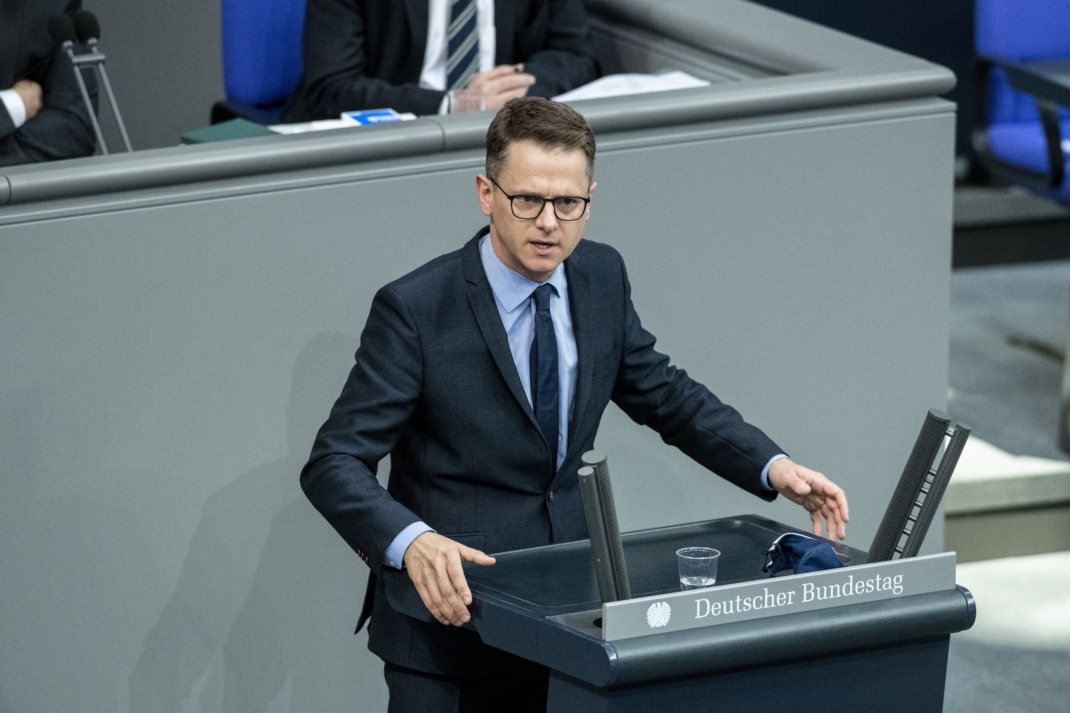
How on earth did Friedrich Merz come up with the idea of appointing the current Secretary-General of the CDU – who is completely inexperienced in health policy – as Health Minister of all people? The answer is obvious: Merz doesn’t need a health policy expert; he wants a loyal enforcer of his austerity policy. Perhaps Merz is also hoping that Linnemann, a business administrator, won’t be quite as fussy about the legal aspects of his austerity policy as Warken, a lawyer.
What qualifies Carsten Linnemann for this post?
Well, at the very least, in early 2025, following the attack in Magdeburg, he called for registers of violent offenders with mental health issues – as well as faster deportations of asylum seekers. That’s about the extent of his expertise in the field of health policy. Although, he did at least take part in the coalition negotiations on health matters. It is not known what contribution he made there.
Even back in 2025, he still had the self-awareness to realise that health was not his area of expertise:
“If they’d nominated me back then, I don’t know – I probably wouldn’t have been successful as Health Minister. People would have said: Why is he becoming Health Minister? What does he have to do with it? And that’s why: cobbler, stick to your last. Do what you’re good at.” That’s what he said in an interview with phoenix about the formation of the government, at around the 4:40 mark.
So now the business economist, who found his way into federal politics via the financial markets, is expected to solve the complex problems facing the hospital sector, general and specialist medical care, statutory health insurance and a few other minor issues.
What this is all about, and what demands – disguised as expectations – are being placed on him, can be read in the *Deutsches Ärzteblatt* of 24 July, under the heading ‘Personnel: Linnemann – High expectations of the newcomer at the Ministry of Health’.
One example is the statement by the executive board of the National Association of Statutory Health Insurance Physicians (KBV): “As a graduate in business administration with a PhD in economics, Mr Linnemann knows full well that businesses can only survive if they have planning certainty and commercial success.”
New ministers certainly know that. But does he already know how to navigate the jungle of competences and rival claims between the KBV, the German Medical Association, the Hartmannbund, the GKV-Spitzenverband, the Hospital Association, the Care Employers’ Association, the Association for the Care of the Elderly and Disabled, the Pharmacists’ Association and, last but not least, the pharmaceutical industry? Many of his predecessors have had painful experiences in this regard.
One can conclude from this appointment alone that the CDU and CSU are very short of personnel. This is also evident from the appointment of Schnieder. Merz wants to get rid of him because he cannot sort out the mess that Dobrindt and Scheuer have made at the Ministry of Transport quickly enough. He selects a replacement minister – probably in a rather high-handed manner – and when the latter then turns the offer down, this appointment is suddenly put on hold until after the Chancellor’s holiday.
Otherwise, the whole affair is less a government reshuffle than a game of musical chairs. It seems the Chancellor’s nerves are on edge. Imagine his reaction if something similar had happened to Olaf Scholz in the ‘traffic light’ coalition after just over a year in office. “He’s not up to the job!” and “We need new elections” is what Friedrich Merz would have demanded from the opposition benches.
Consider Friedrich Merz’s tweet on 15 January 2024: “If a Chancellor with such a low approval rating shows no sign whatsoever of changing his communication, his policies, or his leadership style, then he is leaving the public to deal with all the problems on their own. That is simply disrespectful.”
Conclusion: It is what it is; as leader of the opposition, Friedrich Merz knew exactly how a chancellor should conduct politics. That was also easier than actually doing it. In this specific case, I have no choice but to wish Carsten Linnemann and the new ministers yet to take office a steady hand and a steady course. I say this not so much with regard to them personally, but in the interests of everyone involved – that is, our entire society.
Empfohlen auf LZ


So können Sie die Berichterstattung der Leipziger Zeitung unterstützen:




There is one comment