Dieser Artikel ist auch in deutscher Sprache verfügbar: Zum deutschen Artikel.
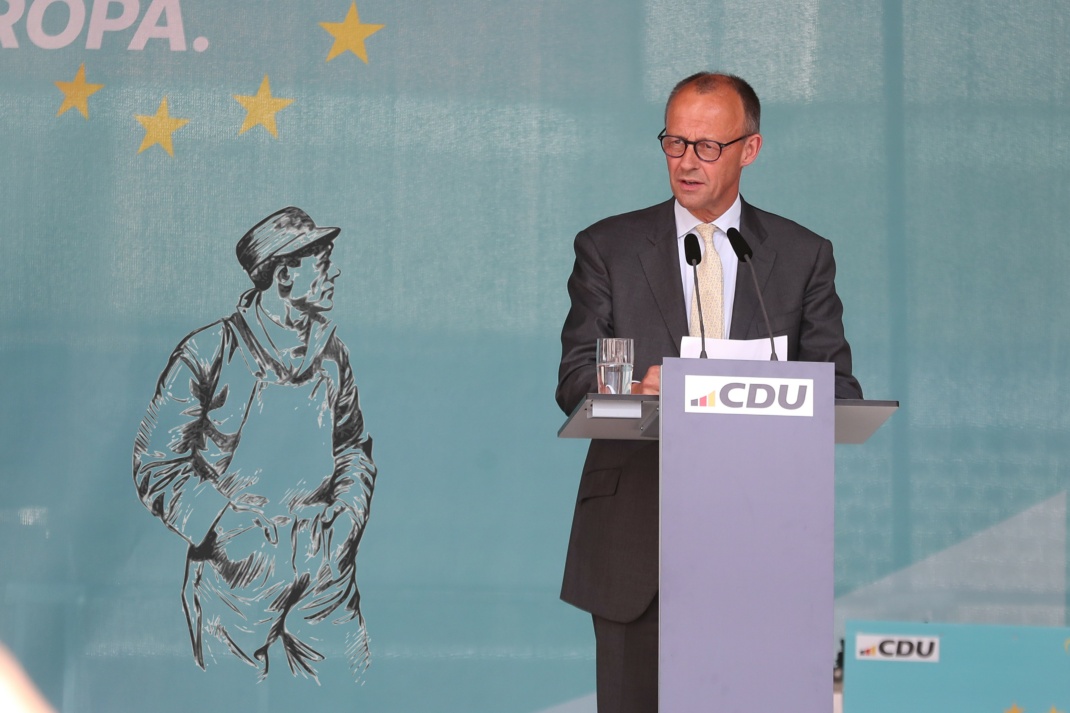
Chancellor Friedrich Merz is a heavyweight when it comes to communication – that is how he sees himself. He tries to push his agenda down the people’s throats with his verbal bludgeon and is then surprised that they do not love him wholeheartedly. Now his CDU has suffered a historic defeat in the Saxony-Anhalt election, and when he stepped in front of the cameras, he wanted to work on his communication skills for the umpteenth time.
Press conference following the election defeat
This was a prime example of Merz-style communication in action; you can watch it on ZDF heute. Following the election polls of recent weeks – and yes, I too often have my doubts about them – he says of the result only: “We didn’t expect it to turn out like this.” However, he believes we must accept it because that is what the rules of our democracy demand.
Then he brings out the verbal cudgel and lashes out at the electorate: “When nearly 60 per cent of voters in a federal state, with a very high turnout, vote for political parties that fundamentally question our country’s democratic institutions and rules of the game, then that is an election result we cannot simply brush aside.”
We really must do the maths here; after all, this applies to everyone who didn’t vote for the CDU. As of 7 September at 03:26, the AfD secured 43.8 per cent, whilst the BSW, which does not rule out cooperation, secured 5.3 per cent of the second votes. That makes a total of 49.1 per cent – so who is meant by the roughly 10 per cent that is missing from Merz’s 60 per cent? The Greens, The Left and the SPD are all hovering around 9 per cent – so every voter, apart from CDU voters, should feel addressed.
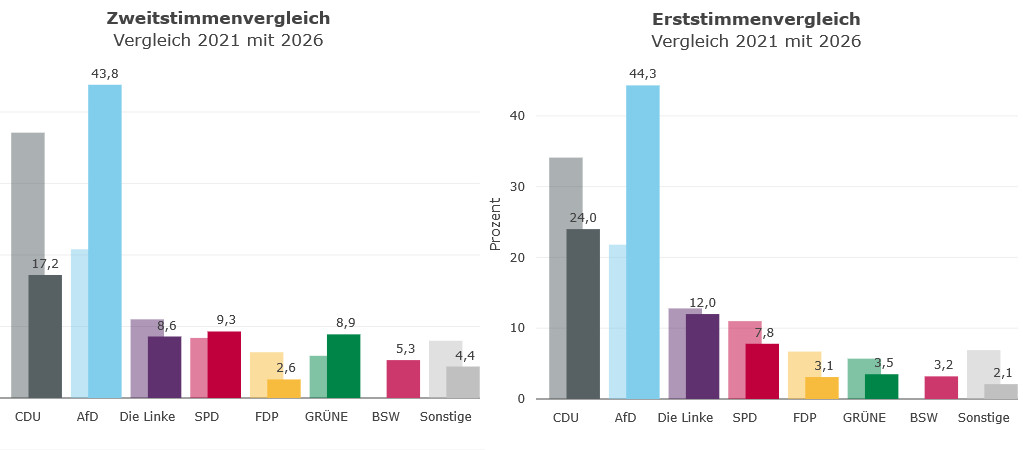 Results of the 2026 state election in Saxony-Anhalt. Source: State Electoral Commission
Of course, Merz doesn’t mean it like that – why doesn’t he say quite clearly who he is referring to?
We need to explain it better!
Yes, that is also a statement made by the Chancellor during the press conference. Before that, however, he says: “We need fundamental reforms in Germany. The fact that we must not only justify them rationally but also convey them emotionally is now a shared task, one which I am also committed to.”
It’s enough to make you tear your hair out – yet again, the refrain: ‘Our policies are good; we need to work on our communication.’ At this point, we’d like to refer to an interview with Prof. Dr Christian Pieter Hoffmann from the University of Leipzig. We asked him:
Many people believe that politics, politicians and the government – at whatever level – no longer communicate with them, but rather over their heads. Can we simply leave that statement hanging in the air?
Politics has a tendency to interpret political problems as communication problems. It’s convenient to say: ‘We simply haven’t communicated our policies well enough, but the policies themselves were right.’ That also seems to me to have been a common reaction to the recent European elections. However, this fails to recognise that sometimes the problems do not lie at the level of communication, but actually at the level of substantive politics – at the policy level.
So it’s not down to the explanation; it’s down to the Federal Government’s policy.
Merz’s emotional appeal
As already mentioned in the headline, many people feel that Friedrich Merz connects with them on an emotional level. Just not positively. Whether he’s rambling on about lifestyle and leisure, casting a blanket suspicion on working people for abusing sick notes issued over the phone, or simply describing people as lazy using incorrect figures on annual working hours.
Quite apart from the ‘little pashas’ who are clogging up the dentists’ surgeries, the doctors as beneficiaries of the healthcare system, and those reliant on basic income support who are, of course, lazy, Friedrich Merz is emotionally very much in tune with his people. In terms of communication, he is no match for the cheerful AfD candidate, who soothes the souls of his electorate. Who cares that he has no solutions?
Friedrich Merz and the media
Merz has also completely misjudged the power of the media, particularly that of the right-wing media. Because he managed to get NIUS, Springer and others to turn against the ‘traffic light’ coalition – particularly against the ‘children’s book author’ Habeck – he believed he was in control of the game. He has now learnt the hard way that those very same media outlets can turn against him and pursue their own agenda.
The other media outlets, particularly the public service broadcasters, adhere to (too) high standards. It is difficult to use them to stir up a shitstorm. As a result, the ‘perfume salesman’ framing simply fizzled out. The concerted action by right-wing parties and media against the public service broadcasters has largely neutered them. Politicians from the AfD and BSW were given a great deal of airtime; in some cases, this is actually laid down in the rules. However, they were contradicted far too rarely, and false claims were, if at all, only addressed after the event.
Does this remind you of the tolerance-paradox too?
A vision is lacking
Even though Helmut Schmidt said in 1980, ‘Anyone who has visions should see a doctor’, we all need visions, as long as they do not arise in a religious or drug-related context.
Thus, the ‘vision’ of the AfD candidate, who wants to go back to the 1990s, apparently went down well. Counter-arguments cited included the ‘baseball bat years’, the economic collapse, high unemployment and other factors, but this did not help. However, if one looks at the figures from the 1990s, one can understand some of these nostalgic recollections; after all, memories are always rosier than reality was at the time.
For instance, at the start of the 1990s, the number of births in Saxony-Anhalt fell from 31,837 in 1990 to a low of 14,280 in 1994. By 1999, there were 18,176 births again, suggesting a surge of hope for the future. This figure remained relatively constant over the following years and then fell steadily from 2019 onwards to a historic low of 11,978 births in 2025.
Before anyone points to demographic ageing, it goes without saying that this plays a significant role. But the ageing of the population in Saxony also has something to do with people moving away, particularly young women.
If one takes the birth rate as a measure of hope or hopelessness, then many people emotionally long to return to the 1990s. Back then, after the initial disappointments, there was renewed hope that things would get better. That hope is completely lacking today.
What about the other parties?
They certainly have visions, but these are overshadowed by the shared goal of ‘Let’s stop the AfD’. This goal is particularly dominant during election campaigns, especially when it comes to ‘tactical voting’. This is seen – and here I am speaking from my own experience in conversations – as sheer desperation. It is no longer about ‘what do I want for the future’; it is solely about averting the greater evil. Many people do not feel this resonates with them either.
Conclusion: what do we need? We need a political approach that gives people hope and delivers on that hope, step by step. The hope that the current federal government seeks to inspire with its focus on the economy is one that is interpreted as ‘The rich are getting richer – what’s in it for me?’
To be honest, as far as I’m concerned, neither Friedrich Merz nor Lars Klingbeil are the sort of politicians who can inspire such hope. However, it’s also not constructive simply to vote against them and fall for the tricks of other populists.
Empfohlen auf LZ


So können Sie die Berichterstattung der Leipziger Zeitung unterstützen:





There is one comment