Dieser Artikel ist auch in deutscher Sprache verfügbar: Zum deutschen Artikel.
In recent days, two ministers from the current government have failed to go down well with affected members of the public – who are having to learn to cope with the heat and drought – due to their flippant remarks about the weather. Due to insufficient rainfall and rising temperatures, the soil is drying out right down to deeper layers. And the smaller rivers are running dry – as the saying goes, ‘they’re drying up’. In the larger rivers, the ‘starvation stones’ are becoming visible due to reduced water inflow.
The lakes are heating up, causing significant additional water evaporation and leading to increased algae growth. This, in turn, results in oxygen depletion and fish deaths.
The new Federal Minister of Transport, Steffen Bilger, commented on the dried-up rivers – the Rhine, Main and Ruhr, which now barely allow inland waterway transport – stating that he cannot influence the weather, “… but we could ensure that our economy gets through these difficult weeks more effectively”.
He includes measures that might only be effective in the short term, such as halting construction work on locks, or proposals that are hardly feasible, such as temporarily relaxing the Sunday driving ban (as there are not enough lorry drivers and vehicles available at short notice) and the faster approval of heavy goods transport (which requires lengthy planning).
In the longer term, he wants to have the navigation channels of the waterways deepened. Whether that is such a brilliant idea remains to be seen. Unfortunately, all too often these are the sort of hastily conceived ideas that, upon reflection, seem rather absurd.
Deepening the navigation channels of rivers
There is only a certain amount of water that flows into the rivers on their way from the mountains to the lowlands. The inflow in the mountains depends on rainfall and water reservoirs; in the high mountains, it depends on the glaciers. The glaciers in the Alps are melting more and more rapidly as temperatures rise. In 20, 30 or 40 years’ time, there will be hardly any glaciers left.
This means that this continuous inflow will dry up in summer. Then, only the water temporarily stored in the ground and precipitation will run off the land.
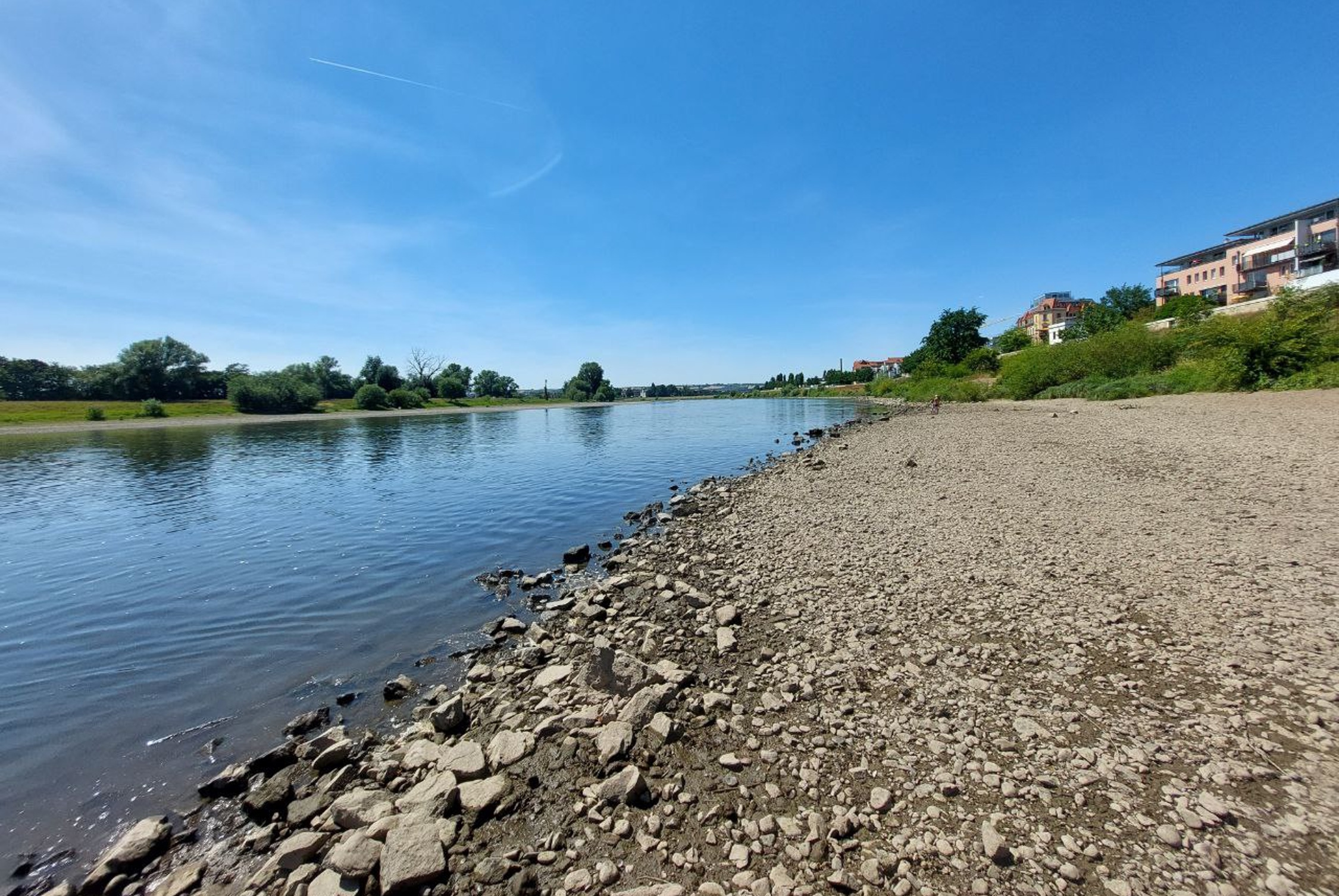
Alarming low water levels on the Elbe near Dresden. Photo: Sabine Eicker
If the river channels have been deepened accordingly, the water flows all the more quickly – unhindered – towards the sea. As a result, the rivers increasingly run dry when there is insufficient rainfall. And inland waterway transport has to be restricted or suspended for extended periods.
So, in fact, the opposite of deepening the navigation channels should be done – the water must be retained across a wider area. Either more barrages would need to be built in navigable rivers. But this too is problematic, as a barrage represents a deep incision into the river landscape and additional land must be flooded (often good agricultural land or built-up areas, of which there is a shortage). Furthermore, additional locks would need to be built for inland waterway transport, and fish ladders for the fish.
Alternatively, the river must be allowed to flow at a gentler gradient. The river would therefore need to be given more space to meander, i.e. it could once again form more bends, sandbanks or new branches. This would reduce the flow velocity. But where are these areas to come from? After all, these areas have been taken away from the river over the past centuries through the construction of dykes.
What would remain in the medium term would be water retention in the upper reaches of the rivers, and water retention on the smaller rivers and streams using weirs, retention basins, ponds and lakes, so that water can flow into the larger river in a steady and reasonably regulated manner. Wherever it is acceptable as a compromise, rainwater would therefore need to be retained within cultivated areas. Retaining water across the landscape also provides flood protection, as the water can no longer drain away too quickly. Excess water should instead be allowed to seep away.
Drought and agriculture
The Federal Minister for Agriculture, Rainer, remarked quite casually: “I can’t make it rain, otherwise I’d do it.” Fortunately, he cannot influence the weather, but he should look after the entire agricultural sector, not just large-scale farms. This also includes fruit-growing businesses, smaller part-time farms, organic farmers and community-supported farms.
Agricultural subsidies need to be reformed. Additional support should be given to farms that implement measures to preserve nature, protect the landscape and promote biodiversity; that work to protect insects and the soil; that ensure water retention on agricultural land; plant windbreaks, preserve fields with tree cover, leave flower strips in place, rewet moors, etc.
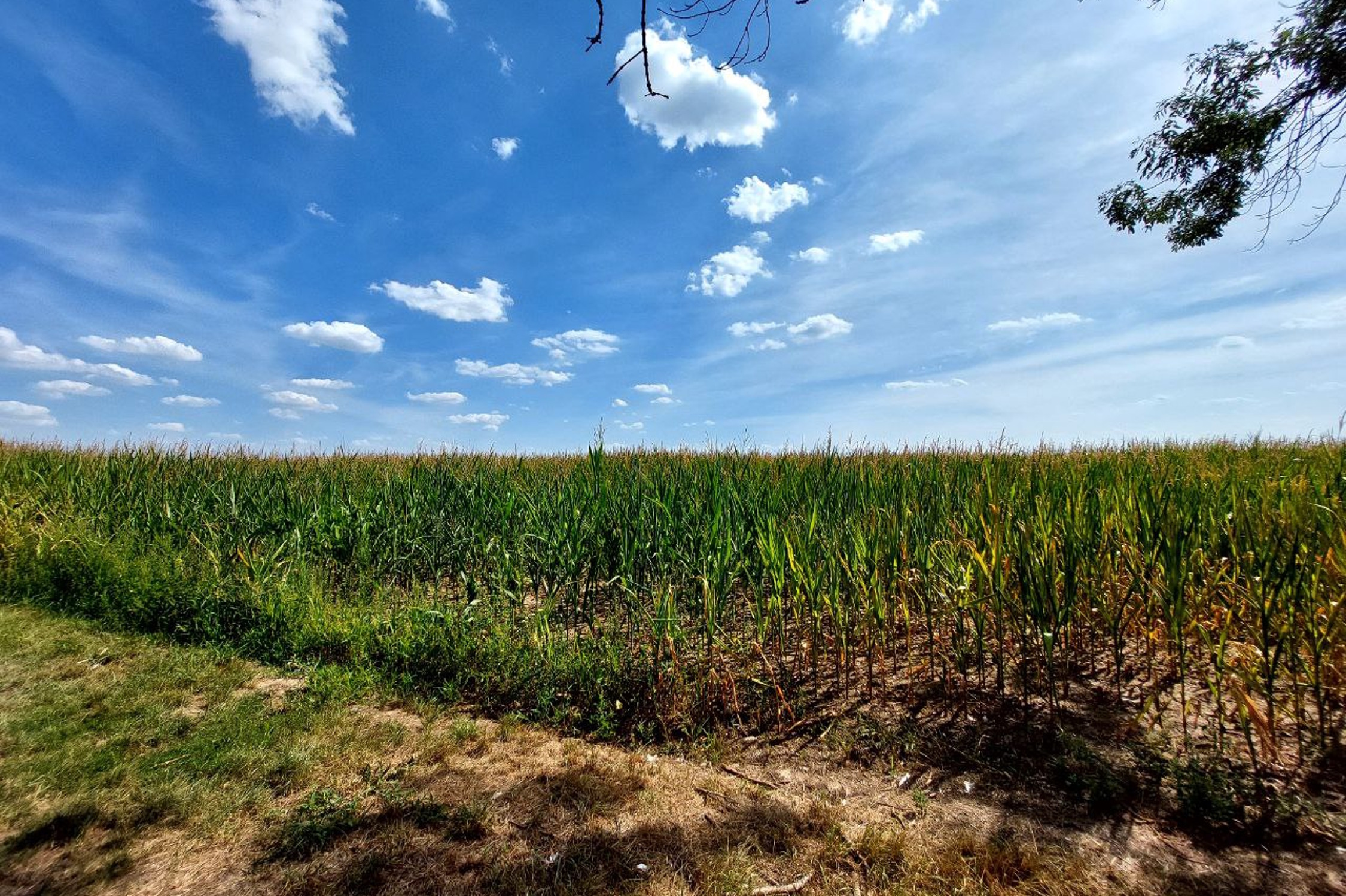
A vast maize field on the outskirts of Leipzig – without a single tree or shrub. Photo: Sabine Eicker
The large agricultural areas in the eastern federal states should be reorganised into smaller plots to reduce soil erosion and excessive water runoff, and to provide refuges for micro-organisms, birds, small animals and plants, as well as paths for village communities.
In the LZ of 15 August 2026
, Ottmar Ilchmann, agricultural policy spokesperson for the Working Group for Small-Scale Farming in Central Germany (AbL) and a dairy farmer from Lower Saxony, is quoted as saying: “Federal Minister for Agriculture Rainer’s response is now primarily to increase funding for multi-risk insurance in case of doubt – this is utterly cynical: no insurance company in the world will be able to financially cushion the massive consequences of the current federal government’s inaction in the future. This would simply create more bureaucracy, whilst elsewhere the slogan of ‘reducing bureaucracy’ is being used to deregulate protective standards.
We need a federal government that wakes up from its fossil-fuel dream and returns to reality. Convening a heatwave summit, enshrining the joint task of climate protection and adaptation in the Basic Law, and reversing the cuts to the Climate and Transformation Fund would be a necessary first step towards a solution.”
Protecting our soils at last
Legally regulated changes to market access for food producers are required, as are measures to improve animal welfare and a reduced VAT rate for healthy, vitamin-rich produce. Organic farmers must also become the owners of the land they use. Land must not be treated as an object of speculation.
This irreplaceable asset – cultivated soil – must be treated with far greater care than has been the case to date. The loss of humus-rich soil is one of the major, largely overlooked disasters of our time. Between 20 and 40 per cent of the Earth’s land area is considered degraded, meaning that this proportion of soil is now only of limited use for food production worldwide. This results in the loss of a precious ecosystem comprising humus-rich soil and communities of plants, fungi and animals – as complex as that of tropical rainforests and scarcely less species-rich than that of coral reefs.
Through the use of agricultural machinery, artificial fertilisers and herbicides, large-scale farmers are encroaching on this sensitive habitat. In the fields, the topsoil is churned up, compacted, over-fertilised, contaminated, leached and salinised. If there is no plant cover to protect the topsoil, the upper fertile layer is eroded and blown away by the wind, and simply washed away by heavy rainfall.
The use of heavy machinery increasingly compacts the soil, preventing water from penetrating as quickly, leading to waterlogging (large puddles in the fields where the plants die off); water from heavy rainfall therefore runs off the surface, washing away the topsoil into rivers and lakes. Excessive application of slurry and fertilisers causes the soil to become acidified or salinised, rendering it infertile.
The use of pesticides and insecticides kills off soil life and destroys the small plants that serve as food for insects, micro-organisms and birds. As a result, groundwater is becoming increasingly contaminated and, in some areas of northern Germany, is now only of limited use as drinking water.
However, the real population explosion is no longer taking place in the cities, but in livestock barns. Around 70 per cent of all agriculturally usable land worldwide is used for meat production. Conversely, this means that food for human consumption is currently grown on just 30 per cent of the total agricultural land.
So if we were to restrict meat production, we could afford to move away from relying exclusively on industrial agriculture with its large-scale farming practices, with oversized, heavy machinery, monocultures, and excessive use of fertilisers, herbicides and biocides, but could instead focus far more on sustainable agriculture and the production of healthy food – in other words, on expanding organic farming.
Global fashion trends and changing lifestyles have led to increased consumption and a greater variety of fashion, outdoor and sportswear. During washing, tiny fibres and water-repellent sealants are rinsed out and end up in wastewater or, if wastewater is not treated, directly into the environment – into the soil, rivers and ultimately the sea.
Empfohlen auf LZ


So können Sie die Berichterstattung der Leipziger Zeitung unterstützen:





There is one comment