Firstly, in this case it really is referred to as ‘excessive workload’; the term ‘overtime’, which is probably what most people have in mind, is defined differently from a legal perspective.
The case of Frank Post, a civil servant headteacher at a primary school in Lower Saxony, has implications that affect many teachers across the country. That is why not only was the courtroom at the Federal Administrative Court (BVerwG) in Leipzig packed, but colleagues were also waiting outside the building.
What was the case about?
In short, the question was: Must the state of Lower Saxony pay a civil servant headteacher of a primary school for the excess hours worked?

GEW members outside the Federal Administrative Court. Photo: Thomas Köhler
It was relatively undisputed that Frank Post had worked more hours in his role than his employment contract stipulated. He also took part in the Lower Saxony Working Hours Study for Teachers in State Schools (Working Hours Study) in 2015/16 and continued to document his working hours thereafter.
Why did he have to document them?
Contrary to the judgment of the Court of Justice of the European Union in Case C-55/18 of 14 May 2019, the working hours of teachers and headteachers are not recorded, at least in Lower Saxony.
The CJEU’s judgment states the following reasoning: “The Court finds that, without a system capable of measuring the daily working time of each employee, neither the number of hours worked nor their distribution over time, nor the number of hours of overtime, can be determined objectively and reliably, with the result that it is extremely difficult, or even practically impossible, for workers to enforce their rights.”
Frank Post documented his working hours right up until he left the service. It was also undisputed that he lodged a complaint regarding excessive workload and, when this failed to bring about any improvement in his working conditions, brought an action for failure to act.
Why was Frank Post forced to work more than had been agreed?
The website of the Education and Science Union (GEW) describes it as follows: “When he became headteacher, Post developed a school in Hannover-Leinhausen that put as much of his vision of equal opportunities into practice as possible. He fostered links between the school and the local community, introduced a class council as a means of pupil participation, implemented inclusion, maintained close contact with nurseries alongside his colleagues, and campaigned for language support. Fifteen years ago, Fuhsestraße Primary School became an open all-day school. That alone, explains Frank Post, turns headteachers into managers in an era of autonomous schools with limited resources: 71 staff members from six different administrative jurisdictions had to be coordinated, ranging from cooperation partners and caterers to nursery staff and teachers.”
Before the Federal Administrative Court, this was summarized as follows: there were ever more tasks that were expected to be completed within the same timeframe. In the end, it transpired that he had worked 8 hours and 42 minutes of overtime per week.
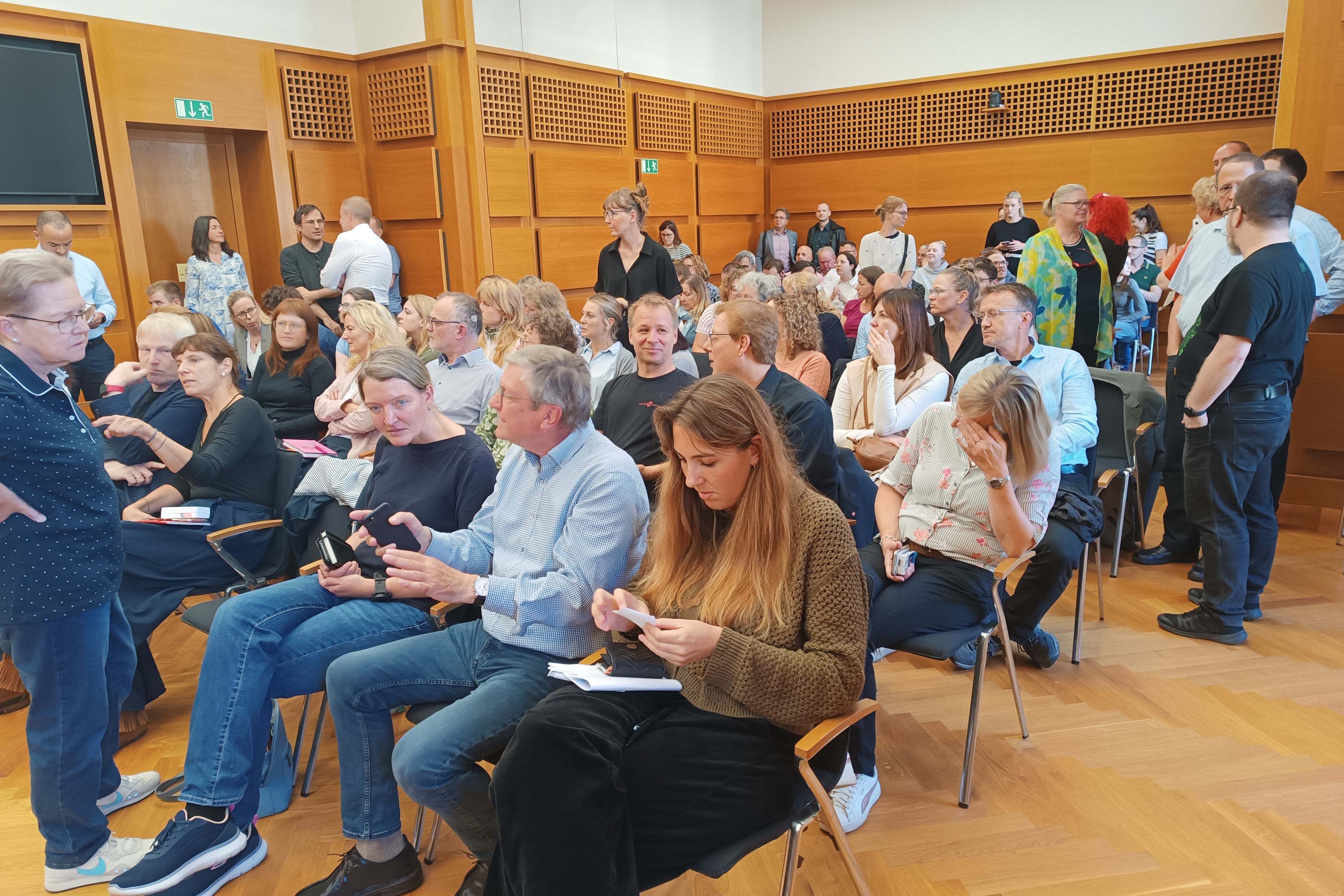
The courtroom was packed. Photo: Thomas Köhler
Frank Post brought the case, with the support of the GEW.
When no improvement materialized even after the working hours study – which the then Lower Saxony Minister for Education and Cultural Affairs described as an “important contribution to the debate on teachers’ working hours” – he brought a case before the Administrative Court in Hanover.
On the grounds that he “delegated too little”, the court dismissed the claim; on appeal, the Higher Administrative Court in Lüneburg ruled in his favour. However, the amount of overtime was reduced from 8 hours and 42 minutes to the figure calculated in the working hours study of 5 hours and 48 minutes. As Frank Post is already retired and therefore no longer eligible for time off in lieu, he was awarded compensation of approximately 31,000 euros. The State of Lower Saxony lodged an appeal against this ruling. The hearing took place on 17 September 2026 at the Federal Administrative Court in Leipzig.
The hearing at the Federal Administrative Court
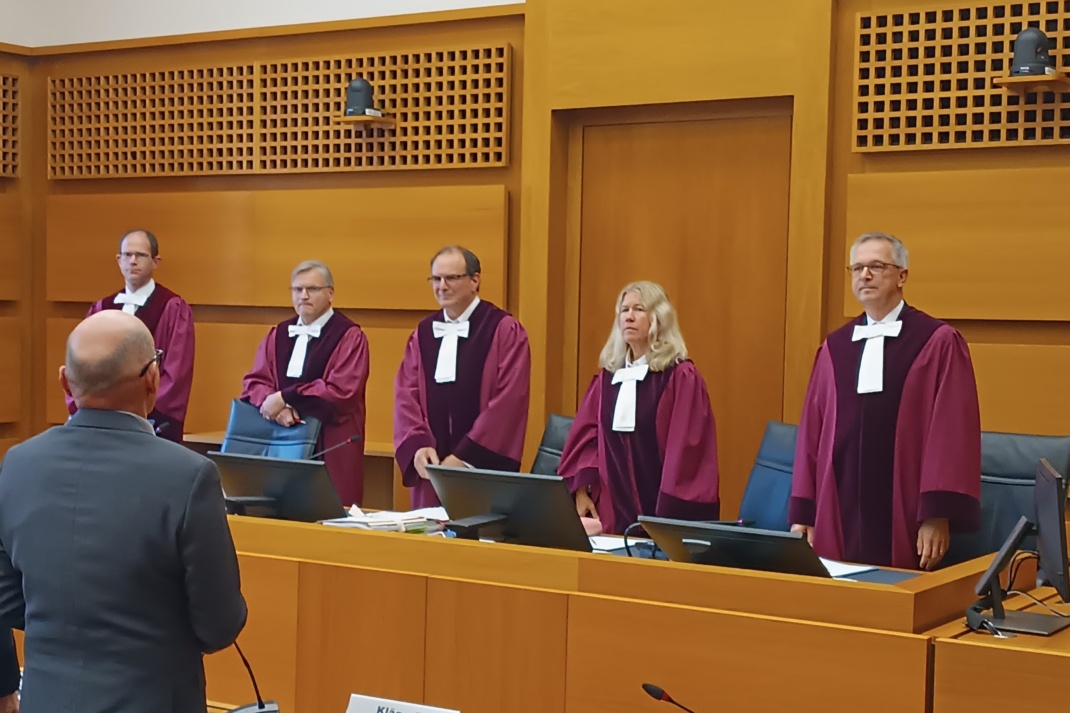
On 17 September, the Second Senate of the Federal Administrative Court, presided over by Judge Markus Kenntner, heard the case ‘Claims by a headteacher regarding excessive working hours?’.
It became clear fairly quickly during the hearing that the presentation of evidence centred on the question of ‘assignment’. Generally speaking, this means: Was Frank Post instructed by his employer to carry out excessive work? His lawyer argued, as did the Higher Administrative Court (OVG) in Lüneburg, that the imposition of ever more tasks amounts to such an instruction. The lawyer representing the State of Lower Saxony, however, argued that Post could have delegated these additional tasks. He was unable to specify to whom.
The representative of the federal government largely concurred with the argument put forward by Frank Post’s lawyer.
Judge Kenntner closed the hearing at around 1.00 pm and the bench retired to deliberate. The judgment was due to be delivered at around 4.30 pm.
Following the hearing, we conducted an interview with the regional chairmen of the GEW: Stefan Störmer for Lower Saxony and Burkhard Naumann for Saxony.
The judgment
The judgment was announced in the late afternoon; it was a sobering blow for the claimant and the trade union.
Under the heading ‘No entitlement to financial compensation in the event of an individual school headteacher exceeding their weekly working hours’, the 2nd Senate of the Federal Administrative Court (BVerwG) concurred with the arguments put forward by the State of Lower Saxony. This is evident from the very wording ‘individual exceeding’.
The grounds for the judgment state: “The working hours put forward by the claimant are, rather, based on his own independent decision and do not correspond to the employer’s requirements.” This means that there is no “assignment by the employer”.
The passage stating, ‘If, in the teacher’s opinion, the time available for non-teaching duties is insufficient, they must report excessive workload and, where necessary, postpone the performance of such duties’, is noteworthy. Unfortunately, the Federal Administrative Court provides no guidance to headteachers on how to deal with situations where postponing tasks might jeopardize the running of the school.
Conclusion: Apart from individual cases, it remains unclear how to deal with the increased workload. If teachers and headteachers ultimately accept the postponement of tasks, as described by the court, as a solution, what will happen to school operations and, in particular, to the children? We will return to this case once the grounds for the judgment have been published.
Empfohlen auf LZ


So können Sie die Berichterstattung der Leipziger Zeitung unterstützen:





There is one comment