Dieser Artikel ist auch in deutscher Sprache verfügbar: Zum deutschen Artikel.
The headline refers to the time it took for the city council to discuss and vote on a proposal that had been drawn up with broad participation from the city’s community. A section of Georg-Schumann-Straße in Leipzig, between Chausseehaus and Böhmestraße – approximately 600 metres in length – is to be upgraded. As part of this project, traffic on this rather unattractive stretch is to be reorganised.
What sparked the debate?
Since the conversion of Georg-Schumann-Straße from a four-lane to a two-lane road with cycle lanes, there have been parallel parking lanes on both sides between Bleichertstraße and Trufanowstraße. Part of these parking lanes is designated as a short-stay parking zone. According to proposal VII-DS-09678, ‘Construction and Financing Resolution: Upgrading of Georg-Schumann-Straße from Böhmestraße to Delitzscher Straße (Chausseehaus)’, these 82 parking spaces are to be officially reduced to 23. Regarding the removal of the parking spaces, the proposal states, under 2.11 Environmental Considerations: “A total of 46 new trees are planned to be planted along the road. The reorganisation of trees and green spaces will be at the expense of on-street parking.”
To prevent this, the CDU parliamentary group has tabled an amendment – described in the discussion as having been submitted ‘at short notice’. In it, they demand: “At least 80 per cent of the existing publicly accessible car parking spaces in the planning area must be retained.” Should this not be possible for compelling reasons, the group wants any additional parking spaces lost to be compensated for “as close to the site as possible”.
The discussion in the council meeting
Dienberg, the councillor responsible for building and urban development, presented the proposal and pointed out that the option put forward is the result of a lengthy process in which, from ‘Phase Zero’ onwards (note this term) “the various interest groups (.) including local business owners and residents have been involved.” He also pointed out that the window of opportunity for this measure – particularly with regard to funding – is in danger of closing. Furthermore, tram services are at risk of being suspended due to the condition of the tracks if action is not taken soon.
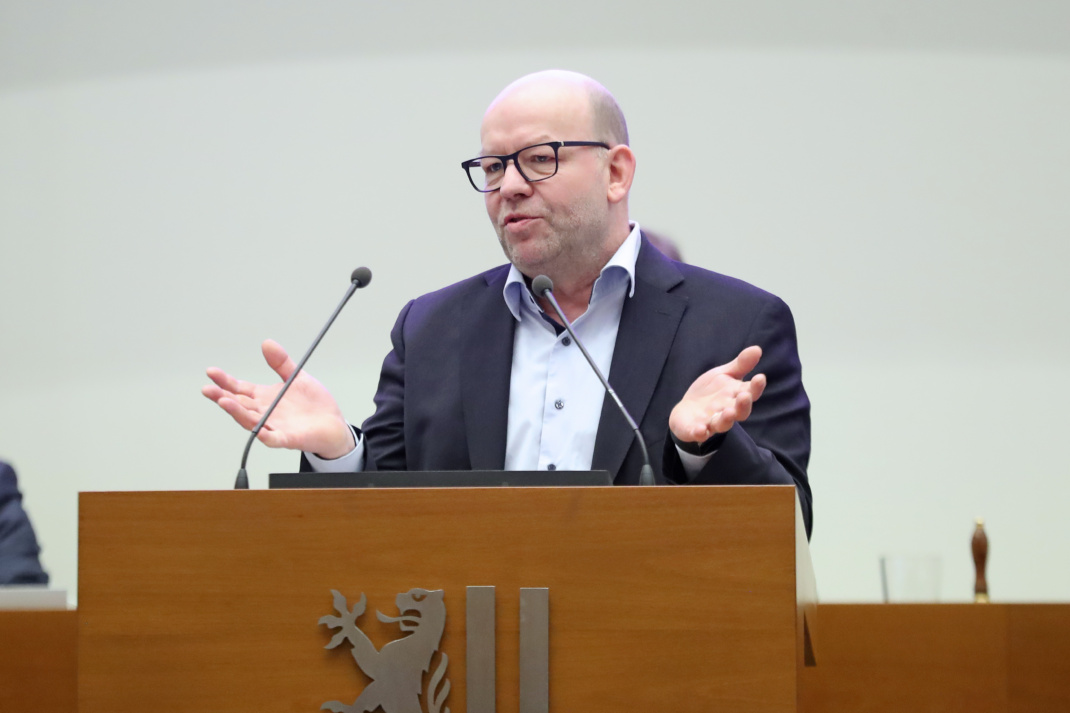
Councillor Schultz takes the floor on behalf of the proposers, and he gets straight to the heart of the matter. He recalls the previous discussions, but: “There’s always only a limited number of citizens present. And in my view, they’re usually the wrong ones.” With fewer parking spaces, accessibility will be severely restricted, he argues. He then sets out the figures: “Today, there are 82 publicly accessible parking spaces in the planning section. Only 23 are planned for the future. That means 29 parking spaces will be lost. […] That’s no minor adjustment.”
It’s not just this blunder; even when Andreas Schultz talks about the traffic count, it’s straight from the heart: “The traffic forecasts must also be plausible. Currently, the figures quoted for this section are around 15,760 to 18,400 vehicles per day. And 3,000 cyclists per day – yes, in 24 hours. Quite honestly, Mr Dienberg, 3,000 – that’s one cyclist for every fifth car. Was there a cycle race or something like that going on just now, or what? I mean, quite honestly, when you drive along there, I never see that many cyclists, but never mind.” The tabling of the amendment wasn’t exactly a masterpiece.
Franziska Riekewald (Die Linke) and Kristina Weyh (Bündnis 90/Die Grünen) followed, and, as expected, spoke against the amendment. One comment by Ms Riekewald is worth addressing, however: “Just read through the CDU’s amendment: ‘Preserving the character of the street’. That’s now supposed to be a planning objective. When I cycle along Georg-Schumann-Straße – and yes, I do often cycle there, though mostly I take the tram – I see absolutely no character there at all, just a bare, featureless road.” Yes, one ought to be a little more cautious about the ‘character of the street’ when talking about a thoroughfare that isn’t really all that attractive.
The real problem
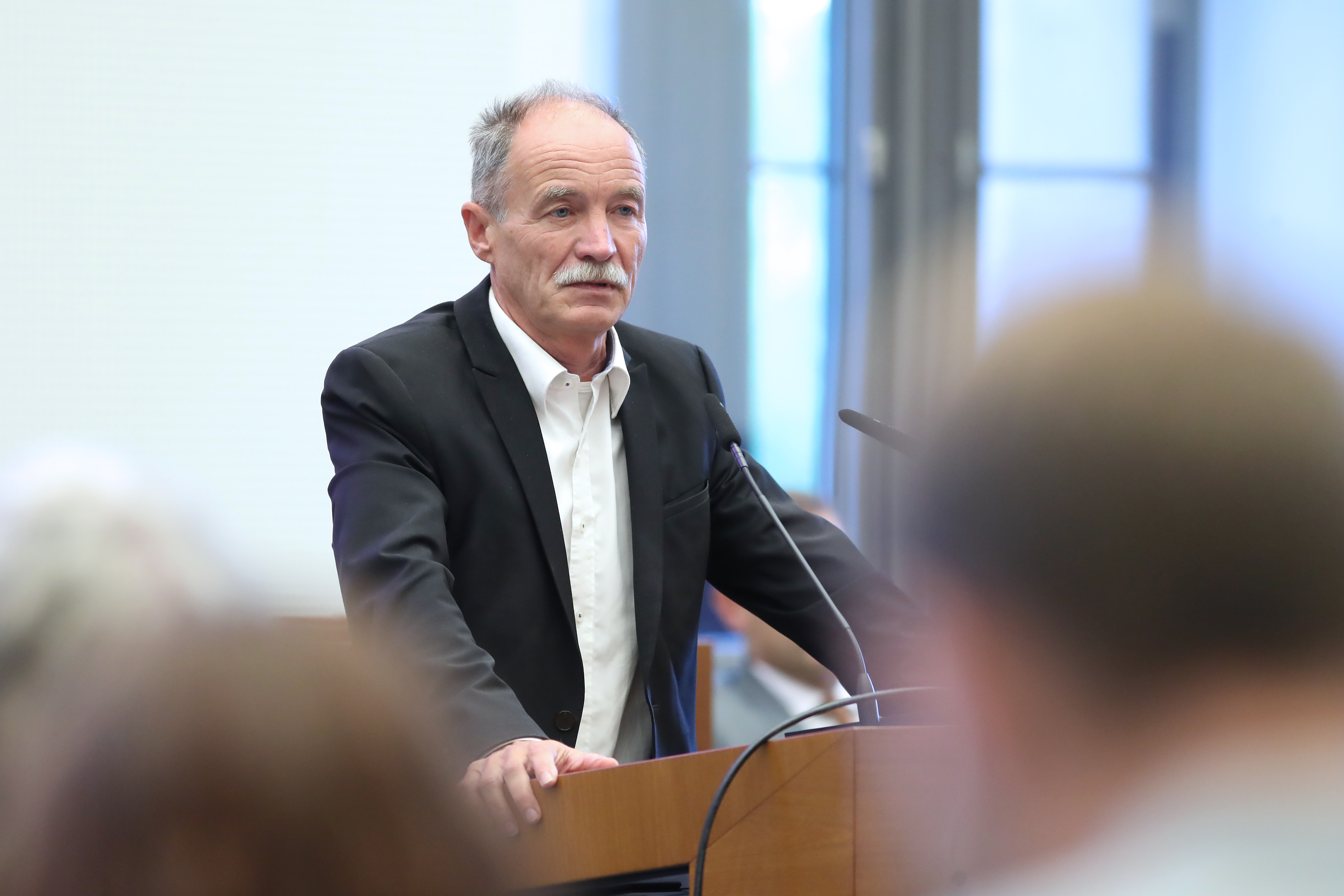
Sven Morlok (Independent Group/FDP) at Leipzig City Council on 2 September 2026. Photo: Jan Kaefer
Here, once again, Sven Morlok (FDP/Independent Group) comes into the picture with his remarks. You will recall the ‘Phase Zero’ mentioned above. Sven Morlok stated that: “This CDU motion calls into question a fundamental procedure that we agreed upon here in the City Council many years ago. One of the key figures in implementing and establishing this procedure within the city was Dr Heymann. Dr Heymann, you, together with other colleagues from various political groups, campaigned for early public participation, namely a so-called ‘Phase Zero’. This was simply to prevent a situation where, when we have decisions on construction and funding here, motions from political groups would effectively overturn preliminary planning that has cost a great deal of money and effort.”
You don’t have to like Mr Morlok, but he does get to the heart of the matter. Why should the city administration with its departments, the LVB and other stakeholders carry out this ‘Phase Zero’ and the subsequent phases of public participation if, at the eleventh hour, a motion throws everything out the window?
The subsequent speeches did not yield much in the way of new insights. In the end, a vote was taken, and the CDU parliamentary group’s amendment was rejected by 25 votes to 32, with 2 abstentions.
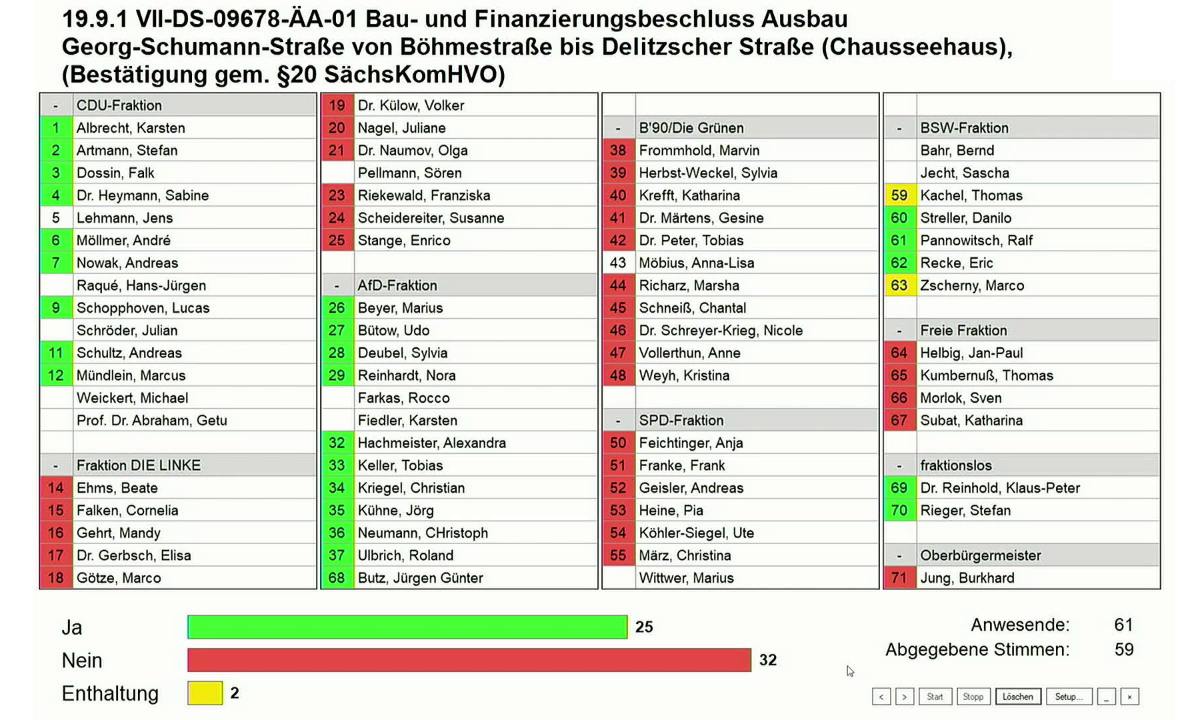
Vote on the amendment. Screenshot LZ
The proposal was approved by 38 votes to 10, with 11 abstentions. The scoreboard showed a different result; one vote was subsequently disregarded.
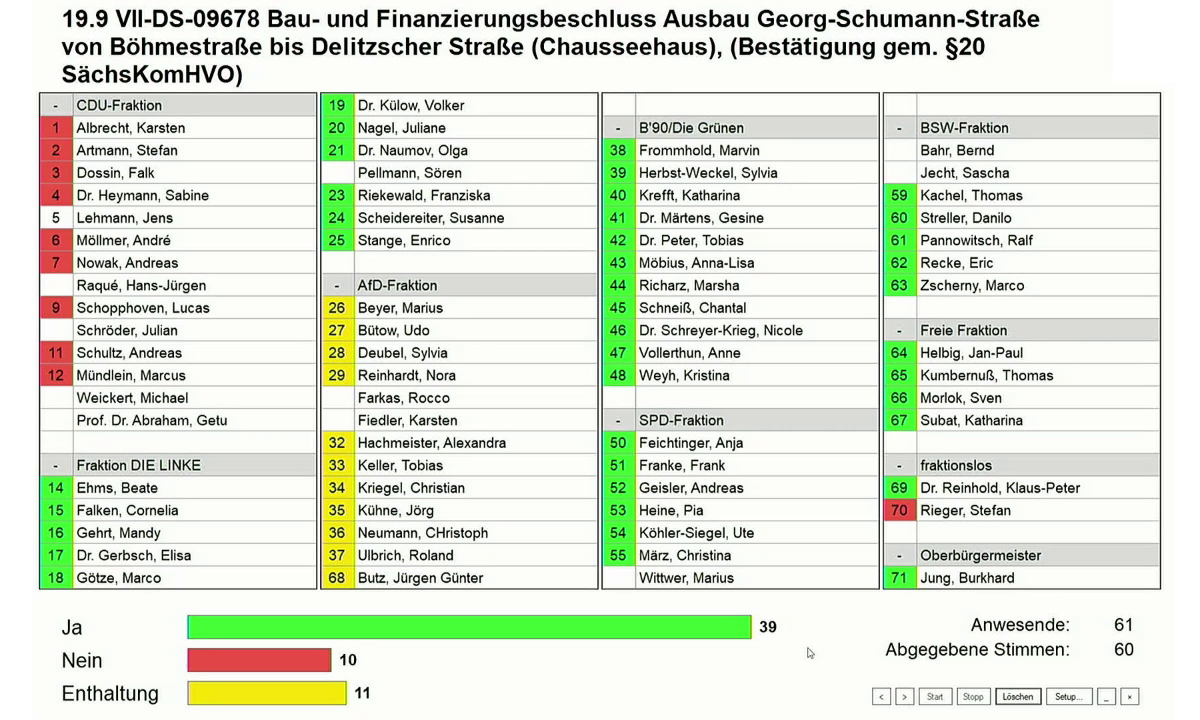
Vote on the motion. Screenshot LZ
Conclusion
: It was a discussion lasting more than half an hour, which really belongs in the specialist committees. Furthermore, it was a disregard for those involved in the consultation process when Andres Schultz suggested that only the ‘wrong’ people were taking part.
One of these stakeholders, the Bürgerverein Gohlis e. V., wrote to us on the matter: “The attempt to prevent the felling of 46 planned trees and the removal of green spaces by invoking alleged grandfathering provisions falls short. A modern high street thrives on its quality of stay, microclimate and accessibility. In light of the extreme weather events of recent years, clinging to outdated planning standards from the last 50 years is no longer tenable.”
Empfohlen auf LZ

So können Sie die Berichterstattung der Leipziger Zeitung unterstützen:





There is one comment