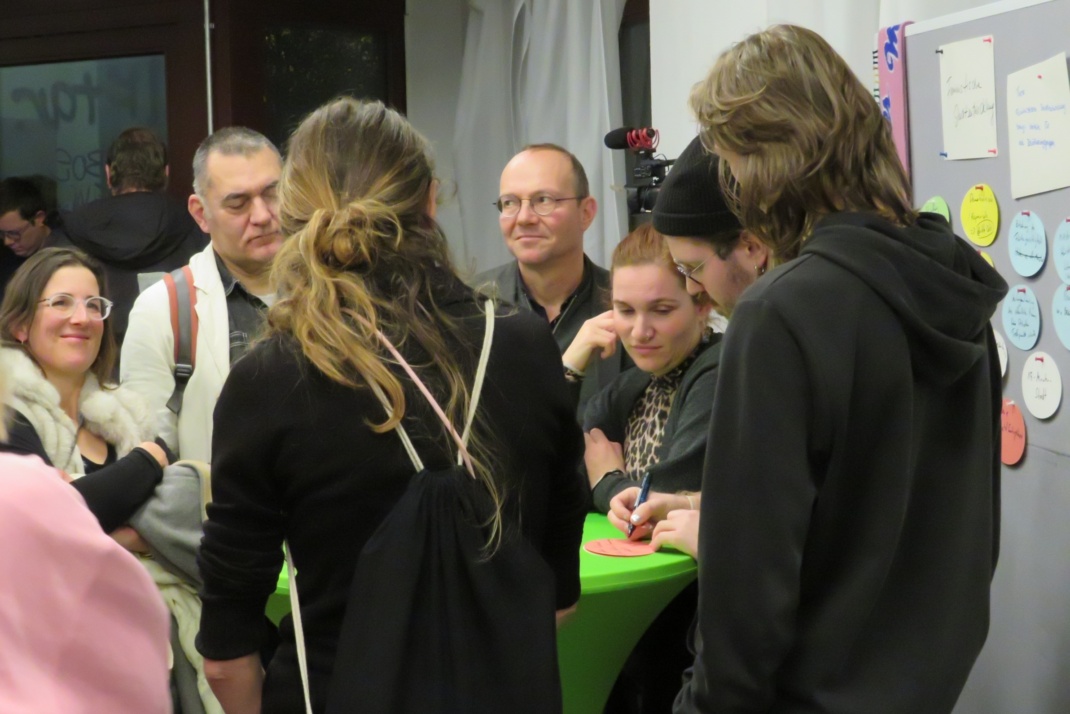
For the second round of the “Leipzig rede mit!” public forums – this time focusing on mobility and urban development – mayoral candidate Wolfram Günther had invited people to the Pöge-Haus on 23 November. So many interested people turned up that there was barely enough room.
As at the first event, Claudia Maicher chaired the session and
Wolfram Günther gave a brief introduction to the topic. Among other
things, he pointed out: “The City of Leipzig is by no means lacking
in plans, policy decisions and strategies. A good, integrated urban
development concept, a sustainable mobility strategy for 2030 –
it’s all there. The only question is: is it actually being
implemented consistently, and followed through consistently? Are
the priorities and resources being channelled precisely where
they’re needed, and is there proper dialogue with people about what
is really required?” 
Contribution by Prof. Martin zur Nedden
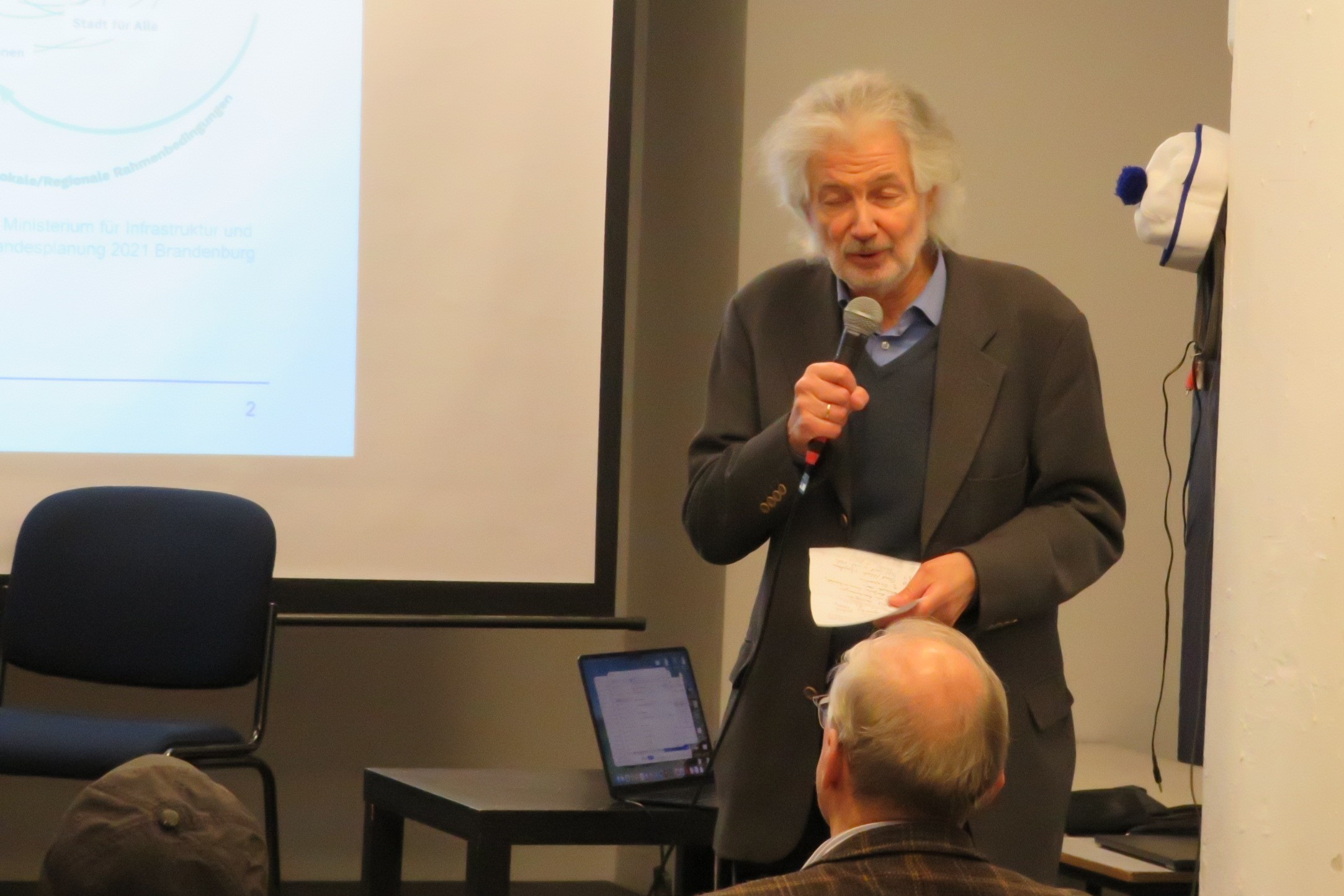
Prof. Martin zur Nedden delivering his presentation. Photo: Thomas Köhler
The first presentation on the topic was given by Prof. Martin zur Nedden, who served as Deputy Mayor for Urban Development and Construction in Leipzig from 2006 to 2013 and as Scientific Director and Managing Director at the German Institute for Urban Studies (difu) until 2018. Right at the start, he pointed out that he could not cover a whole semester’s worth of sustainable urban development in five minutes; it ended up taking 15 minutes, but nobody found it boring. In a tour de force, he guided the audience through the topic; we can only touch on a few brief highlights here. On the subject of housing construction, there were two statements designed to give pause for thought: “We do not have housing problems in general, but we do have problems in the area of affordable housing, particularly in the area of social housing, where we have to deal with the fact that, due to German regulations, more flats fall out of the right to occupancy each year than new social housing units are built.”
With regard to the constant reference to the excessive processing times for planning applications, he explained: “That said, planning permissions are not the problem either, as we have a nationwide backlog of planning permissions for around 700,000 homes. This means that 700,000 flats have been approved but have not yet been completed – in some cases, work hasn’t even started. Leipzig also has a backlog of planning permissions. This means we have considerable potential, if you recall the figures: 300,000 flats are needed per year. 800,000 have already been approved, which means that, in terms of the figures, we would have absolutely no problems for two years.”
There was much more to it, but this brief overview illustrates the implementation problem highlighted by Wolfram Günther here as well.
We asked Martin zur Nedden:
What has happened in Leipzig over the last 13 years, and
where do you see a need for action?
A great deal has happened, not least because these significant
growth processes began around 2010, bringing with them all the
positive consequences such as more jobs and the development of
neighbourhoods that had previously struggled to gain momentum, and
so on. A great deal has happened, and, in my view, ultimately in a
thoroughly positive way. At the same time, of course, such
processes – not only in Leipzig but everywhere – are linked to
developments that present a challenge. Leipzig, too, now has to
give serious thought to how, for example, sufficient housing –
particularly affordable housing – can be created, to name just one
issue. In this respect, the challenges for the future will lie in
finding integrated solutions to the major challenges: housing
needs, climate change, climate adaptation, sustainable mobility,
and a resilient economic structure that can also cope with changing
conditions.
Input from Superblocks
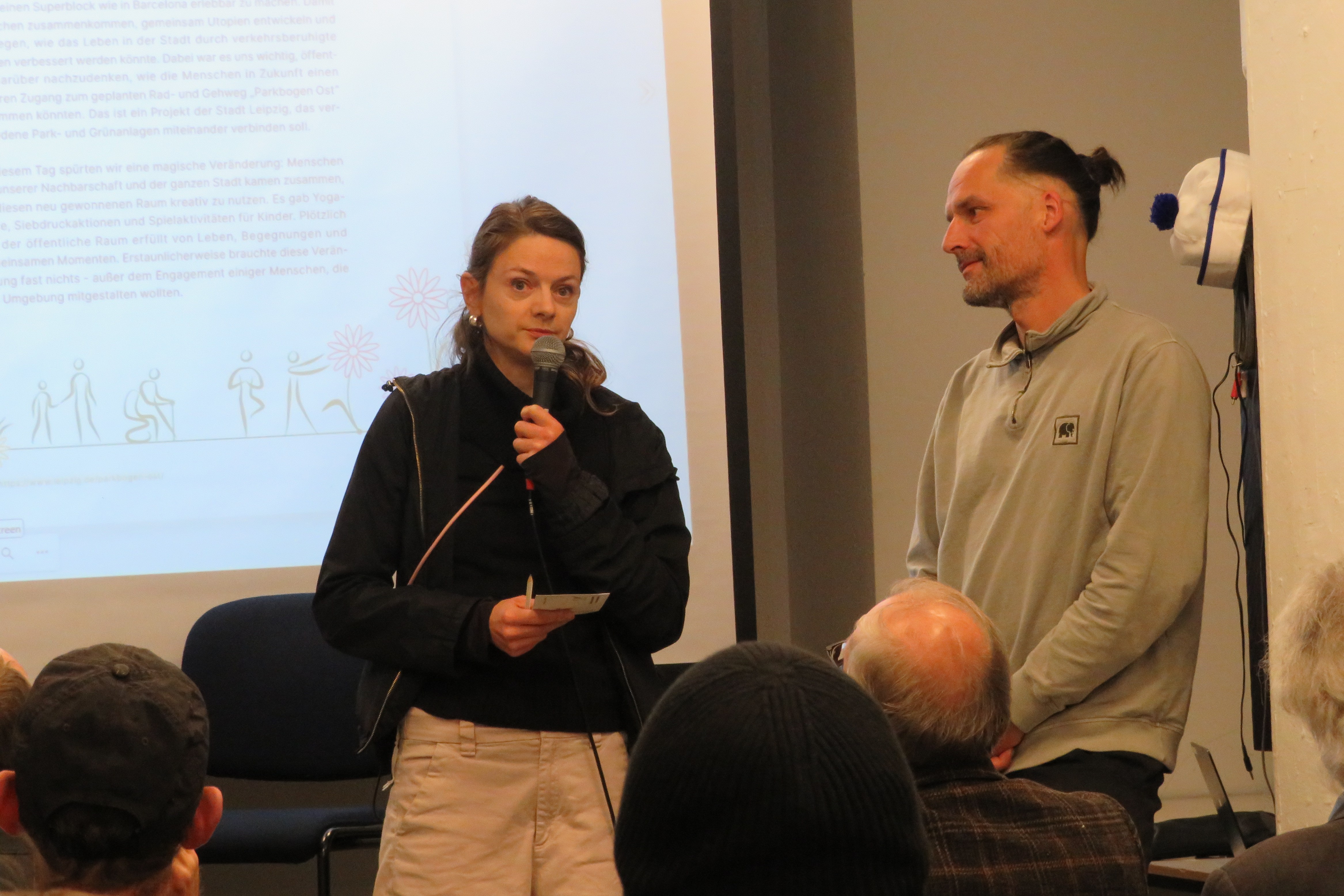
Cornelia Bischoff and Matthias Petzold from SUPERBLOCKS Leipzig e.V. Photo: Thomas Köhler
Cornelia Bischoff and Matthias Petzold from SUPERBLOCKS Leipzig e.V. spoke about their project and their experiences with sustainable urban development at neighbourhood level. We spoke to Matthias afterwards.
Matthias, what are these Superblocks and what has been your experience with the project here in Leipzig?
From our point of view, the fundamental idea isn’t to change the city and introduce a new traffic scheme with the new road layout, but rather to create a space where people can experience what life in a neighbourhood could be like. When through traffic is removed, when the streets are redesigned and a pleasant environment for spending time is created. That was actually the aim. The fact that we’ve come this far with the project was essentially down to the efforts of everyone involved, whether that was the advisory board, initiatives, residents or political parties. The local authority adopted this as a concept and finalised a participation plan, which can also be downloaded online, and now the area is being redesigned bit by bit.
There were, particularly in the run-up to the last city
council election, a number of objections from various political
parties claiming that the concept had not proved its worth. What is
the situation now?
I’ve looked at the results of the latest surveys, and the majority
view it positively. Of course, people still have ideas, and some
have different needs and suggestions – that plays a part. But I
believe all the hype that arose during the election campaign has
died down, and even the opponents now recognise the benefits. For
example, the fact that through traffic has been eliminated and we
now have more quiet periods in the neighbourhood. But also that
delivery zones have been set up, which actually provide a sensible
solution for local businesses as well.
Input from Prof. Roland Müller
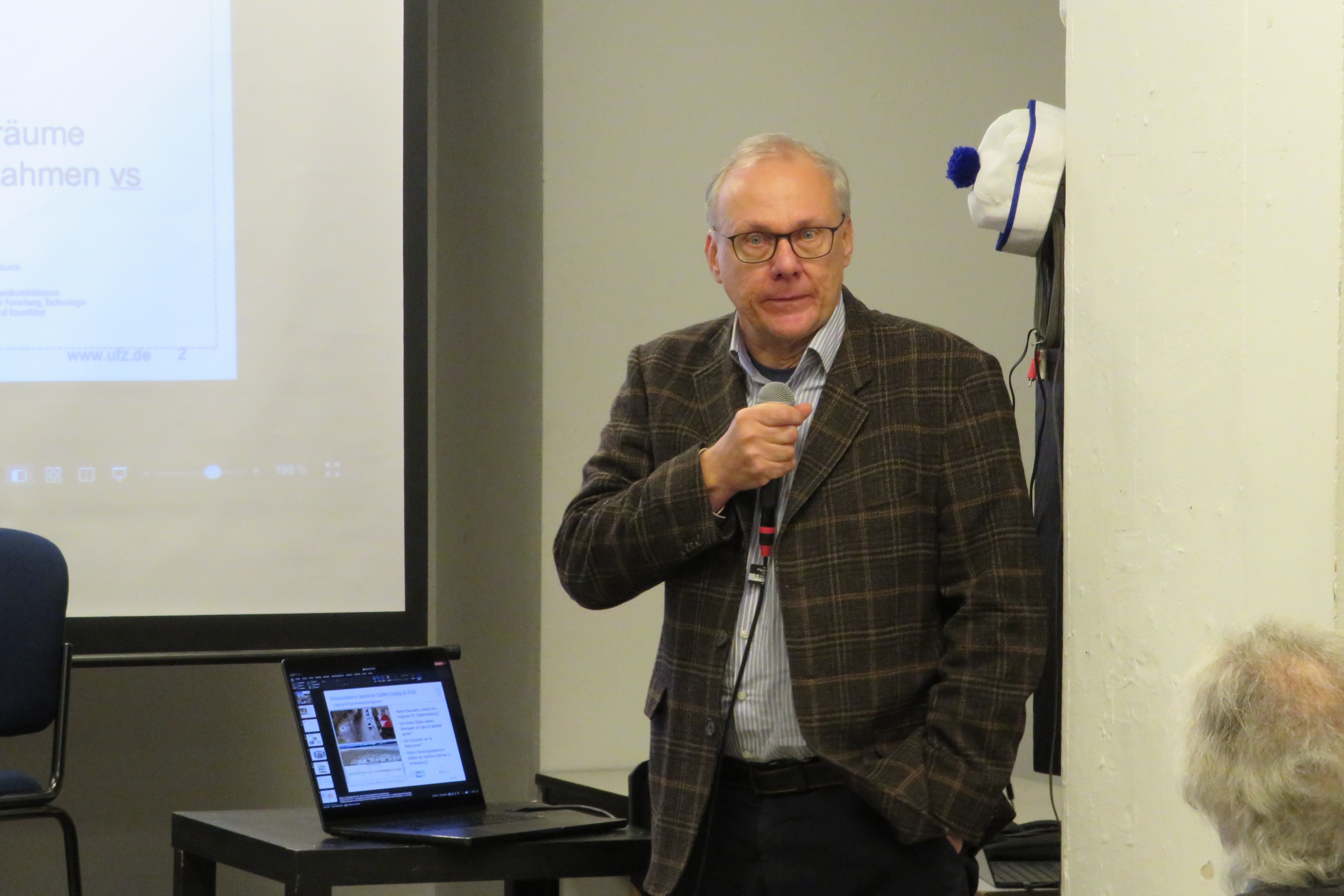
Prof. Roland Müller from the Helmholtz Centre for Environmental Research. Photo: Thomas Köhler
Prof. Müller conducts research at the Helmholtz Centre for Environmental Research, including on the topic of ‘Multifunctional blue-green water infrastructures for water-sensitive cities’, which he spoke about. How does a city cope with the challenges posed by heavy rainfall events, prolonged dry spells, falling groundwater levels and the associated water stress on urban green spaces? The answer sounds simple, but putting it into practice is complex: “Our answer, our vision, is blue-green water management, which you’re probably familiar with. We need to strike a balance between drought and heavy rainfall. At first glance, the solution sounds relatively pragmatic and straightforward. When we have a surplus of water, we must try to store it.”
Naturally, he elaborated on this at length; we spoke to him afterwards.
Professor Müller, do we need to rethink our approach to
blue-green infrastructure in the city? I recall that in the past,
we couldn’t get water – particularly rainwater – out of the city
quickly enough.
It’s a certain paradigm shift, although of course we’re not talking
about water in its entirety – that is, urban water management as we
know it, with its hygiene objectives. The water has to be drained
away; that remains the case, of course. But imagine if we were to
retain a proportion of the rainwater and surface water within
neighbourhoods to enable water cycles there. So that, for example,
during the hot season, we have water available for irrigation to
make the most of the benefits of urban green spaces. That is part
of the blue-green concept.
Climate change is bringing us long dry spells. What
quantities of rainwater – or what percentage – do we need to
retain?
We’re talking about around 25 per cent – not all the rain, mind
you. After all, we’re discussing relatively simple technologies.
For example, designing courtyards so that water can seep away in a
controlled manner without flooding the cellars. In green spaces,
for instance, we have storage options – or rather, we need to
create more storage options when we have densely built-up areas. In
densely built-up areas – meaning areas with a high concentration of
buildings – we have the option of using, for example, green roofs,
infiltration trenches and trough systems: in other words, very
simple technical systems. If we deploy these in a targeted manner,
we can, to some extent, restore what we call this natural drainage
function. Incidentally, this is an issue that comes up when we’re
planning construction projects.
What role would the removal of impervious surfaces
play?
A very significant one, and for reasons that go beyond just water
management. Sealing off surfaces also leads to heat hotspots. We’ve
heard the tragic figures of 16,000 deaths. A large proportion of
these occurred in urban areas during the first heatwave. We need to
view this as a comprehensive solution; evaporative cooling, in
particular, can serve as a prime example. To achieve this, we need
to consider – and this is something we Germans still struggle with
– measures that are common in southern Europe, such as providing
shade via sun sails in city centres, creating ventilation
corridors, and similar measures.
Input from ADFC
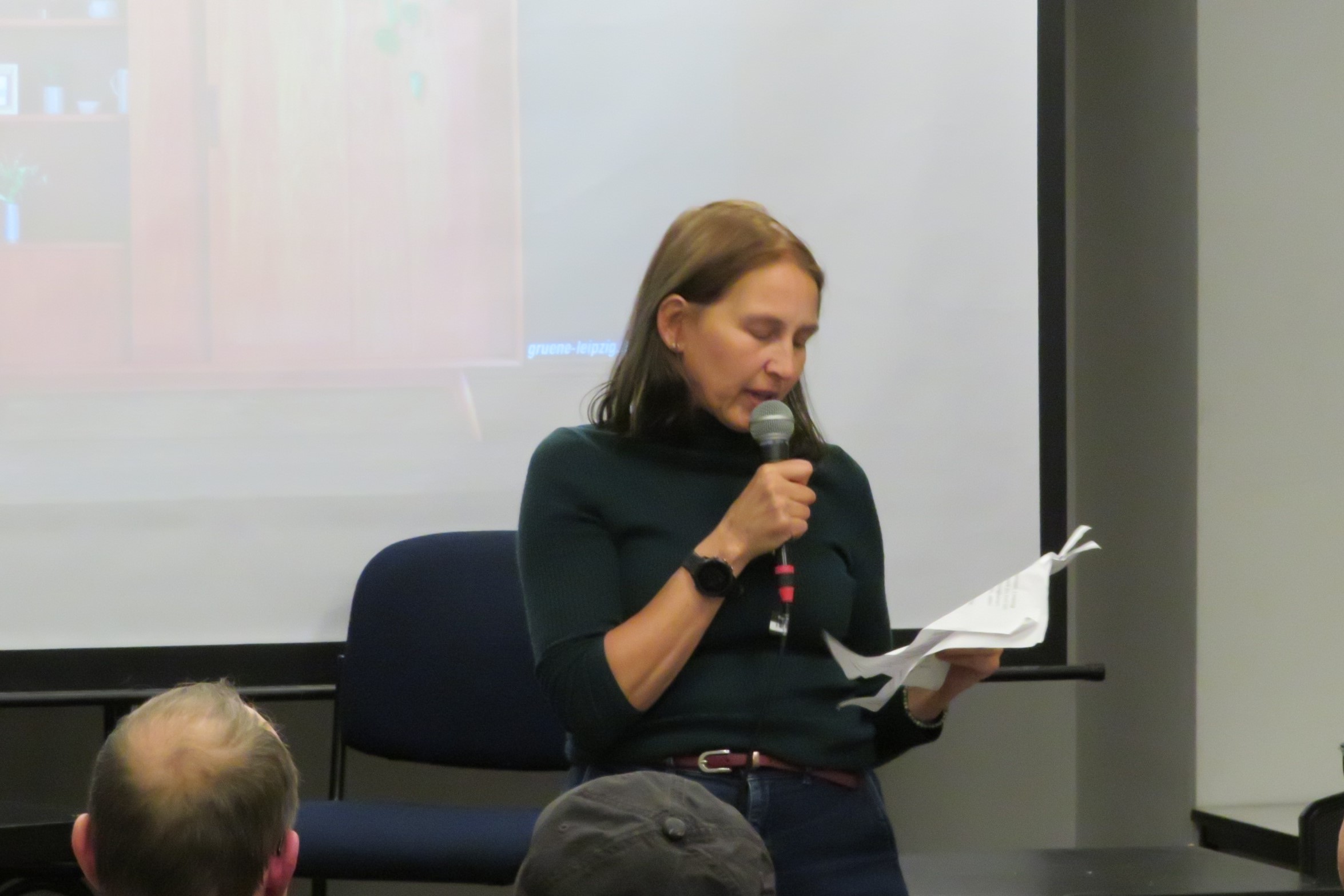
Viola Gründemann from ADFC Leipzig Photo: Thomas Köhler
Viola Gründemann, deputy chair of the ADFC Leipzig board, spoke in the final session on the topic of sustainable mobility. In the run-up to the mayoral election, ADFC Leipzig aims to set priorities. Leipzig is to have a continuous and safe main cycle route network by 2030. The ADFC is calling for a fault-tolerant infrastructure, protected cycle lanes on main roads, safe junctions and the consistent closing of gaps in the network. Safety on the journey to school must be a priority, and not just for cyclists. From a certain age, children should be able to cycle independently to sports activities, to friends’ houses and to school.
The ADFC is also calling for a new culture of implementation. Leipzig has many good plans; we know what needs to be done. An ambitious transport development plan is in place, setting out the plans up to 2030, but what is lacking is consistent implementation. The ADFC does not wish to pit road users against one another. The aim is a Leipzig where everyone can get about safely and easily. This applies in particular to children and older people, but also to pedestrians, cyclists, motorists and users of public transport.
The discussion tables
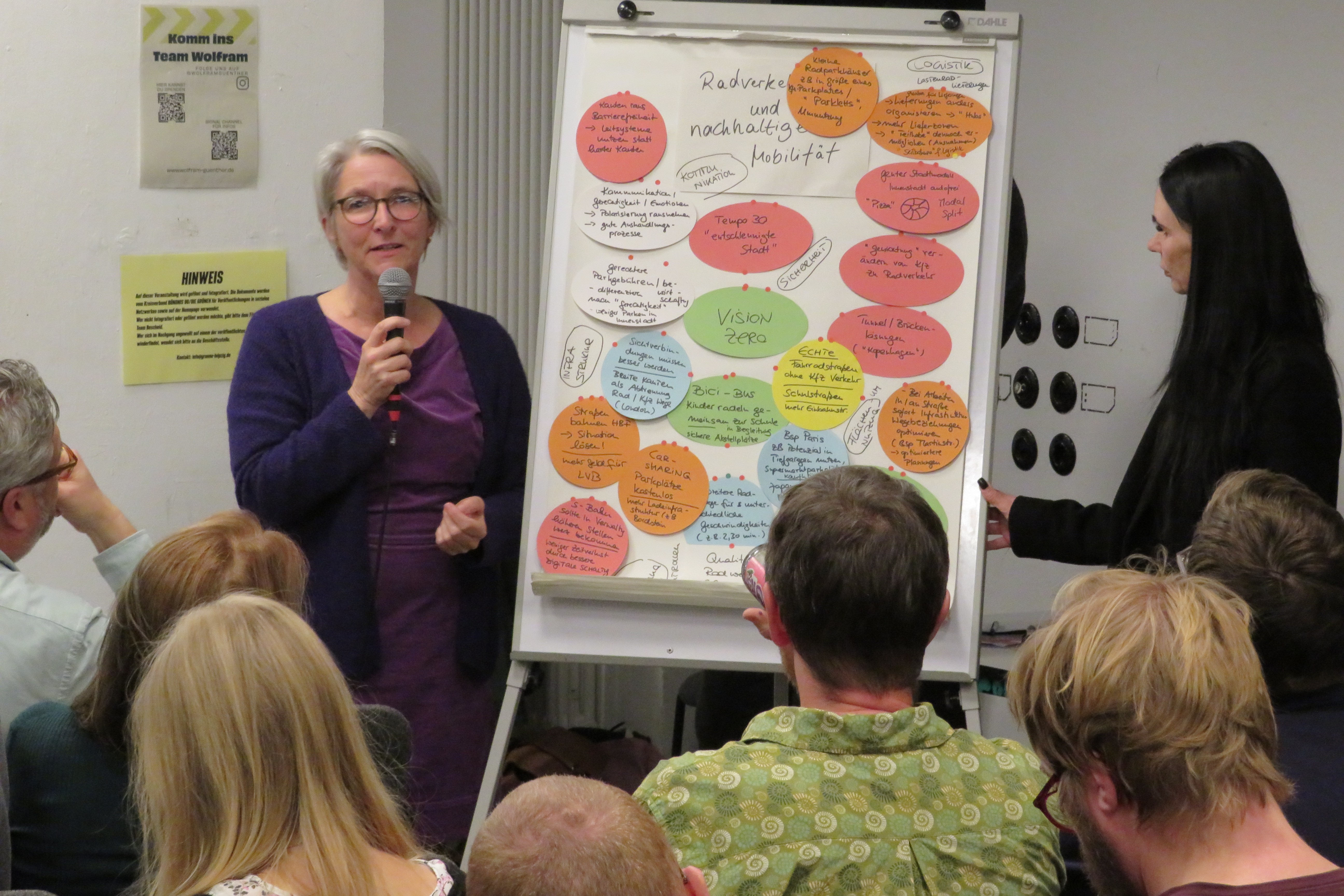
Presentation of the results from a discussion table. Photo: Thomas Köhler
Afterwards, there were 45 minutes to focus on specific topics at five discussion tables with city councillors and other committed members of the Alliance 90/The Greens. The tables covered the topics of cycling and sustainable mobility, quality of life, accessibility and walking, sustainable and blue-green neighbourhood development, building culture and heritage conservation, and feminist urban development. There was a great deal of interest; discussions took place at all the tables and ideas were gathered. The results were then briefly presented.
Concluding remarks by Wolfram Günther
Wolfram Günther thanked the participants and promised to include the evaluation of the work carried out at the discussion tables in his election manifesto. He emphasised: “Things are getting better, and we can achieve this together – and I’m really looking forward to it.”
We then asked him for a brief statement.
Mr Günther, how did it go, and what takeaways do you have?
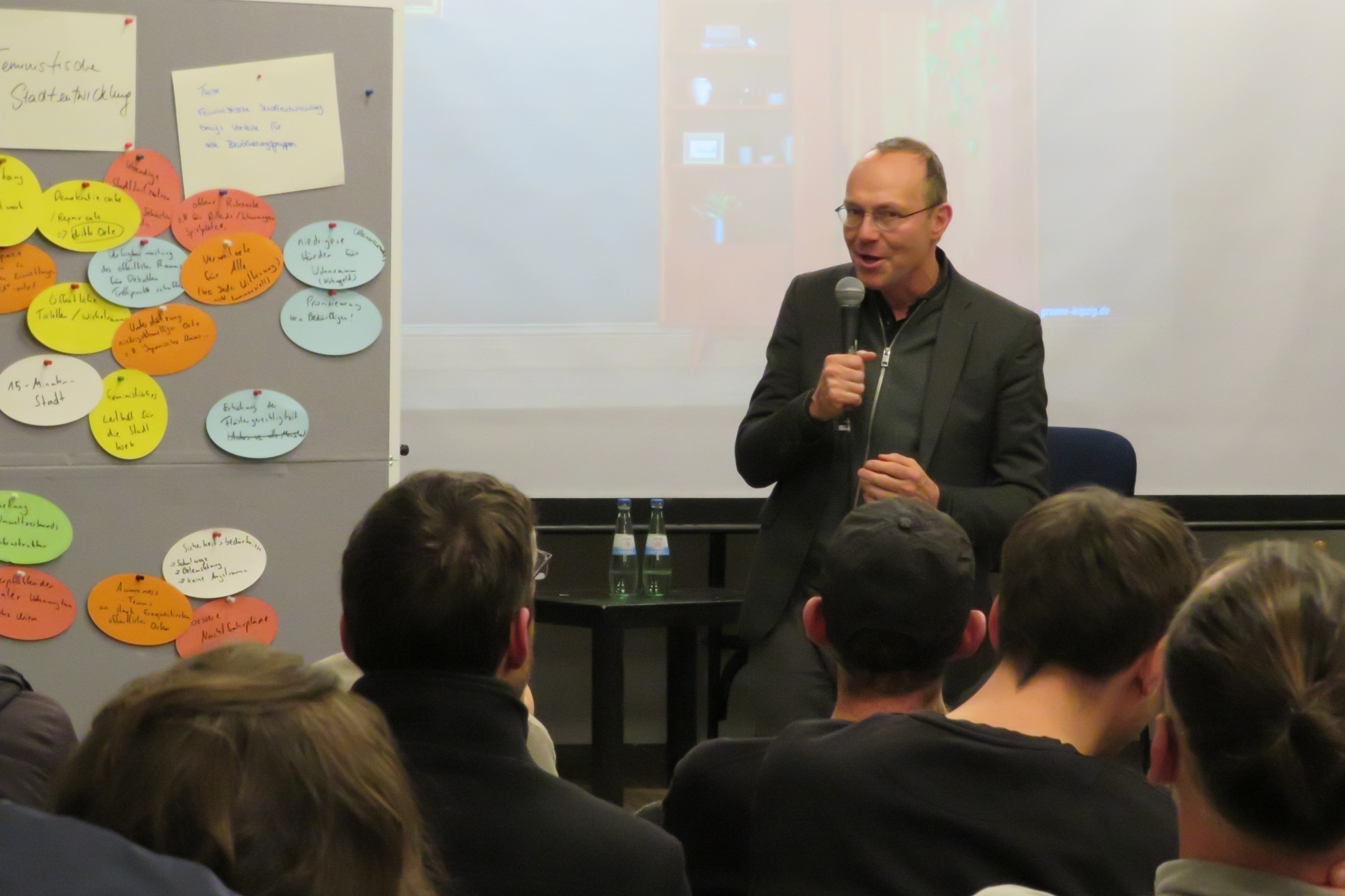
Wolfram Günther summarising the event. Photo: Thomas Köhler
There were loads of people there, with loads of ideas. The great thing about it was that it’s not really about inventing completely new things at all; rather, we already have good strategies in this city. How we can improve mobility, how we can approach many issues from a people-centred perspective, how we can better design public spaces and enhance our built environment, how we can make things safer for older people and young people – and yet, consistent implementation is often still lacking. That’s where we really need to channel resources and see it through consistently. From urban green spaces to cycle paths, to short-term parking for specific purposes. There are loads of specific initiatives, and people here who are already getting involved in their neighbourhoods, who’ve already developed concepts and now simply want the city’s support so that these can be put into practice in their neighbourhoods. It’s really inspiring to see that so many people want to do so much good; if we work together, we’ll succeed, and the city can become even more beautiful.
Conclusion: There is a great deal of interest in events like this; and it wasn’t just members and supporters of the Green Party who were there, but also curious members of the public. The next event on the topic of housing and social affairs will take place on 27 November at the Erich-Zeigner-Haus. Wolfram Günther is still keen on the election campaign and on the role.
Empfohlen auf LZ


So können Sie die Berichterstattung der Leipziger Zeitung unterstützen:


There is one comment