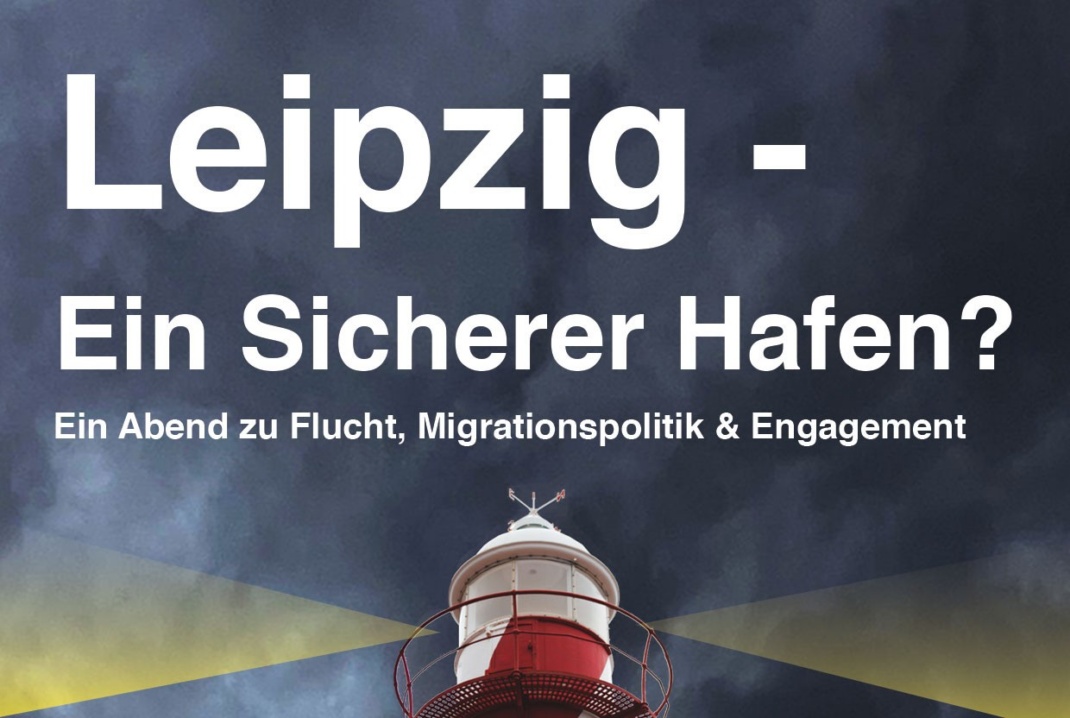
The Independent Group on Leipzig City Council had organised an information and discussion evening on the topic ‘Leipzig: A Safe Harbour?’ for Friday 13 November in the council chamber of the New Town Hall. We were there, followed the event and spoke to participants.
What was the event about? According to the invitation, the aim
was to examine whether there have been genuine improvements to the
situation of refugees, or whether it is merely symbolic politics.
What is the legal framework for the city, and how can committed
citizens help to make Leipzig a ‘safe harbour’ for refugees? These
were the questions the event was intended to address. 
Before the event began, we asked a few participants from various initiatives and organisations what they expected from the evening.
Short interviews
Jonas from Seebrücke was the first to speak.
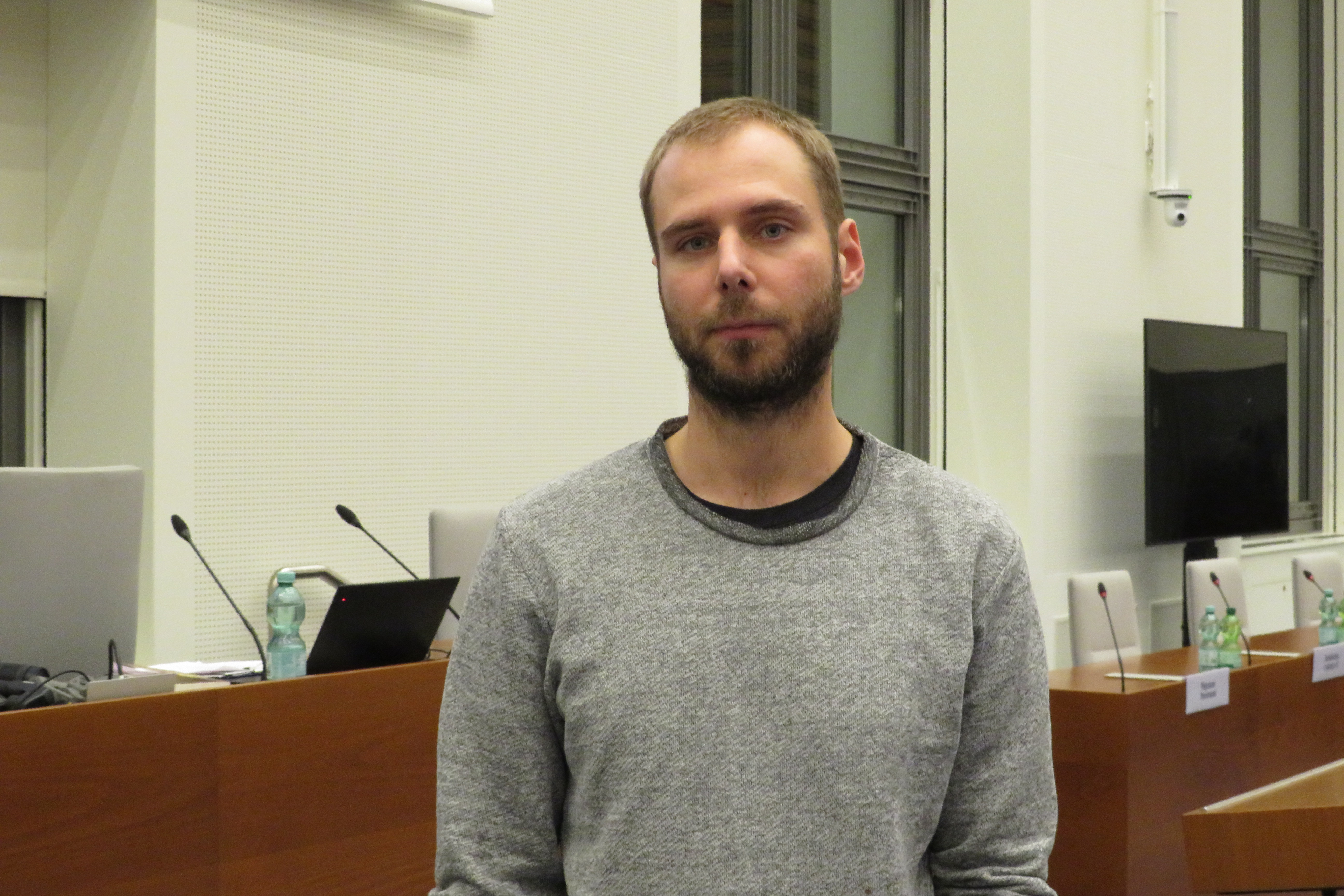 Interviewee
Jonas (Seebrücke) Photo: Thomas Köhler
Jonas, you’ve been invited to this event as representatives of Seebrücke. What do you hope to contribute here?
First of all, we’re very pleased with the Free Faction’s initiative, which aims to raise the profile of solidarity with refugees through this event. Fundamentally, that’s exactly what we want to contribute here too. We want to advocate that we all have a responsibility to change the situation regarding deaths in the Mediterranean and the appalling conditions faced by refugees, both in their countries of origin and whilst fleeing, as well as here. And tonight we want to put our heads together to consider how we can bring about that change.
When it comes to the topic of ‘Leipzig: a safe Harbour’, the Mediterranean issue is, of course, a secondary concern. This is about Leipzig as a city that takes in refugees. Are you planning any campaigns or similar initiatives on this in the near future?
We do understand our responsibility on a global scale; we want to show solidarity both with the refugees here locally and in their countries of origin. We always have a few events planned; next, for example, on 2 December, there’ll be a discussion on global inequality and global redistribution at the inclusive Lindenau neighbourhood meet-up. And we regularly organise fundraising events, film screenings, panel discussions and demonstrations in support of refugees’ rights.
Thank you for speaking to us.
Anja from Mission Lifeline was also happy to provide us with information.
Anja, what does this mean for you: Leipzig as a Safe Harbour?
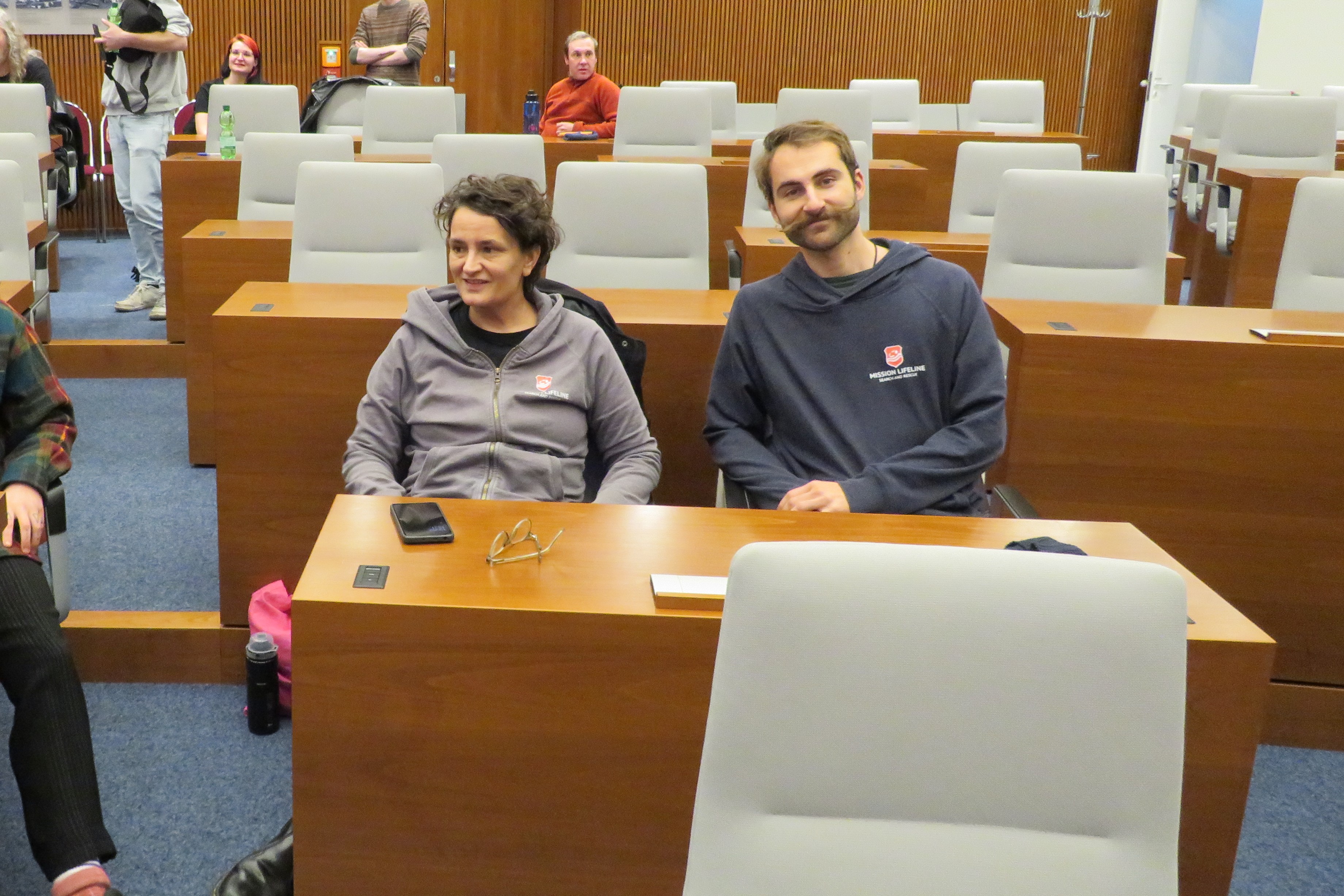 Representatives
from Mission Lifeline; on the left, our interviewee Anja. Photo:
Thomas Köhler
We are very pleased that there is still a Safe Harbour in Saxony at all. Dresden has, after all, managed to withdraw from the alliance again. Leipzig has already taken on a symbolic sponsorship for our last rescue vessel and has now done so again for our new one. We very much hope that this sponsorship and the commitment to a Safe Harbour will be given more substance, and that the city of Leipzig will succeed in encouraging its citizens to give more substance to this pledge to support refugees in their integration. Municipal institutions and political bodies should also be prepared to go further than merely paying lip service; perhaps they could also provide funding. I’m keen to see what ideas are put forward here.
What are your plans for the near future?
We’re well connected with Seebrücke Leipzig and Dresden and naturally want to try and organise joint initiatives. We want to use this to draw attention back to our work, show what we’re currently doing and that our ship will soon be back in service. The best thing that could happen to us is if we manage to make such a loud and clear case that the City of Leipzig turns its non-financial sponsorship into an institutional one and supports us financially. Ultimately, it’s not just about the money; it’s also about raising awareness of our work. Particularly here in the east, where the ground is very fertile for right-wing movements, we must strengthen democratic values even further and recognise how important it is to stand together as a community in solidarity and to support people fleeing their homes.
Anja, thank you for the interview.
The Free Group consists of representatives from three parties: Die PARTEI, with one city councillor; the FDP; and the Pirate Party, each with one city councillor. Of these, Thomas (Kuno) Kumbernuß (Die PARTEI) and Sven Morlok (FDP) were present; only the latter took part in the discussion as a political representative. The actual key figures on the parliamentary group’s side were the staff at the group’s office. Tom Rodig (Die PARTEI) chaired the event, assisted by Shehzad Shaik (FDP), whilst Anne Giermann (Pirate Party) took the floor microphone to the panellists in the audience.
Sven Morlok was also happy to answer our questions.
What motivates you personally to help organise an event like this?
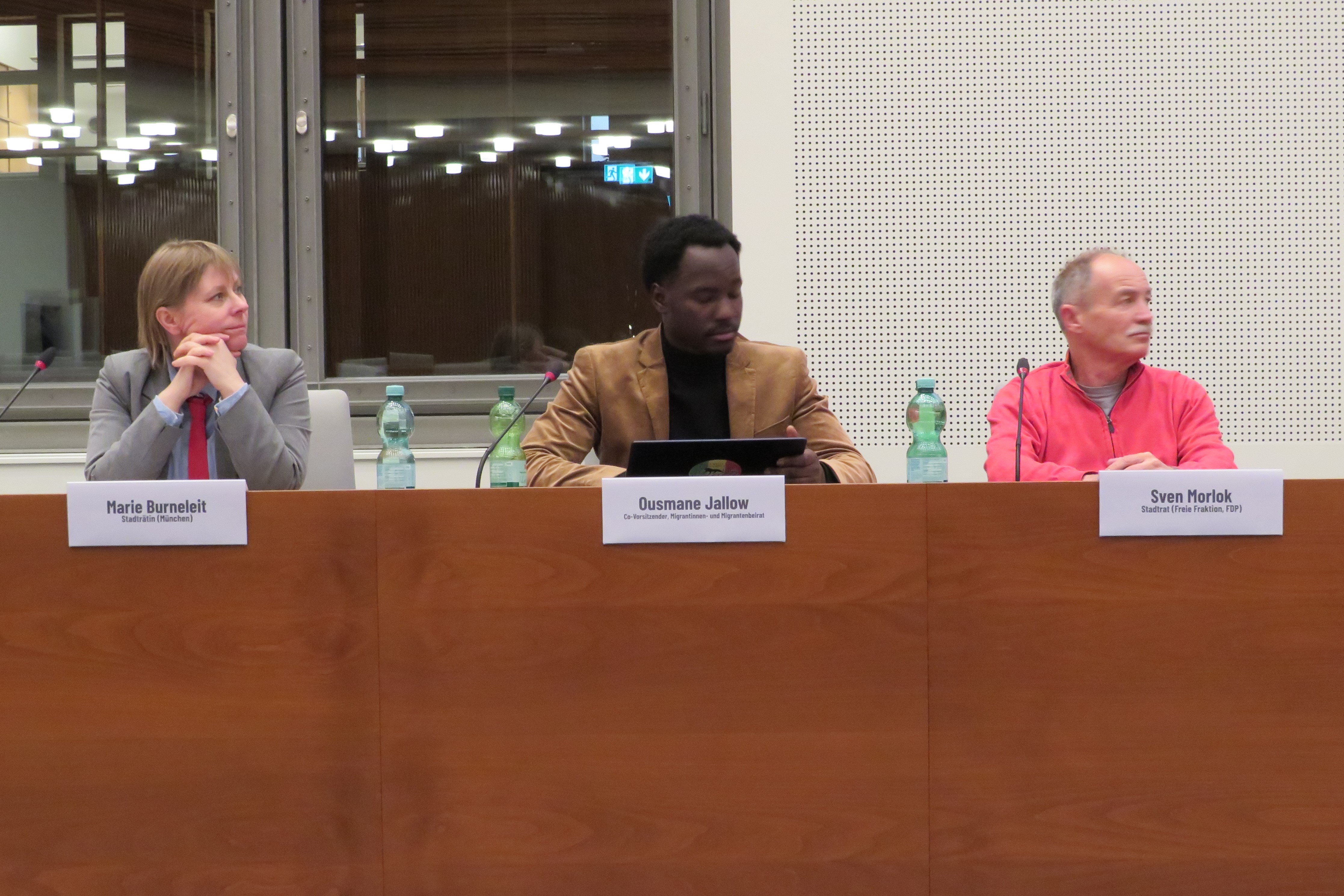 Marie
Burneleit, Ousmane Jallow and Sven Morlok on the podium. Photo:
Thomas Köhler
It’s a difficult topic because, on the one hand, one is naturally very moved emotionally by the plight of the people Seebrücke is campaigning for. But on the other hand, I also have mixed feelings about it, because one has to draw a clear line as to what actually constitutes a local authority’s responsibility. And whilst I have every sympathy for people’s voluntary commitment, sea rescue is not necessarily a municipal responsibility of the City of Leipzig. I found it difficult to take a stance on this – and I made that clear in the City Council. As a local authority, we have to say that this is not our responsibility. And if volunteers come forward who want to get involved in Leipzig and, for example, set up a collection box at a City of Leipzig event, that’s a good thing. But it is not the City of Leipzig’s responsibility to set up the collection box.
The event is called ‘Leipzig: a Safe Harbour?’. Is it part of being a Safe Harbour if people are here?
When people are here – and I have always advocated for this on the city council – in such emergencies, when people arrive here in Germany, the City of Leipzig should declare its willingness to take in people even beyond its allocated quota. That is a completely different situation, because these are people who are already here in Germany and who need a Safe Harbour. It is, of course, a local authority’s responsibility to ensure that people can live here safely and well.
Sven, thank you for the conversation.
One of the first contributions at the event came from Ousmane Jallow, co-chair of the City of Leipzig’s Migrants’ Advisory Board. Ousmane Jallow recounted his story, which began with what amounted to serfdom at the age of 11, whilst living with his uncle. At the age of 17, he embarked on a long and arduous journey of flight, fraught with many obstacles, humiliations and experiences of violence. We spoke to Ousmane Jallow before the event.
Mr Jallow, what does today’s event mean to you?
As a refugee myself, the invitation to take part in events like this and to tell my story so that people can hear it means a great deal to me. I want them to learn about it not just through political debates and what is always reported in the media, but to hear it from someone who has experienced it first-hand. To hear, but also to see, what it feels like. In my opinion, if events like this didn’t take place, there would only be prejudice, but not the clarity that comes from truly knowing and understanding what these people have gone through to get here.
So you think it’s important that people don’t just hear some anonymous report, but hear from a person to whom this actually happened?
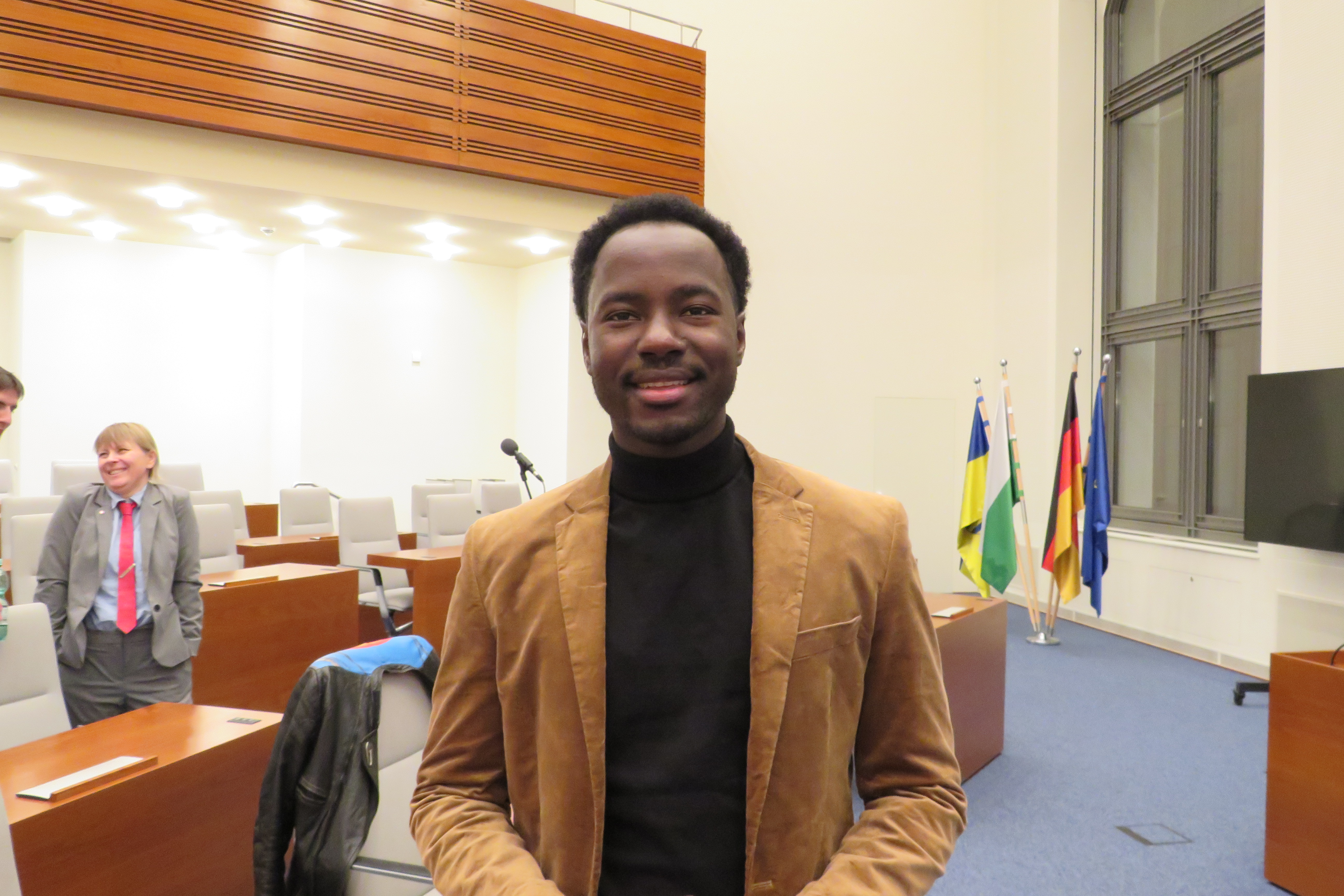 Interviewee
Ousmane Jallow Photo: Thomas Köhler
I think that means a great deal, and it also provides greater clarity when you hear it that way. At the same time, it should give people the opportunity to experience these individuals – their thoughts, their despair and the uncertainty they felt – in order to gain a clear picture.
Mr Jallow, thank you for speaking with us.
The event
The event itself went according to plan: Tom Rodig spoke on a number of legal aspects, Seebrücke had its say, and this was followed by Marie Burneleit, a city councillor for Die PARTEI in Munich, who spoke about the City of Munich’s activities regarding the ‘Safe Harbour’ initiative. Following successes in 2020–21, with donations totalling 140,000 euros – to which the city added a further 100,000 euros – people’s willingness to donate declined in the years that followed. Added to this is the fact that a deportation terminal is being built at the airport, in which the city holds a stake, which does not bode well for this issue.
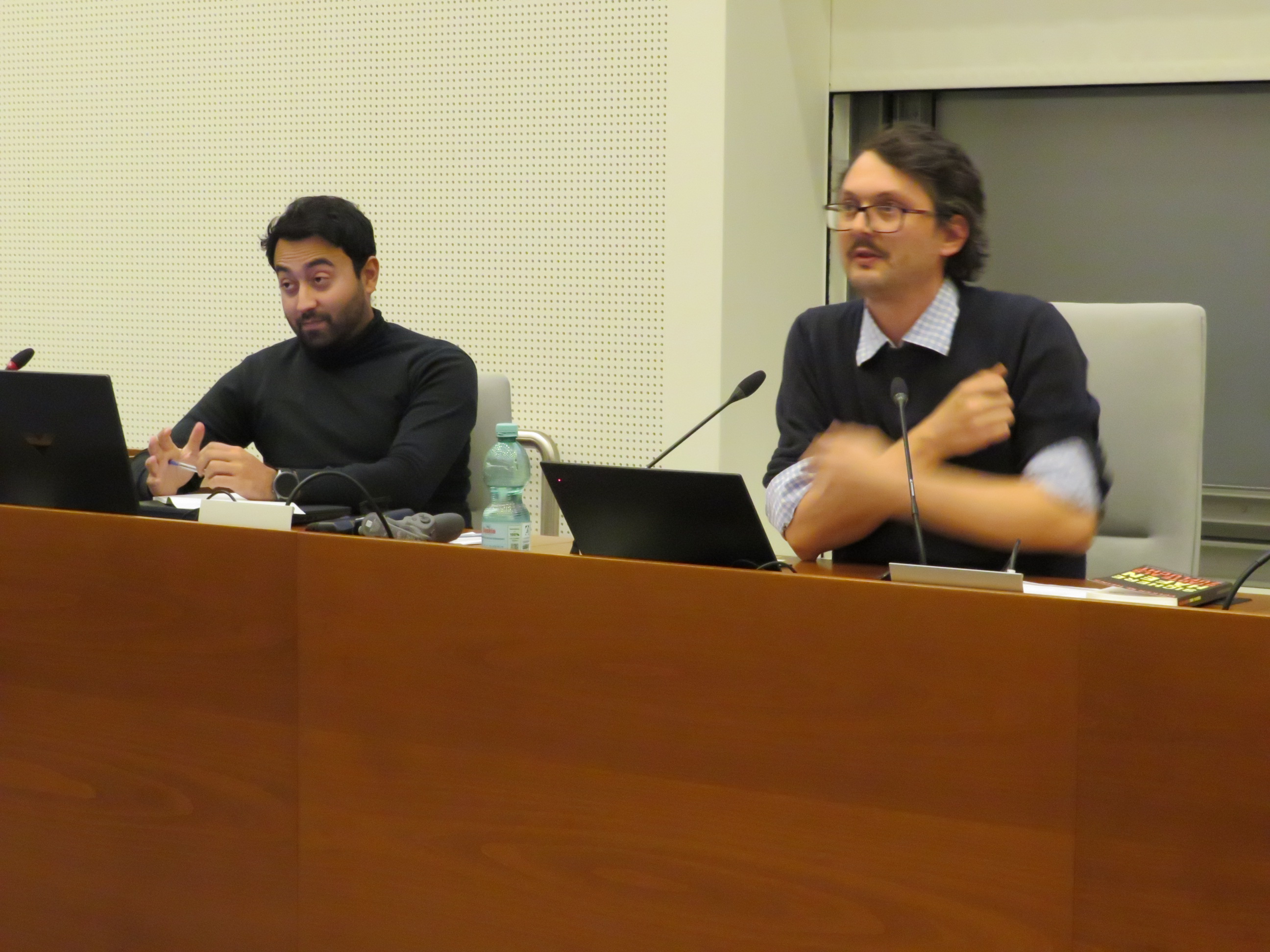
Event organisers Shehzad Shaik and Tom Rodig. Photo: Thomas Köhler
Sven Morlok then elaborated on what had been said in the short interview, albeit in more detail. He pointed out how people can bring about change: “If this is politically important to me – and it is politically important to me – there is the opportunity, in the next federal election and the next European Parliament election, to make this a priority when casting your vote, by only voting for parties that support sea rescue in these parliaments. That is the political decision.”
This prompted one of the few (spoiler) questions. In short, it was: “What can we do, what can each individual do, and what can each institution do to put an end to these humanitarian disasters?”
Sven Morlok pointed out that whilst anyone can make a donation, they should not demand that others do so. He also saw a problem in the fact that, on the one hand, the local authority demands that the federal and state governments finally make funds available so that the local authority can fulfil its priority tasks. On the other hand, if it then allocates funds to something outside its remit, it undermines its own credibility, particularly in the current budgetary situation. Marie Burneleit agreed with this in principle, but found the political signal this sends out to be worrying.
The Seebrücke, the Saxon Refugee Council and the Migranos Movement initiative also made statements. Many important issues were raised concerning the situation of refugees living in Germany. Whether it was the unspeakable payment card, the lack of psychological support, poor conditions in refugee accommodation, discrimination or the mistreatment of refugees – even by public officials – everything was discussed, though unfortunately it was all already familiar to those present.
After about 90 minutes, the event came to an end, though some people gathered outside the council chamber to continue their discussions. We asked the organisers for brief statements.
After the event
Tom Rodig commented: “The issues of Safe Harbour, asylum and sea rescue have faded into the background of public discourse in recent years. Yes, there was that business in the Mediterranean, but unless Morocco happens to wave a few poor souls through to Ceuta, the issue is no longer relevant. That’s how most people see it. The fact that people are still dying on the journey, that sea rescue is still necessary… that doesn’t seem to be the most pressing issue, even amongst left-wingers. That’s why we felt it was necessary to bring the current situation back into the spotlight, and I hope we’ve managed to do that to some extent. It was certainly a very enlightening evening.”
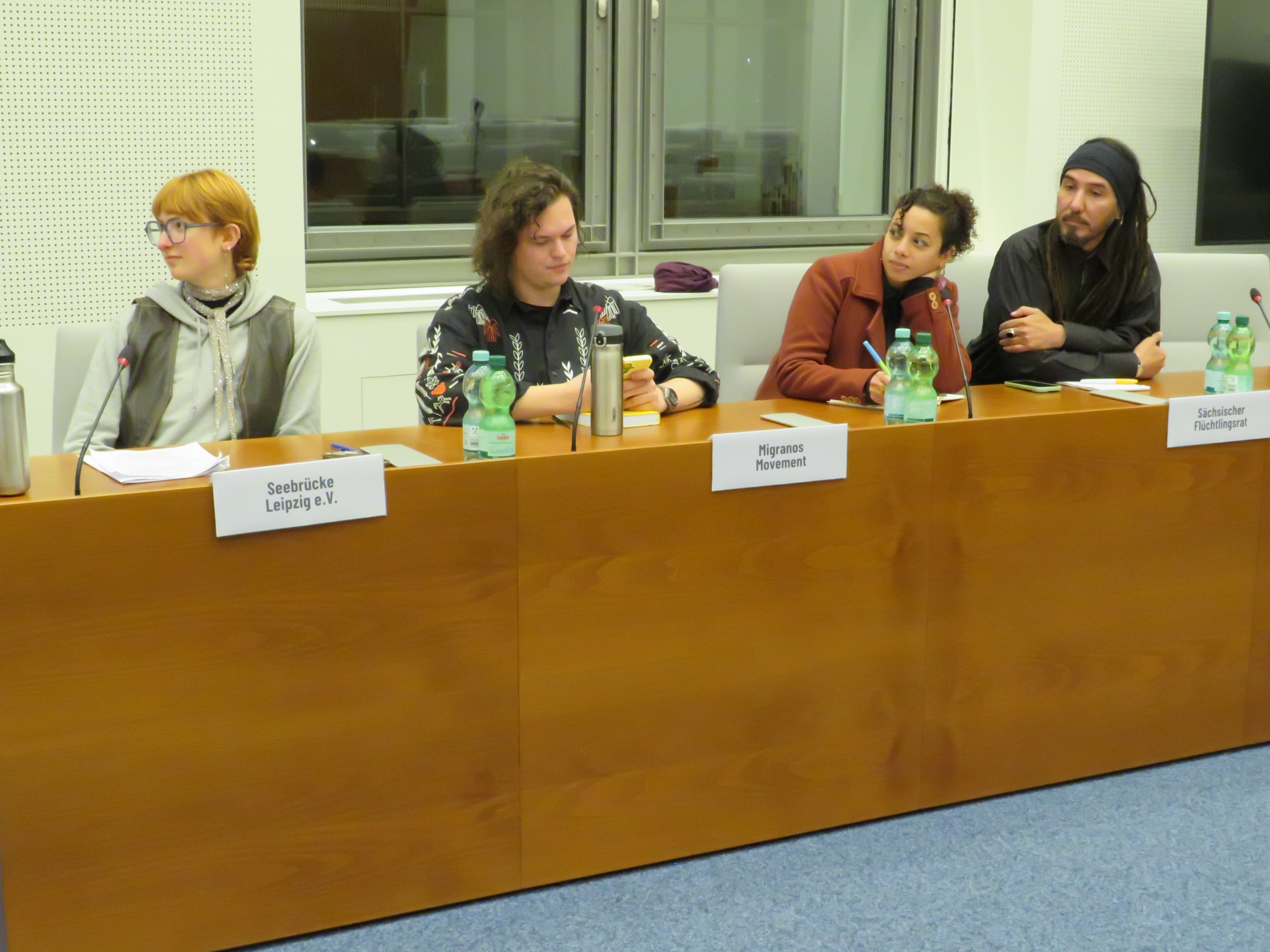
Panel guests from Seebrücke, Migranos Movement and the Saxon Refugee Council. Photo: Thomas Köhler
Anne Giermann said: “I see it in a similar light: the issue of flight and asylum has fallen out of focus, or rather, the humanitarian aspect – the desire to help and so on – hardly plays a role anymore. When the topic of refugees comes up, it’s as a cost factor, as a means of spreading racist narratives and the like. In other words, in a rather negative light. That’s why it was important to us to let those directly affected have their say and to show that this isn’t about numbers, nor about some ‘knife-wielding men’ coming here, but about people who need help. At the same time, Mr Morlok isn’t entirely wrong when he points out the city’s financial problems and the issues of jurisdiction in the debate. So it was good to hear his perspective as well.”
There was another political representative present; Falk Fiebig from the Volt party was in the audience, and we asked him for a statement as well. He said: “The event on refugees and migration policy was informative and deeply moving, but unfortunately there were hardly any people there who weren’t already working in or involved with this field. As a result, the personal exchange didn’t really get off the ground. In terms of content, much of the discussion centred on whether the local authority should take a stance at all, or whether this isn’t a local authority’s responsibility. For me, it’s clear: even if the local authority cannot bear the full financial burden, it must take a stand. It represents its citizens and, in doing so, also sends a signal to the state and federal governments. Integration is not a one-way street – responsibility lies with both sides.”
The author largely agrees with Falk Fiebig’s statement. Disappointingly, it was not a genuine debate, as was evident from the fact that Sven Morlok was the only one to make statements that did not meet with general approval. It was a sort of educational event for like-minded people. This is not meant to belittle the topic or to criticise the organiser in general, but particularly for an event taking place just a few metres from the offices of the city council parties – with their opposing views – I had hoped for more. Perhaps even some points of contention that could have been discussed.
Empfohlen auf LZ


So können Sie die Berichterstattung der Leipziger Zeitung unterstützen:




There is one comment