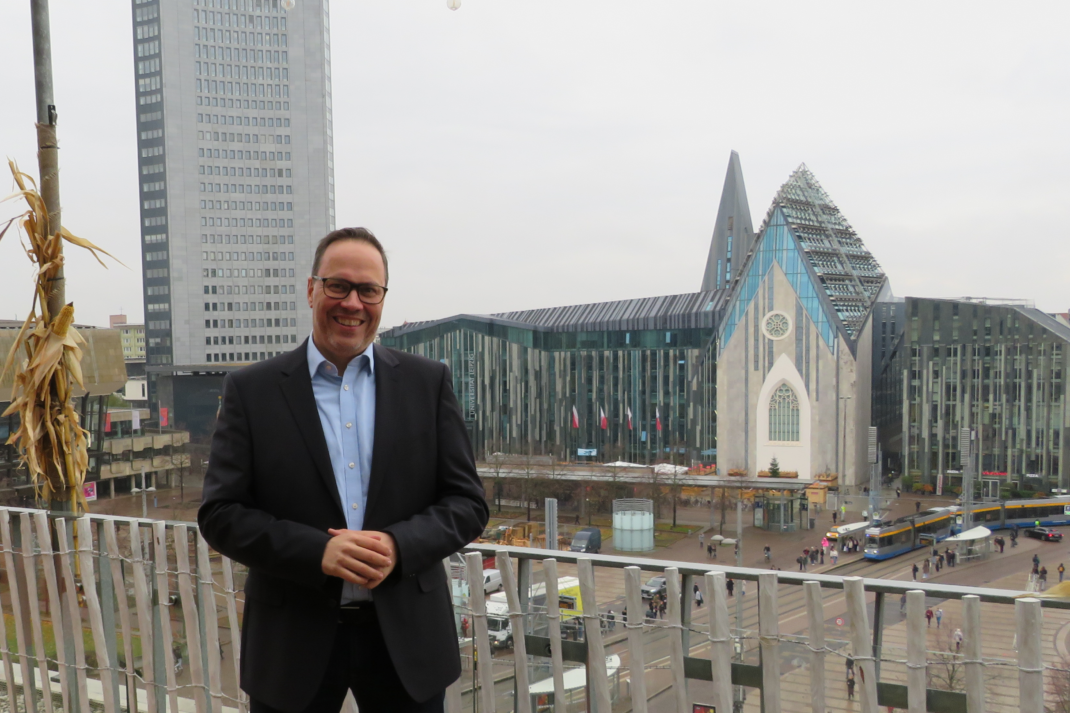
Things are starting to heat up in the 2027 Leipzig mayoral election campaign. The candidates are gradually positioning themselves with their key issues. At the press conference on 29 May, Dirk Panter had announced an election manifesto for the autumn, and he fulfilled this promise on 12 November. Not only that, but it is intended to be ‘more than just an election manifesto’.
High above the rooftops of Leipzig, at the ‘Felix’ on
Augustusplatz, Dirk Panter and Christina März, representing the
SPD’s city association, met with members of the press. Following a
brief introduction by Christina März, Dirk Panter began by
explaining why it is more than just an election manifesto. 
“This isn’t just a city council election, where we discuss a whole host of different issues, where parties then put forward their representatives and try to prioritize these issues and implement them in the city council. The city council is, of course, a very important body in its own right, but there is also a Lord Mayor who, ultimately, bears responsibility for the whole. And who, beyond individual policy points, must also answer the question of how one intends to lead this city. And that’s why the approach for this election manifesto wasn’t to list every single point.”
OK, less is more – that’s one way of doing it. However, in many respects, the manifesto is better than the rationale behind it. Dirk Panter wants to bring the city’s communities together. When we asked him about this, he also emphasized that he particularly wants to finally involve the outlying areas through his personal presence.
Without openly criticizing the incumbent, he wants to take on board the concerns, wishes, and expectations across the whole city; he wants to listen. He doesn’t just want a review of the finances; he wants a review of the strategies. He explains this by saying: “We have over 20 or 25 strategies for the whole city. We still have nearly 80 plans in this city, and some of them fundamentally contradict one another. And virtually none of them have been implemented. That doesn’t work.”
Naturally, the city administration is also an issue for him. Over the next ten years, around 20 per cent of staff will retire. This calls for greater digitalization and process optimization; finding new staff is becoming increasingly difficult. It works in other cities and countries, so why shouldn’t it work in Leipzig?
One of our questions concerned tradespeople, the self-employed and other small businesses – what does Dirk Panter intend to do for them? In any case, he wants to look into commercial traffic, amongst other things. He explains: “If I look just at the town, the biggest problem that tradespeople always tell me about is traffic and parking. I think we need to take a holistic view of this and ensure that they are given a certain degree of priority. When people need to carry out short jobs to help others – for example, to get the sink working again or to paint a wall – we shouldn’t always take a hard line, but rather look for ways to accommodate tradespeople.”
Translated with DeepL.com (free version)
As Lord Mayor, Dirk Panter wants to be a partner to the whole of the city’s community, working together with the city council. Social institutions, churches, cultural venues, associations, and clubs should not feel like supplicants, but should be taken seriously as equal partners and treated accordingly.
He then goes on to elaborate on the individual points of his election manifesto, which can be read on his website. At the end, he emphasizes once again that he wants to be a mayor for everyday life: “I’d like to solve everyday problems, but I’d also like to tackle them in the long term. Because I believe that’s a responsibility you have if you want to lead this city.”
We then asked Dirk Panter three specific questions on topics we hadn’t really found covered in the election manifesto.
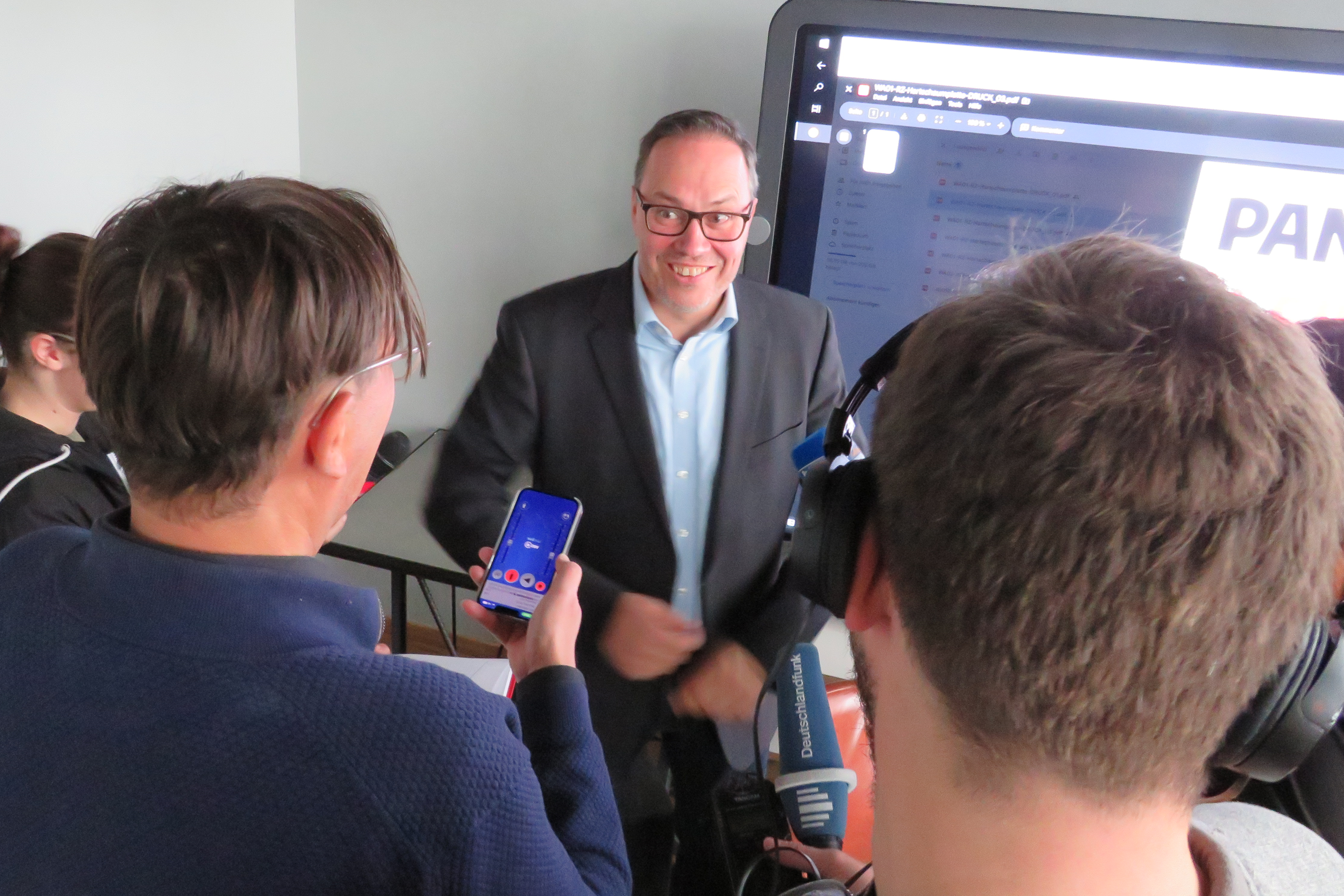
Interview with Dirk Panter:
Mr Panter, Leipzig is often described as a young city, but it also faces the challenge of an ageing population. For older people and those with disabilities, accessibility plays a crucial role in daily life. What are your priorities in this regard?
Definitely pavements and pedestrian traffic. We’ve made good progress in recent years when it comes to bus stops. The LVB has been carrying out improvements there time and again, which is all well and good, but it does need to be done properly. I think this is often underestimated far too much. Pedestrian traffic probably accounts for the largest share of traffic in Leipzig, and we mustn’t underestimate it, particularly when it comes to older people. That’s why it’s a priority for me to ensure we have pavements that actually work, where people don’t have to worry about tripping or simply find that the pavements aren’t accessible.
Leipzig declared a climate emergency seven years ago and presented an emergency action plan six years ago. Fridays for Future are planning to demonstrate again tomorrow. How do you intend to address this issue?
There is absolutely no question that, in everything we do, we must definitely keep climate adaptation and heat protection firmly on the agenda. We have ambitious targets for the city, which the City Council has set for itself and for the city. We won’t save the climate on our own, but we can do our bit. The best way for us to do that is by continuing to prioritize more trees, heat protection and drinking fountains in the projects we have planned, particularly in infrastructure and urban regeneration. There are various options; I mean, there are also those mist sprays. I don’t know why that shouldn’t work here. The city administration has said it wouldn’t work, but it does in other local authorities. I’d like to look into this in more detail once I take office, because I believe we can achieve a great deal even with a modest budget – or rather, by making use of the excellent funding schemes we have, which offer very high funding rates of up to 90 per cent. We need to give this some thought, because last summer was particularly extreme, and it’s been the same story for the past few years. We need to transition this society to renewable energy, as far as we can manage and as far as we can afford. There’s still a long way to go, and the city can play its part. We need to factor in heat protection in everything we do. That also means, for example, that we need to think about how we can better equip municipal properties. I’ve got one or two ideas on that as well; feel free to ask me again in due course.
Final question: can you envisage Leipzig switching to open-source software in the future? The city is, after all, heavily reliant on Microsoft.
At the moment, there’s certainly no alternative. We can’t switch overnight, because things have to keep working. But generally speaking, I’m firmly convinced that we should reduce dependencies in all areas of life. At the moment, we’re heavily reliant on a single provider. That not only costs money but ultimately poses a security risk as well. If someone in the US were to decide: ‘We’re going to switch things off now’, then we’d be in a right pickle. Consequently, it must also be a priority for a city administration like Leipzig’s and for the city’s leadership to reduce dependencies. That’s one of my core principles across all areas. Consequently, I’m also very open to open source. We need to look at where we can introduce it and how we can do so step by step. There’s no ‘one-size-fits-all’ solution that can be implemented overnight – we know that. But that’s the point, and that’s why I’ve also tried to make my fundamental stance clear in the election manifesto. My stance on this is quite clear: we must reduce dependencies. That means making further progress on this issue as well.
Mr Panter, thank you for the interview.
Dirk Panter has presented his election manifesto; it’s available to read, and he will have to explain and defend it at various events. Then it’s up to the voters to decide. We’ll keep you updated.
Empfohlen auf LZ


So können Sie die Berichterstattung der Leipziger Zeitung unterstützen:


There is one comment