Dieser Artikel ist auch in deutscher Sprache verfügbar: Zum deutschen Artikel.
For decades, the proportion of East Germans in top positions within companies, the Bundeswehr, the judiciary and other sectors has been significantly lower than their share of the population. A research team from the Universities of Leipzig and Jena, as well as Zittau-Görlitz University of Applied Sciences, has now produced new, nuanced data on this topic as part of the ‘Elitenmonitor’ project and analysed the underlying causes. In their recently published book, they show that the proportion of East Germans in elite positions rose slightly between 2018 and 2024 – from 10.9 to 12.1 per cent – although there are marked differences between the various sectors of society.
The increase is particularly pronounced in public administration and academia, whilst business, culture, security and civil society have even seen slight declines, and the remaining sectors (politics, the military, the media, religion, trade unions and the judiciary) have recorded only minimal increases or no change at all. In politics alone, the proportion of East Germans corresponds to their share of the population, but only when elite positions at the state level are taken into account.
The team arrived at these findings using the Leipzig Elite Database, which systematically records the highest leadership positions in Germany. It investigated the underlying mechanisms through surveys of top executives and interviews with HR managers. The project was led by Dr Lars Vogel, Prof. Dr Astrid Lorenz (both from the University of Leipzig), Prof. Dr Raj Kollmorgen (Zittau/Görlitz University of Applied Sciences) and Prof. Dr Marion Reiser (Friedrich Schiller University of Jena).
Networks and selection mechanisms
“Our analyses make it clear that the low representation of East Germans in top positions is not solely a consequence of the system change in the GDR and its accession to the Federal Republic,” says Leipzig-based political scientist Dr Lars Vogel. “Different career paths, regional structures, access to networks and the question of which experiences and CVs are perceived as suitable in selection decisions also play a role.”
According to the ‘catch-up theory’, this under-representation will resolve itself over time, as East Germans increasingly acquire the qualifications and resources necessary for advancement and thus move into elite positions vacated by West Germans.
“Our findings only partially confirm this theory,” states political scientist Astrid Lorenz. “There have been, and continue to be, formal and informal barriers to advancement.”
What options for action are there?
Based on its analysis of the causes, the team also explored possible courses of action for recruiters, those seeking career progression and policymakers. “We have established that these courses of action should be tailored to the specific sector, career stage and age cohort in order to be effective,” says Astrid Lorenz. These considerations are supplemented by interviews on possible courses of action with practitioners from various sectors and a newly developed ‘Guide to origin-sensitive recruitment’.
Accordingly, even ‘without an Eastern German quota – which enjoys very little support amongst the elite and the general public’ – policymakers have a range of low-threshold options at their disposal to increase the representation of Eastern Germans. For the early stages of a career, the federal government could, for example within the framework of grant agreements with organisations supporting gifted students, work towards broader promotion of merit-based scholarships in under-represented regions.
For later stages of a career, the federal and state governments could, within public authorities, make it even easier for East Germans – given equal performance – to gain access to career-enhancing experience in leadership positions through transfers or secondments, the book states. The establishment of further central government agencies in eastern Germany also falls directly within the remit of the federal and state governments.
Background on the ‘Elite Monitor’
The ‘Elite Monitor’ has been in existence since 2022, initially funded by Carsten Schneider, then Federal Government Commissioner for Eastern Germany. Since October 2025, the work has been continued in a follow-up project (‘Elite Monitor 2: Under-representation of East Germans in key leadership positions: Extended monitoring, specific action plans, analysis of the effects of public discourse’), funded by the Federal Government Commissioner for Eastern Germany, Elisabeth Kaiser.
“Previous studies on elites mostly provided only sporadic snapshots of the composition of elites. The Leipzig Elite Database has established a systematic and ongoing monitoring of elite structures,” says Dr Lars Vogel of the University of Leipzig.
The Minister of State and Federal Government Commissioner for Eastern Germany, Elisabeth Kaiser, emphasises: “Fair access to leadership positions is a central concern of my work as Commissioner for Eastern Germany. Wherever the course of our country is being set, we need people from diverse backgrounds. Only in this way can we overcome the various challenges of the present day.
Elite Monitor 1 clearly showed that the East German perspective is often missing from the upper echelons of management, but also that it is becoming increasingly easier for East Germans to advance in certain sectors. Building on this, with the Elite Monitor 2 we will take a closer look at the effectiveness of various courses of action and also at the public’s perspective on this issue.”
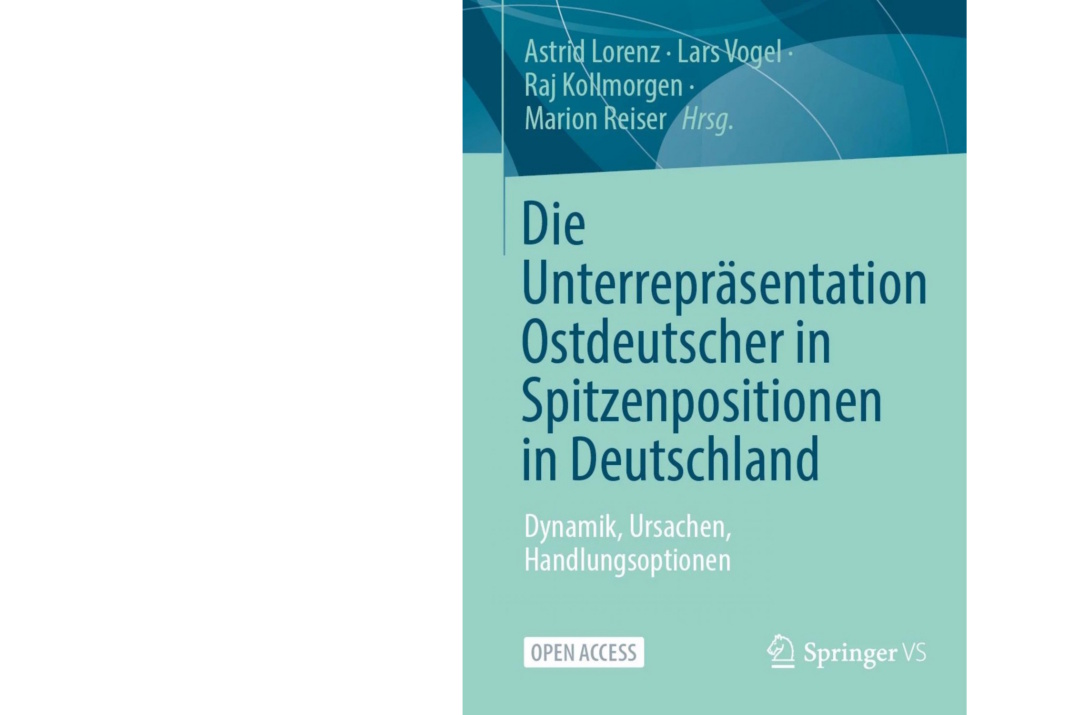
Publication: Lorenz, Astrid/Vogel, Lars/Kollmorgen, Raj/Reiser, Marion (eds., 2026). The Under-representation of East Germans in Top Positions in Germany. Dynamics, Causes, Courses of Action. Wiesbaden: Springer VS. To accompany their findings, the researchers have published the six-part podcast ‘Elites in Focus’.
Empfohlen auf LZ


So können Sie die Berichterstattung der Leipziger Zeitung unterstützen:




There is one comment