Dieser Artikel ist auch in deutscher Sprache verfügbar: Zum deutschen Artikel.
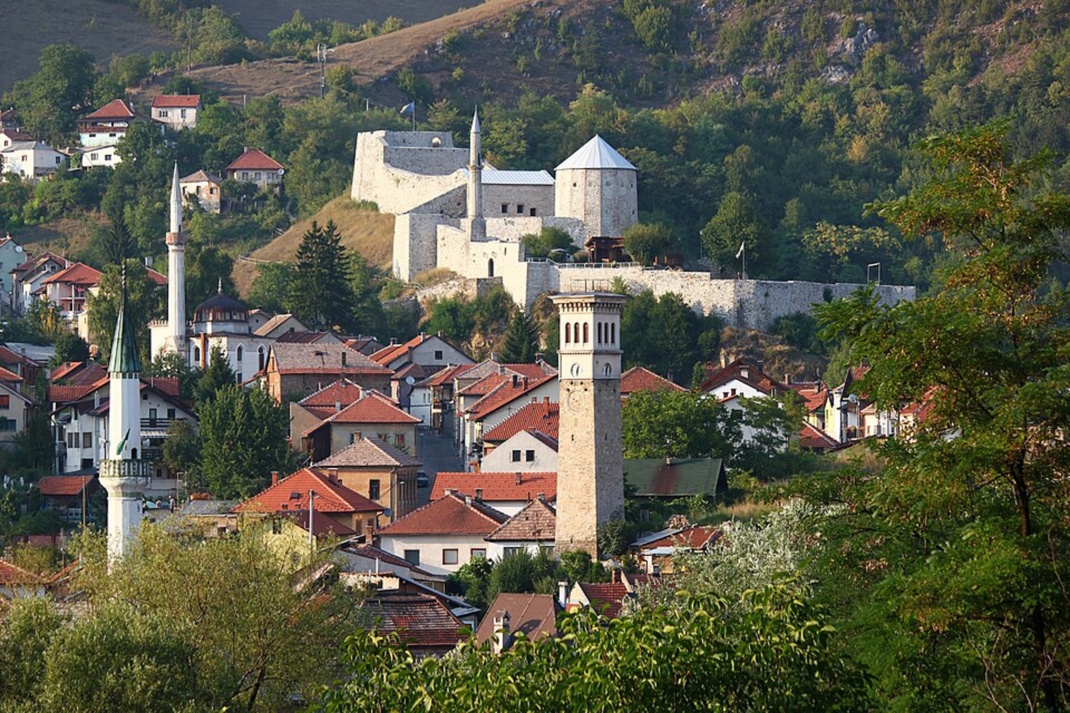
Travnik, a town in the heart of Bosnia and Herzegovina, is twinned with Leipzig. This text was written following the local elections, but moves from local observations to a reflection on democracy, political power and social developments in today’s world.
The elections are over. Here in Travnik, too. And now we’re back to square one.
There’s an old song about Travnik. Before the elections, I rewrote the lyrics for myself:
Two mountains tower over the town of Travnik,
Vilenica on one side, Bukovica on the other.
Then Vilenica asks Bukovica:
Why is Travnik shrouded in mist today?
Is the town on fire, or is it ravaged by a plague?
It is neither on fire nor ravaged by a plague,
replies Bukovica to Vilenica.
The time has come; the elections are upon us,
and elections are sometimes worse than the plague.
And now the old question plagues us:
Have the better ones come, or the worse ones?
It is the same ones who have come.
And?
Everything remains the same.
Just a little worse.
How and why?
Because, within the political order that emerged from the Dayton Peace Agreement, it is hardly possible otherwise. But also because the political, economic and cultural situation in the world today is as it is.
And perhaps also because we ourselves are as we are.
Neither Europe nor the world is in a better state.
Here, everything continues to revolve around Bosniaks, Croats and Serbs.
We ‘others’ are barely mentioned.
Everything remains the same.
The Serbs dream of a Greater Serbia, the Croats of Herceg-Bosna, and some are offering the Bosniaks something they would never accept for themselves.
And then they are surprised when this is rejected.
Why?
Let us look at the Palestinians.
Let’s look at how, even today, borders are being shifted, territories appropriated and power declared to be the law, whilst the law itself becomes an obstacle.
After the Second World War, it was said that borders should no longer be altered by force.
Much has been said.
We have seen what happened to Yugoslavia.
We saw what happened to Bosnia and Herzegovina.
We are seeing what is happening in Gaza today.
And the world?
It stands by and watches.
As usual.
The European Union is preoccupied with itself.
The big players with their interests.
The small players with their fears.
And so everything goes round in circles.
Meanwhile, something is taking shape.
Or perhaps it is nothing new at all.
Perhaps it has simply finally cast off its mask.
I call it neoliberal criminalism.
What is it?
It is the moment when politics and crime merge so closely that one can hardly tell where one ends and the other begins.
Money determines the truth.
Power determines justice.
Strength determines the law.
In the past, such things were at least concealed.
Today we are watching it unfold live.
States are being threatened.
Resources are being appropriated.
Nations are being put under pressure.
Wars are being waged.
From Ukraine and Russia, through Palestine, to numerous conflicts in Africa.
And all of this is happening right before our eyes.
How can we prevent this madness from escalating further?
How can a democratic fresh start succeed?
This is where the answer begins.
Dictators, neoliberal criminals, oligarchs, sham politicians, populists and the like should be treated like nappies.
They must be changed.
And for the very same reason.
They have long since become unbearably foul-smelling, and their stench is spreading ever further, hand in hand with climate change.
How?
In the very same way that they came to power.
Democratically.
Coming to power was easy.
Removing them from power will be considerably harder.
But we must try.
Those in Serbia are at least trying.
And the attempt itself is something.
We must seek ways forward, seek democratic solutions.
Any other path has, time and again throughout history, shown where it leads:
to hopelessness and chaos.
And we are coming dangerously close to both.
***
In the constitutional system of Bosnia and Herzegovina, the term ‘Ostali’ (‘Others’) refers to all citizens who do not belong to any of the three constituent peoples (Bosniaks, Croats and Serbs). This population group occupies a special constitutional position within the country’s political system. There are currently 18 recognised national minorities in Bosnia and Herzegovina, of which the Roma constitute the largest population group.
Branko Filipović
is a poet and essayist from Travnik. “The text was written following the local elections in Bosnia and Herzegovina, but it goes beyond local political events and addresses issues of democracy, political power, identity and social developments in today’s world,” he says of his text.
“It is written from the perspective of a citizen of a small town in Bosnia and Herzegovina, but addresses issues of general significance.” Travnik
has been twinned with Leipzig since 2003.
Empfohlen auf LZ

So können Sie die Berichterstattung der Leipziger Zeitung unterstützen:




There is one comment