Dieser Artikel ist auch in deutscher Sprache verfügbar: Zum deutschen Artikel.
This is just the tip of the iceberg. We have already reported on several occasions here about trams being prevented from continuing their journey by illegally parked vehicles. But illegally parked vehicles also obstruct other types of vehicles. The Left Party raised this issue at the last council meeting with a question.
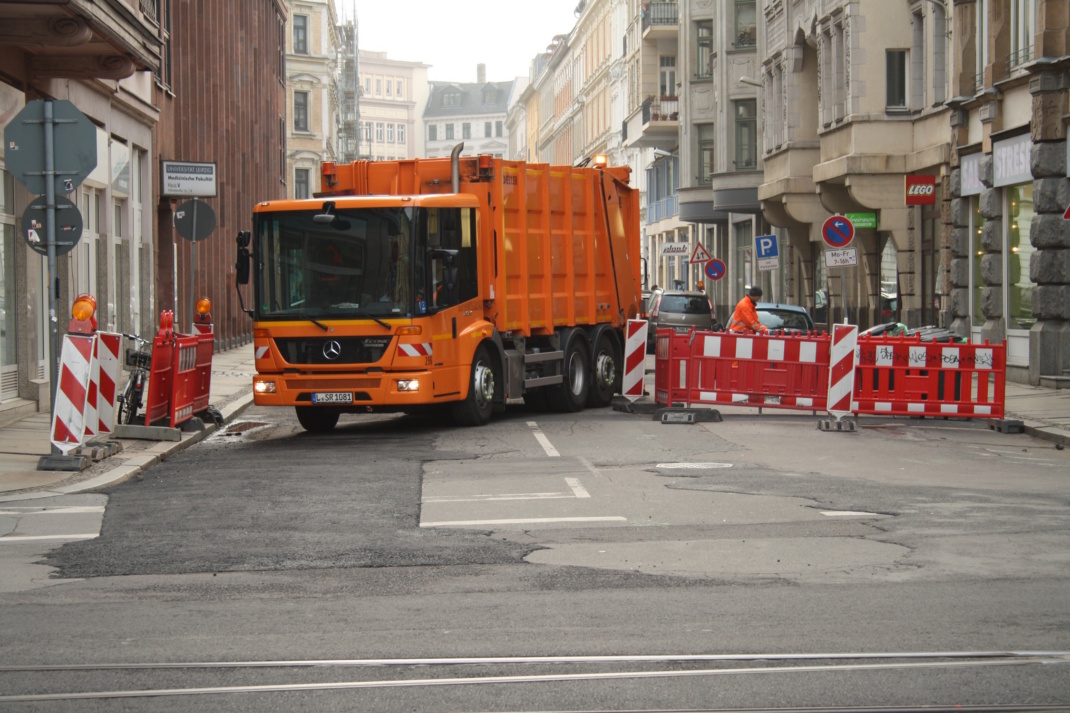
“Increasingly, refuse and waste collection vehicles operated by the city’s cleaning services or ALL Abfall Logistik are unable to access residential streets and, in accordance with the refuse collection calendar or waste disposal schedule, empty the bins that have been put out, because illegally parked vehicles are blocking access or passage,” the Left Party stated at the start of its question.
It then went on to request precise figures.
“How often in 2025 and in the months from January up to and including May 2026 were general waste, organic waste or paper bins in the city centre and the surrounding districts go unemptied because access was blocked by ‘illegally parked vehicles’, and in which residential areas did this lead to a build-up of waste, if any?”, they asked.
This is because if the collection lorries cannot enter narrow streets, it usually affects the entire street, where the rubbish cannot then be collected. The collection lorries simply carry on with their planned route, leaving residents high and dry.
Or they end up phoning the city’s waste collection service to arrange for a follow-up collection.
330 follow-up collections in 2025
The response from the Department of the Environment states: “During the period in question, a total of 330 follow-up collections were recorded due to parked vehicles, 284 of these in the residual waste category and 46 in the organic waste category. We do not have any data available for the paper category.
Generally speaking, such situations involving illegally parked vehicles can occur in all residential areas with narrow streets throughout the city of Leipzig. It makes no difference whether just one car or several cars are parked illegally.”
However, this is only the tip of the iceberg, as these additional collections incur a charge. Homeowners are therefore wisely reluctant to request an additional collection every time the refuse lorry cannot get through.
The problem is that these missed collections are then not recorded anywhere.
The Environment Department comments: “In all the cases mentioned in Question 1, special collection rounds had to be carried out, as traffic disruptions are only statistically recorded in this context. It should be noted, however, that special collections are not the standard procedure for EB SRL. These special collections are only carried out on request. In other words, if a collection cannot be carried out at a property, that collection is cancelled and the resident can request a special collection, which is subject to a charge.”
Call to the Public Order Office
Most homeowners will probably have grudgingly rolled their unemptied bins back onto their property.
Others will have called the Public Order Office in frustration. After all, it is the Public Order Office’s job to deal with illegal parkers.
Bad luck for the Left Party: the Public Order Office is once again unable to provide these specific figures.
“Advance reports from members of the public are not the norm and are limited to a few isolated cases. Often, such reports only reach the operations centre once it has been established that the bins could not be emptied due to a parking offence. Members of the public then enquire what further action they can take,” stated the Department for the Environment in its reply.
“A detailed search for this information is only possible to a very limited extent and must be carried out manually, as the WinOWiG application does not offer a suitable filter. Furthermore, the parking offences reported in this context are not recorded separately, but are treated in the same way as all other parking offences. They are not usually given separate priority. The effort involved in a manual search and analysis is disproportionate to the benefit and is therefore not carried out.”
With limited success
It can be assumed that these figures are significantly higher than the number of recorded cases of waste being removed at a later date.
And the problem is not a new one. In 2023, the city set up a special ‘Narrow Streets’ working group to seek solutions to this problem. 200 streets in Leipzig fall under this definition. In some of these, special signs were then put up to indicate that access must be maintained for the fire service and refuse collection.
“In an effort to find a solution to the problem, a pilot project was carried out in the past, in which information boards were used to advise on the correct parking of vehicles to ensure access for refuse collection or the fire service,” the Environment Department states, before soberly noting: “with limited success.”
Empfohlen auf LZ


So können Sie die Berichterstattung der Leipziger Zeitung unterstützen:





There is one comment