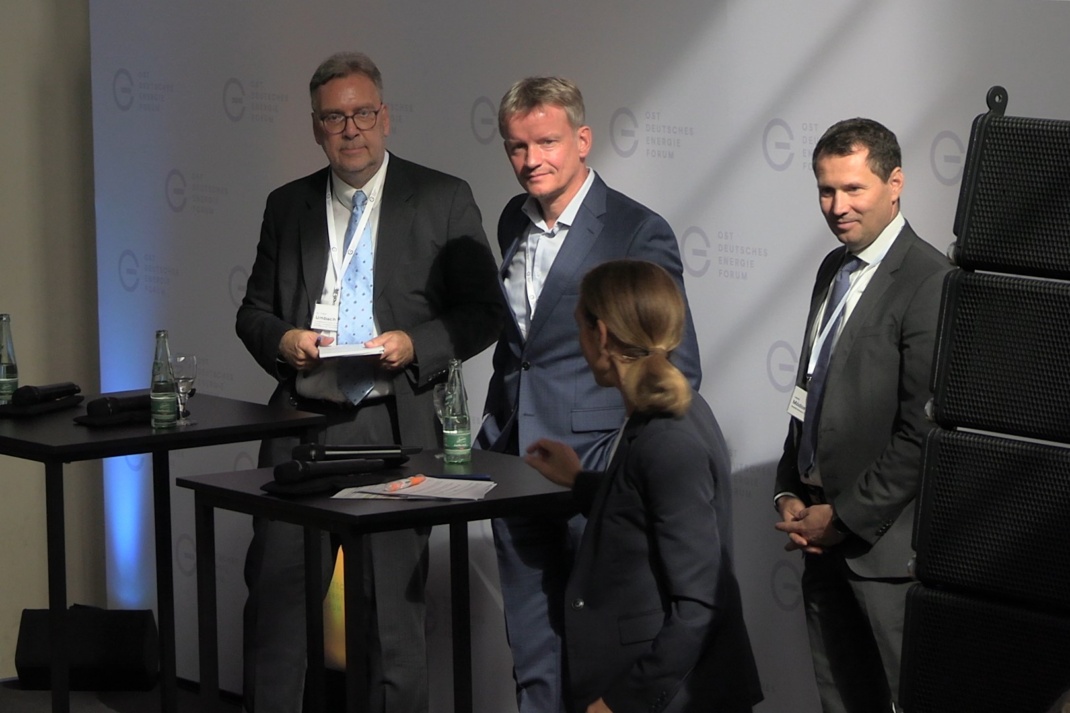
How can we increase the resilience of Germany’s energy supply, and how can we become independent of imports? What role does grid expansion play, and how can battery storage systems contribute? These and other questions were discussed at the 15th East German Energy Forum. The discussions were often controversial, but that is a good thing; after all, the aim is to find solutions, not to engage in navel-gazing.
On the first day, under the theme ‘The energy mix of the future – security in uncertain times’, the event began with a keynote speech by Dr Frank Umbach; we spoke to him about it. This was followed by a presentation from Karsten Rogall of Leipziger Stadtwerke – we’ll come back to his remarks later – and finally a panel discussion featuring Dr Gunter Erfurt, László Módos and Dr Frank Umbach.
It would be presumptuous to attempt to cover all the topics raised during the panel discussion here; those interested can watch the full recording on the ODEF’s YouTube channel. We would like to focus on part of Dr Erfurt’s remarks, which proved pivotal to our subsequent discussion.
For those unfamiliar with Dr Gunter Erfurt, we’ll reproduce here the introduction given by the moderator, Andrea Thilo, during the panel discussion: “He headed the solar module manufacturer Meyer-Burger from 2020 to 2024; he was Chairman of the Supervisory Board at Next2Sun AG and Swift Solar Germany GmbH – Next2Sun is currently in insolvency. But he’s not giving up; he was the figurehead of the German solar energy sector, and he even wants to resume production in Saxony.”
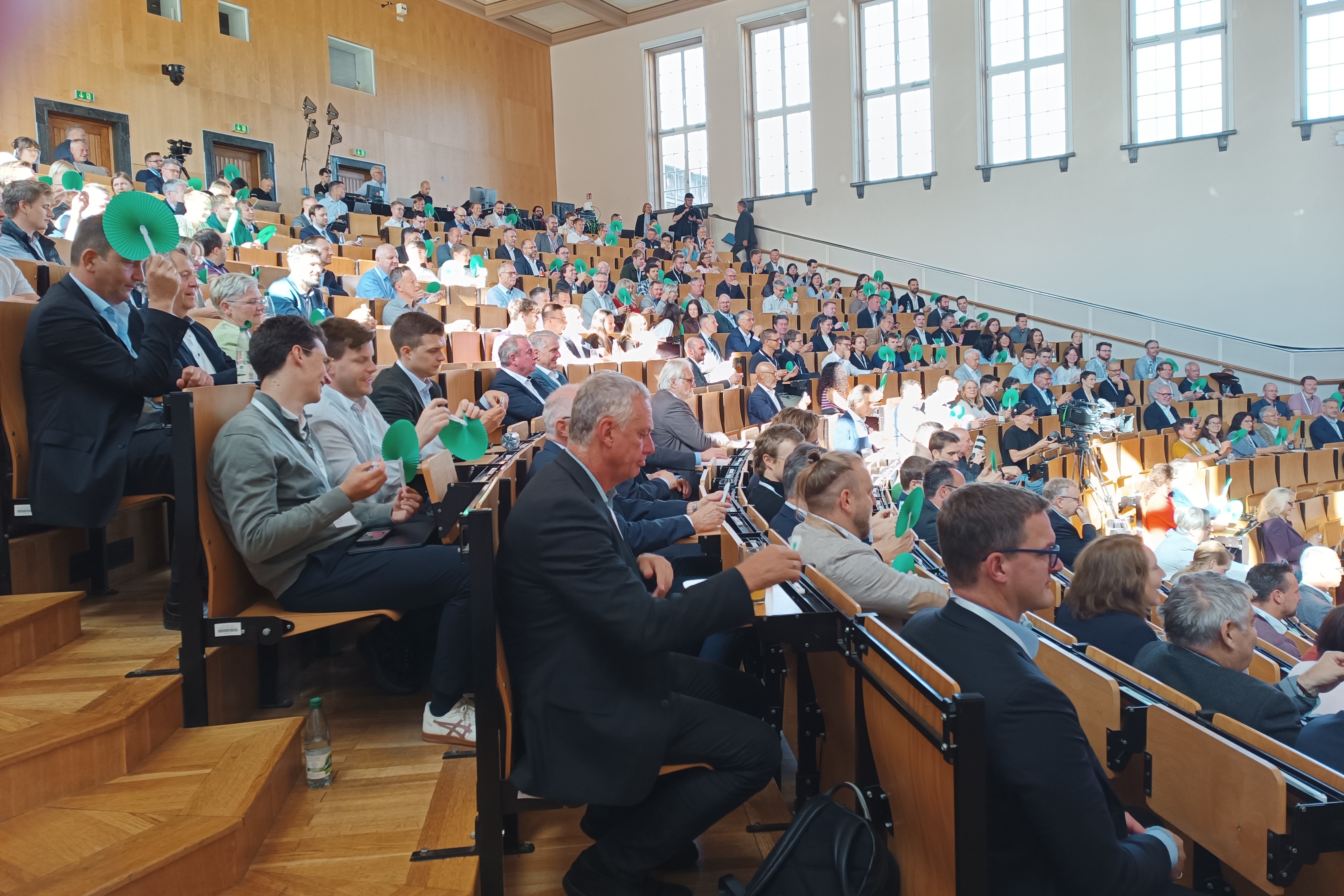
On the panel
Right at the start, he dispels a myth that keeps cropping up: “We often act as though the problems in our country only affect Germany. It’s only us who are so daft as to expand solar energy. Last year, solar was by far the leading new energy source worldwide with over 500 gigawatts installed, followed by wind at 160, coal at just under 100, then gas at 60, hydropower having reached its limit at 18, and, according to the 2025 IRENA report, 3 gigawatts of nuclear power.” This global expansion of nuclear power really does seem to be a myth.
He also sets out his position on nuclear fusion: “I’m a physicist myself; I can tell you that it will never work on an industrial scale. It’s a pure illusion that we’re chasing after. It won’t work; even if it did, we’ve been hearing since the 1980s that it’ll be ready in 20 years. I even have an old energy book from the GDR era; it was already mentioned there. It never happened. And even if it were to work, we need solutions now. That’s why we have wind and solar, and that’s what will have to do the job, because otherwise we won’t make any headway at all on the path to electrification.” A clear statement.
The comments on the trade deficit with China, the US market, the safeguard measures on electric steel and Germany’s policy of delay are highly interesting; in the video linked above, these can be heard from the 4-minute mark.
Towards the very end of the panel discussion, the presenter Andrea Thilo brings up the preliminary discussion with Dr Erfurt and quotes him: “The deliberate delay in rolling out smart meters, at 5.9 per cent. Metering point operators are responsible; the problem is that retail business models would be undermined if we were to launch the smart meters.” These business models referred in particular to municipal utilities. We discussed this during the conversation and also spoke to a representative of Stadtwerke Leipzig about it later.
Following the panel discussion, Dr Erfurt was kind enough to make himself available for an interview.
The interview
Dr Erfurt, yes, having seen and heard you and Dr Umbach one after the other, one might have thought you had huge problems with each other. But if you compare what you’ve said, the problem isn’t actually that big. Perhaps it’s just a matter of differing viewpoints at times. You mentioned earlier that people always buy the cheapest option. What impact do you think this has – assuming we’re not trying to disparage the quality of Chinese solar panels – but what are the real consequences?
For a start, I don’t think Mr Umbach’s arguments and my responses to them were all that different; in fact, we agree on many points. I see no problem whatsoever in entrepreneurs naturally sourcing goods in a cost-optimised manner. Neither that, nor the consequences, are ultimately the fault of these people. The only thing this leads to is that we are gradually losing industrial value creation in Europe. And that is, of course, our main issue. And what has happened, for example, in the solar module sector over the last 10 to 15 years – the same mechanisms are now at play in the automotive sector and in machine tool manufacturing. And I believe we have now reached a point where we need to rethink our approach – as consumers, as industry and, above all, of course, as politicians, who must create the framework conditions to bring about change. Because it is not the entrepreneurs’ problem; rather, we have a problem at the political level – at federal level in Germany, but above all within the European Union.
If I take the view – leaving aside the ‘Altmaier slump’, from which you yourself have suffered – that if everything is produced abroad, this means that our gross domestic product falls. Our domestic purchasing power, both for individuals and businesses, declines, and we face a huge economic problem. Am I right in this?
There are certainly many details and aspects to this, but it can broadly be illustrated in this way. With every euro that leaves Europe, that money is, of course, also withdrawn from the local economic cycle. And that ultimately leads to an overall weakening of the economy. You can’t solve this through trade alone; in other words, one might cling to the notion that we simply source everything internationally, always from wherever it’s cheapest, but even then it will still lead, within our overall economic system, to us becoming weaker and, in all likelihood, to a decline in demand for products. So, in a way, it’s a vicious circle, and we absolutely must break out of it.
Karsten Rogall probably didn’t like what you said earlier about the municipal utilities. But perhaps you could say it again. What does that mean, in the sense that ‘every municipal utility does its own thing’, but for its business model as a whole it isn’t helpful? Have I understood you correctly?
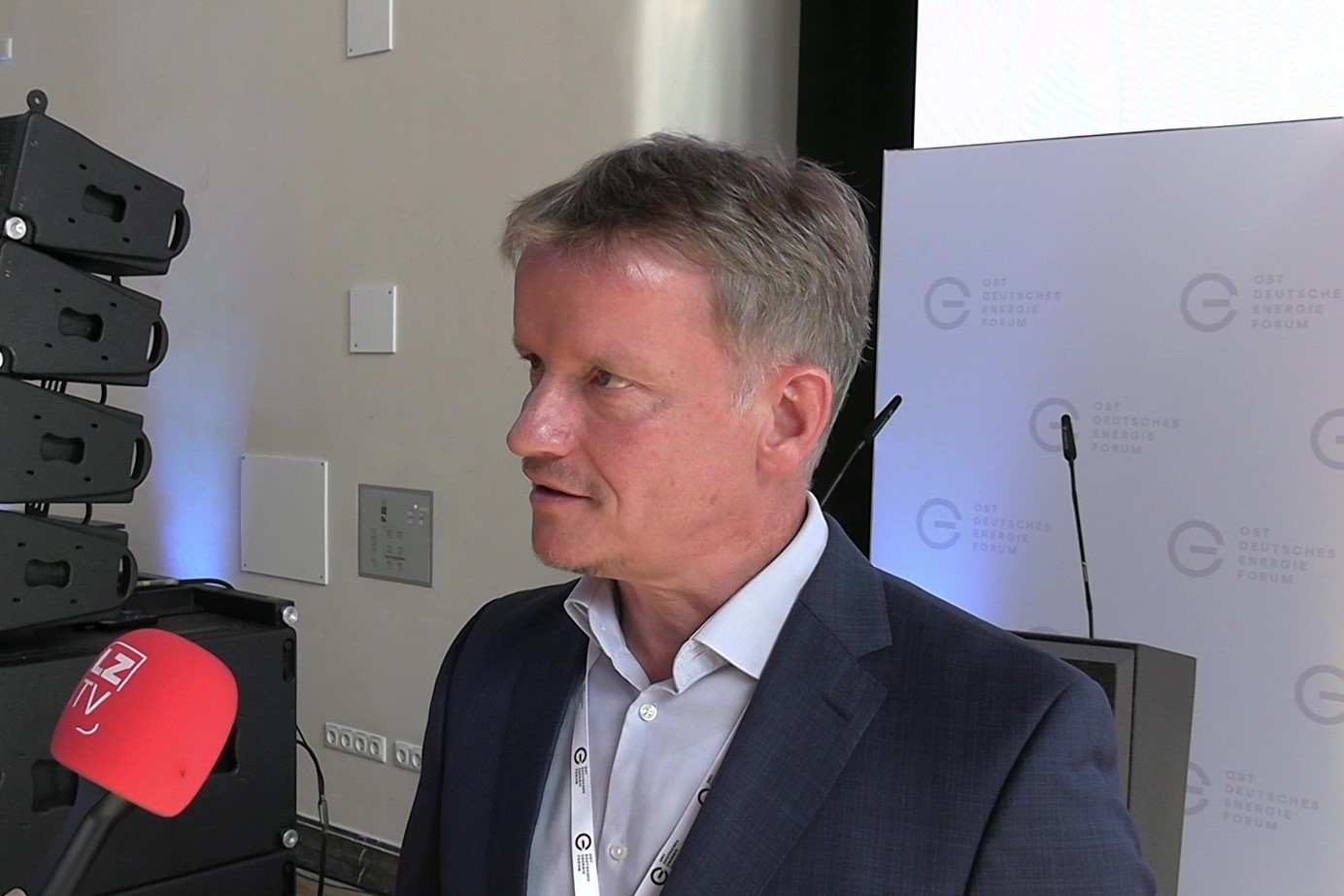
Interlocutor Dr Gunter Erfurt. Photo: Thomas Köhler
The East German Energy Forum is, after all, also there so that people can say something provocative every now and then. So I wasn’t exactly lashing out at the municipal utilities, for heaven’s sake. The municipal utilities are a vital part of Germany’s energy supply, and I certainly hope they’ll be around for a very, very long time – ideally forever. The problem we have in Germany – compared to the rest of Europe and internationally – is the urgently needed roll-out, that is, the installation of smart meters. These are small devices that allow electricity to be fed out of and back into a household, and ideally the whole system can be controlled at 15-minute intervals. We urgently need this to balance electricity demand against generation, which is, of course, more volatile due to renewable energy sources. And it has been proven that this can also help to reduce electricity costs.
The challenge for municipal utilities is that, in the liberalised electricity market in which we live, the moment people install smart meters, their ability to purchase electricity from sources outside the municipal utility and to participate fully in the market naturally increases. This means that, to a certain extent, they themselves become competitors to the municipal utility. And there are many municipal utilities in Germany that have their own energy generation facilities – small gas-fired power stations, other systems, and hydroelectric power stations too. And so it may well be that these business models are less competitive compared to larger players who have already adapted more fully to the whole concept of virtual power plants controlled via smart meters. Conversely – and I believe this is always a positive aspect – it means that municipal utilities which haven’t yet done so must also take a close look at how the markets are developing and adapt accordingly. And then, I believe, there will be plenty of room in the market for all players.
Now I’d like to return to the original question raised by Dr Umbach: cyber security. We have virtual grids, we have smart grids – or at least we want to have them – smart meters and so on, all of which mean that even the slightest disruption to the energy supply can cause enormous problems. I mentioned the Elsberg blackout earlier – you may be familiar with it. How can we counteract this? What do you think can be done to improve the resilience of the grids?
There are various approaches. Firstly – and here I’m coming back to European industrial production – We can do this particularly with these safety-critical components – smart meters, for instance – where this is already the case today. But when it comes to inverters for solar installations in particular, foreign suppliers – primarily Chinese ones – dominate the market. And anyone who has an inverter at home knows that you can use an app to see exactly what the energy yields are. This means the data flows somewhere, is aggregated centrally by the manufacturer and sent back. You get a clear analysis.
In other words, the data leaves the country. There is data access, and that is vulnerable, as they say these days. So this gives us yet another reason to say that resilient infrastructure and cyber security go hand in hand with systems produced here, where we control the components ourselves and ensure that the whole system is housed in a secure environment. Then, of course, artificial intelligence is a huge issue, because – as we often read in the newspapers – these systems effectively gain access on their own. But there are countermeasures in place for that too. You simply have to stay up to date.
And perhaps one final argument in favour of renewables. There are now 5 million solar installations in Germany. And if we look back 30 years, there were probably 20, 30, 40, perhaps 50 energy producers. These were all the large power stations. This means that our energy supply system is inherently more resilient to attacks simply because we have so many small-scale generators. It means we’re in a position where a major blackout could suddenly occur here. I believe the risk is much, much greater in other regions of the world where grid expansion hasn’t yet reached that stage. In Europe, with an interconnected grid stretching from the Atlantic to Ukraine and now as far north as Norway, Sweden and Finland, the system is actually significantly more resilient than, for example, in the USA. In the US, there are a great many local, concentrated grids, and the vulnerabilities there are much, much greater. So we’re actually not in such a bad position.
Dr Erfurt, thank you very much and all the best to you. Conclusion:
We clearly need a comprehensive strategy for the energy supply of the future. On this point, let me refer once again to the comments made by Andrea Thilo during the preliminary discussion with Dr Erfurt. He highlighted the following points:
- We must understand that research and development (R&D) does not stop at the Fraunhofer’s door.
- We treat business and deep tech as if they were humanities.
- We do not fully realise the strengths that we largely possess.
These are just three points, but we believe they are significant. Many related topics were discussed at the forum; we will report on selected ones.
Empfohlen auf LZ


So können Sie die Berichterstattung der Leipziger Zeitung unterstützen:


There is one comment