Dieser Artikel ist auch in deutscher Sprache verfügbar: Zum deutschen Artikel.
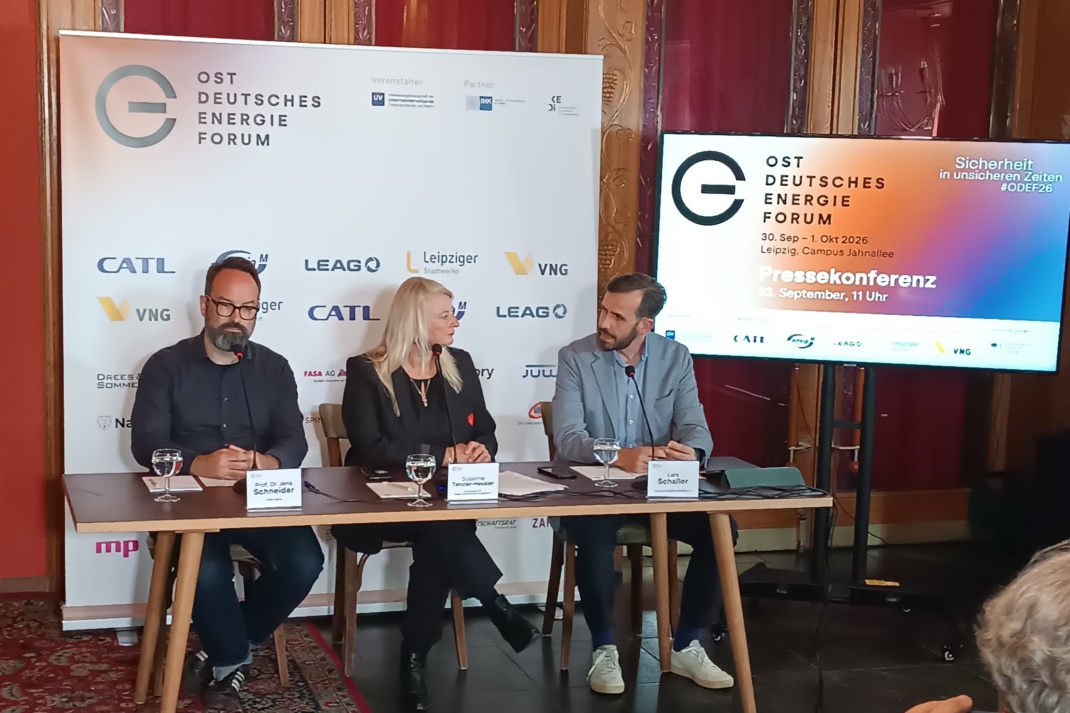
The press conference held by the Saxony Business Association on 22 September in Leipzig really whetted the appetite for taking part in the 15th East German Energy Conference. On 30 September and 1 October, East German business associations are organising this forum and have invited not only their members but also a large number of experts from the energy sector, academia and politics. Exciting panel discussions and debates are on the agenda.
“Eastern Germany is a pioneer in the energy transition”
Following the election results in Saxony-Anhalt and Mecklenburg-Western Pomerania – where propaganda, particularly against wind turbines, played a not insignificant role – this statement by the managing director of the Saxony Entrepreneurs’ Association (Unternehmerverband Sachsen e.V.) was not to be expected at the press conference for the 15th East German Energy Forum. Specifically, when asked about the focus on Eastern Germany, he said: “We do, after all, play a certain pioneering role when it comes to the energy transition. We are exporters of renewable energy and we also have opportunities. We have the land; we can make use of all of it, and that is why we are focusing on Eastern Germany. That said, we know – and I did mention this in my last statement in the *Leipziger Internetzeitung* – that we always bear in mind that energy policy is, in fact, a European responsibility.”
Cooperation with Eastern European partners – such as Bulgaria, a major storage location, and Hungary in the field of solar energy – will also be a topic at the forum.
The real problem lies less in the economy than in politics; this can be inferred from his remarks: “I believe that these political shifts and the various interests we are constantly trying to balance make it extremely difficult to follow a consistent course. The pioneering role we actually played has been curtailed by political decisions or other framework conditions over which we do not always have control. Other countries have overtaken us; if you look at China in the automotive sector, you can feel the effects here in Zwickau too.”
Lars Schaller explained the purpose of the forum as follows: “We are trying to give a voice to representatives from politics, public administration, the energy sector, academia, and small and medium-sized enterprises – in other words, our core clientele – so that we can discuss the energy transition and how we can successfully implement it. It is highly relevant not only for our small and medium-sized enterprises, but also for the economy as a whole, and that is why we believe it is extremely important that we discuss how we can successfully implement this energy transition and shape the framework conditions – particularly for our small and medium-sized enterprises – in such a way that they remain competitive in Germany, in Europe and globally.”
At least as far as the Saxony Entrepreneurs’ Association (Unternehmerverband Sachsen e.V.) is concerned, the question is not whether there must be an energy transition, but simply how it should be shaped. Lars Schaller comments: “How can we reach an agreement on this so that we can move forward together, and how do we reconcile populism with pragmatism on this issue?”
The technical-scientific perspective
This was provided by Prof. Dr Jens Schneider from HTWK Leipzig, who also coined the term ‘energy policy quadrangle’ featured in the article’s headline. He explained that renewables already account for around 60 per cent of the electricity supply, but that other sectors, such as transport and buildings, are lagging behind.
On how this can be changed, he said: “The opportunity lies in interconnecting these various energy sectors, in electrifying a relatively large proportion of the other sectors through electric mobility and heat pumps, and in finding ways within industry – through electrolysis and hydrogen – to utilize the low-cost energy supply from wind and solar power, so that we can also provide low-carbon, environmentally friendly energy at affordable prices in the other sectors, and so that, in turn, we do not have to curtail the fluctuating supply from wind and solar in the electricity sector, but can instead utilize it intelligently.”
This requires the increased use of storage technologies, but above all cooperation between storage and grid operators. He goes on to explain: “In my view, the most important thing at present – and we’re addressing this at the East German Energy Forum too – is that grid operators and storage and flexibility operators do not work against one another, but find a way to work together. I like to put it this way: we must find a way – and this is where politics comes into play – for grid operators to trust storage operators – to put it briefly, though I mean all flexibility operators – that they won’t do the wrong thing.”
What is the ‘wrong thing’? Grid operators must keep the grid running without interruption all year round, and battery storage could help with this. “The thing about battery storage, however, is that it’s very flexible; it can release or absorb energy and can actually help the grid. At the moment, however, they have no idea what the grid actually needs. And if they don’t know, they can’t do it. Instead, they tend to base their operations on the nationwide electricity price, whilst local grid utilization is irrelevant. And that means – and this is actually measurable – that a few times a year they do exactly the wrong thing. The grid is overloaded; there’s already too much energy in the grid, and the storage systems are feeding even more energy into the local grid. This is actually measurable; it happens with the grid operators, and they then have to react to it and may well say: ‘We must first expand the grid to cope with these situations before such a storage system can be connected to the grid.’
There are researchers at the HTWK and elsewhere who are working on this issue. According to his explanations, the challenges posed by the ‘dark lull’ seem to be relatively easy to resolve. What matters is how to deal with the surplus electricity during the ‘sunny spell’. This is where smart storage solutions are needed.
What does political science have to say?
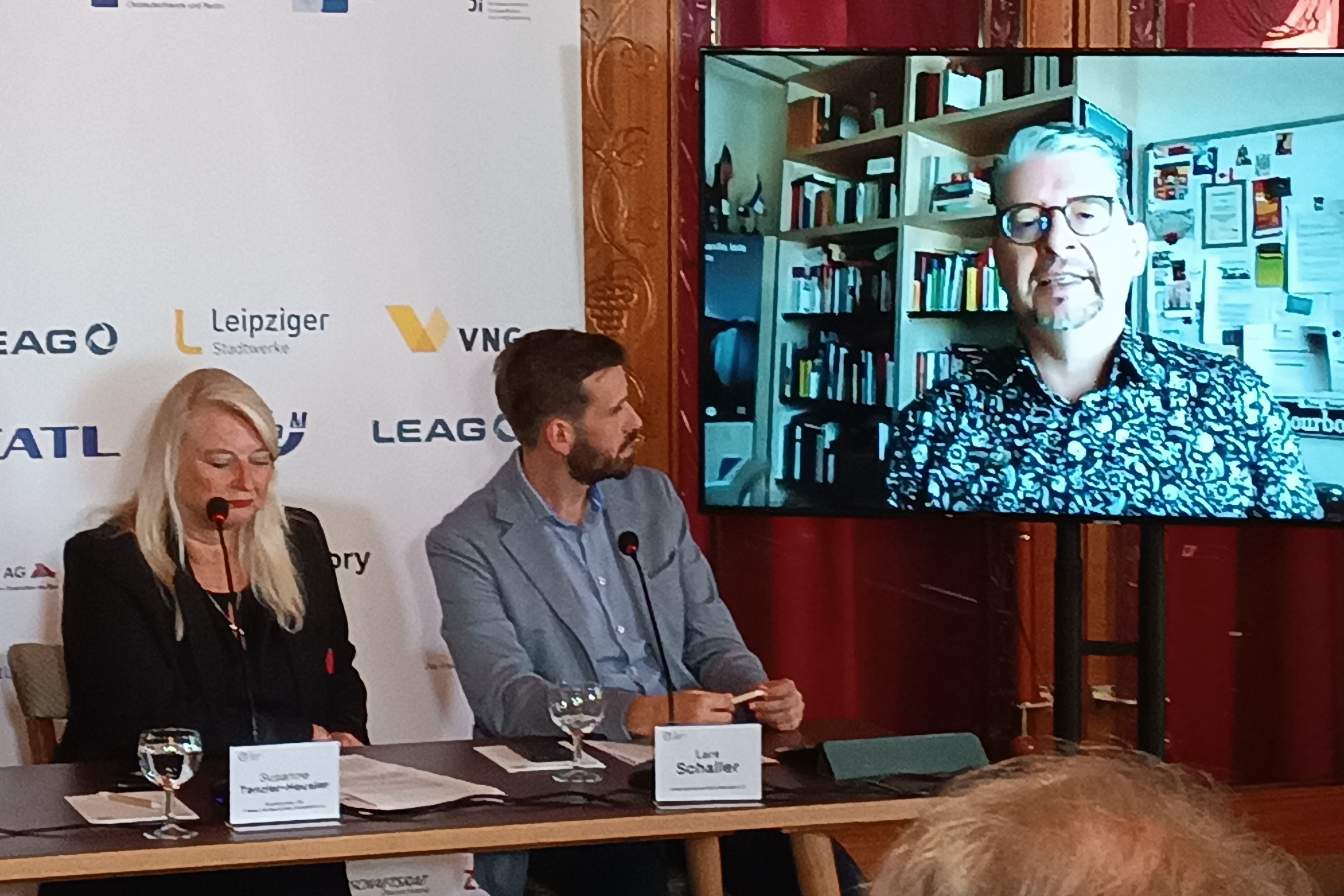
Lars Schaller spoke of populism and pragmatism in the context of the energy transition, and these played a significant role in the recent state elections. It was therefore logical to bring Prof. Dr Wolfgang Muno from the University of Rostock, a political scientist, on board.
Prof. Muno, who joined via video chat, addressed, amongst other topics, the return to nuclear energy often championed by political actors. “We see calls for a return to nuclear energy in election manifestos, for example from the AfD but also from the CDU. And, as far as I am aware, one nuclear power station is currently being built in Europe: Hinkley Point C in the UK. It is still a long way from completion, and the current costs stand at 55 billion euros. And this is supposed to be a cost-effective energy supply? Someone will have to explain that to me first.”
At the Energy Forum, Prof. Muno will engage in a fundamental political debate with Paul Ronzheimer on the topic of ‘Energy policy between pragmatism and populism’. We look forward to it.
Conclusion: For a press conference, there were a great many detailed remarks on the topics; we’ve already taken a lot of it on board. One conclusion is that the vast majority of companies do not question the energy transition or renewable energies. What everyone is calling for, however, is a long-term and reliable energy policy. This must also lead to reasonable energy prices.
We will be reporting on what happens at the East German Energy Forum. The press conference was also livestreamed; the recording can be found here.
Empfohlen auf LZ


So können Sie die Berichterstattung der Leipziger Zeitung unterstützen:



There is one comment