Dieser Artikel ist auch in deutscher Sprache verfügbar: Zum deutschen Artikel.
The role of electricity grids and energy storage systems in the increased use of wind and solar power is surely undisputed. The former are needed to transport electricity from where it is generated to consumers, whilst the latter must store any surplus electricity generated until it is needed. That’s a simple way of putting it; specialists would probably find more and different words for it, but let’s leave it at that.
So what is the problem?
At the press conference for the East German Energy Forum (ODEF), Prof. Dr Jens Schneider from HTWK already elaborated on this: “In my view, the most important thing at the moment – and this is something we’re also addressing at the East German Energy Forum – is that grid operators and storage and flexibility operators do not work against one another, but find a way to work together. I like to put it this way: we must find a way – and this is where politics comes into play – for grid operators to trust storage operators – to put it briefly, though I mean all flexibility operators – that they won’t do the wrong thing.”
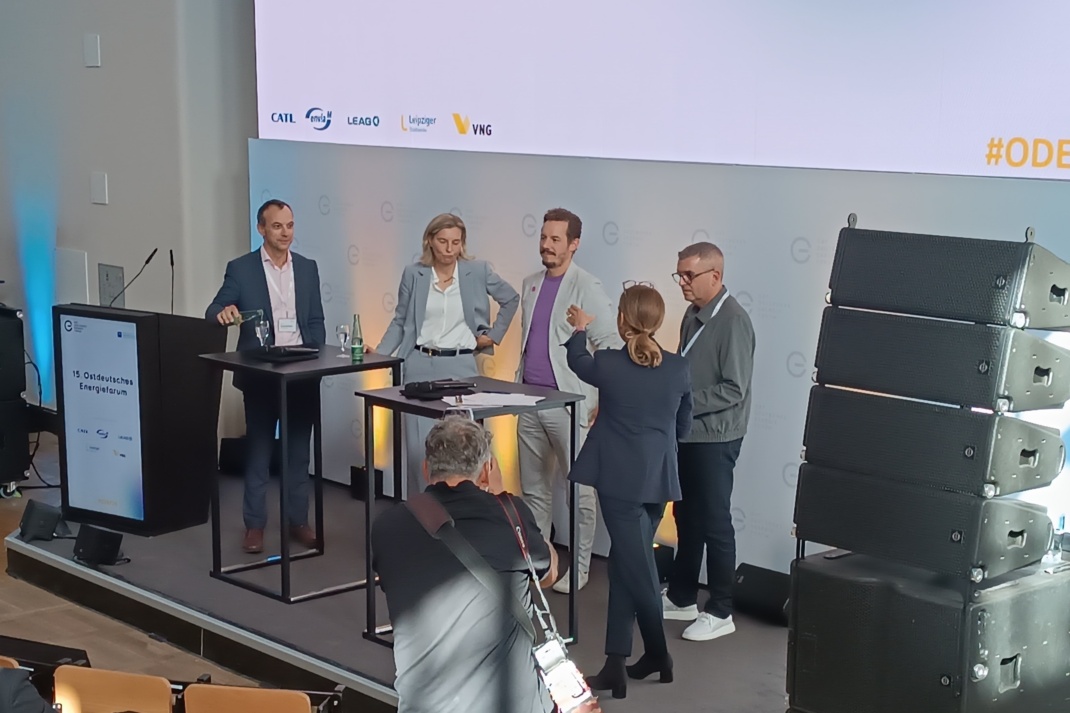
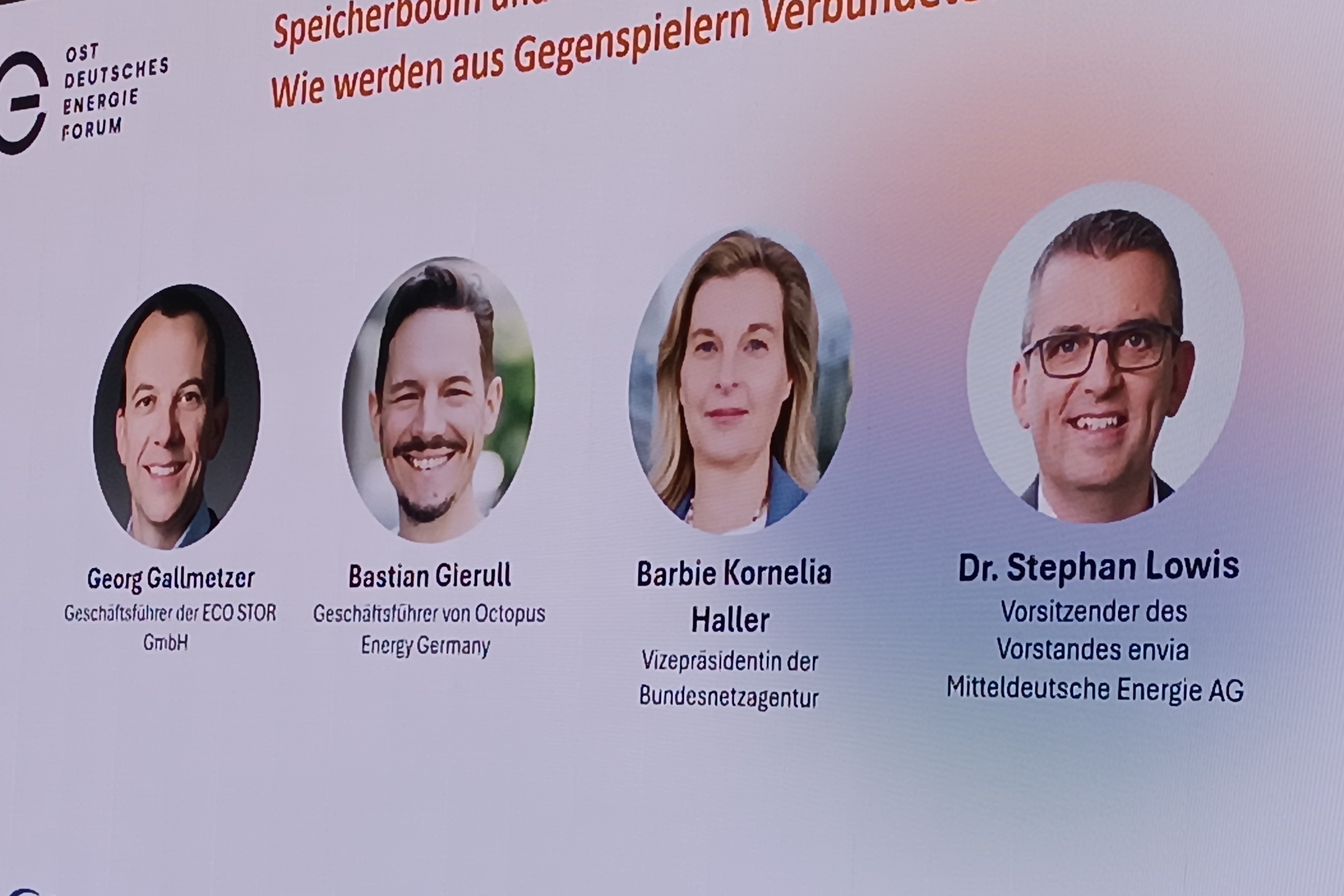
On day one of the ODEF, the panel discussion ‘Grids vs. Storage: Opponents in the energy transition or strategic allies?’ took place. The panel featured a high-calibre line-up comprising Barbie Kornelia Haller (Vice-President of the Federal Network Agency), Georg Gallmetzer (Managing Director of ECO STOR GmbH), Bastien Gierull (Managing Director of Octopus Energy Germany) and Dr Stephan Lowis (Chairman of the Executive Board of envia Mitteldeutsche Energie AG), and was moderated by Andrea Thilo.
The grid operator
The problem highlighted by Prof. Schneider at the press conference quickly became apparent when Dr Stephan Lowis explained, on behalf of the grid operators, that they were being inundated with grid connection requests. Some of these, he said, were “gold diggers” who would resell the connections at a higher price. He said: “All our grid connections would be completely taken up by battery storage systems. No data centres, no local supply customers, no renewables – nothing would be allowed to connect any more. And we’re currently sorting that out ourselves.”
The decisive factor for allocation would be the benefit to the grid or the system. Dr Lowis continued: “Of the 10,000 connection applicants who are currently battery storage systems, 9,900 claim that they are beneficial to the grid, beneficial to the system or whatever – which is absolute nonsense. Really, absolute nonsense. I’ve looked at lots of storage units in our area that discharge when we have too much electricity on the grid. At 12 noon, they’re firing it out. And they’re not charging up either; instead, they say: ‘The price is what it is.’ ‘I’ll feed the electricity into the grid as quickly as possible because that’s how I make my margin.’ That’s part of the truth, and that’s exactly what we need to sort out right now. And in this regard, politicians and the Federal Network Agency are quite frankly not helping at the moment, because we have to define the rules ourselves.”
The law sets out how grid connections are allocated, but according to Dr Lowis, this is now outdated: “We’ve told the Federal Network Agency and politicians that the ‘first-come, first-served’ principle we have today – where whoever gets there first gets the grid connection – simply doesn’t work.”
The Federal Network Agency
Barbie Kornelia Haller does not accept this: “But you could have moved away from the ‘first-come, first-served’ principle earlier – and there are many grid operators who have done so – and established your own rules. You could also have come to us and asked: ‘Is this discriminatory? Can we do this? Can we not do this?’ That’s exactly what we’re doing now. The E.ON Group is now also approaching the Federal Network Agency and saying, ‘We’ve changed our system.’”
The legislature is currently working on a grid connection package to lay down basic rules. Ms Haller hopes this will be finalized quickly so that the Federal Network Agency can draw up the subsequent regulations. But in her view, the grid operators are not entirely blameless either: “Thirdly, there are good and bad grid operators, and fourthly, there’s sometimes a bit of a scuffle at the party. In that respect, yes, we need to sort it out.”
The battery storage operator
It was Georg Gallmetzer who, right at the start, introduced the ‘party’ metaphor – later adopted by everyone – into the discussion. He said: “The battery storage systems have turned up at the party, and the host, who controls the grid connections, didn’t even invite them. Incidentally, neither did the government nor the Federal Network Agency.” The storage operators had connected them, he explained, and then the grid operators had demanded rules. There had also been incidents, he added, meaning the players had often become adversaries. That’s the short version; you can find the long version in the video linked above.
In response to Ms Haller, he speaks of a market size for the battery storage market of 50,000 megawatts. “There won’t be any more than that, because investment decisions – and that’s what matters – are what count; you can make rules however you like. The financial market thinks in terms of investment decisions: is it still a viable business case? And the break-even business case ends at 50,000 megawatts. I’ll stand by that.”
Mr Gallmetzer believes, however, that there are enquiries for 500,000 megawatts and commitments already in place for 80,000 megawatts. The question would be: how do we get rid of the other 30,000? In his opinion, the maturity assessment process is coming years too late.
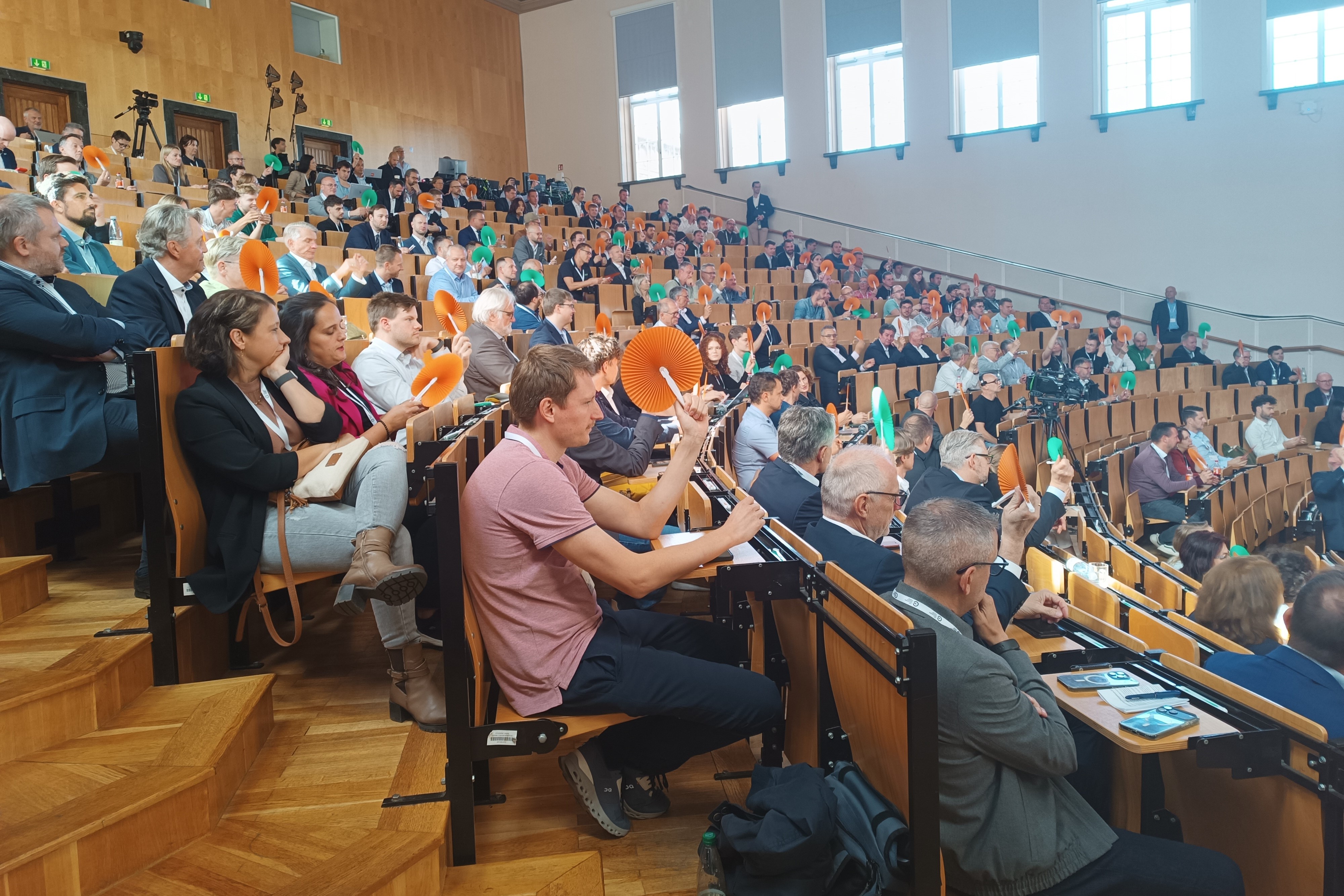
The audience doesn’t always agree in polls: green – in favour, orange – against. Photo: Thomas Köhler
The energy supplier
Bastien Gierull posed an important question right at the start: “Who’s footing the bill? Ultimately, it’s the consumers out there. They’ll have to pay for it if we need to expand the grid further – yes – and why do we have to do that? Well, the question isn’t whether it’s batteries versus grids or grid connections, but rather why do we have one of the most expensive grids in Europe and are we running it blind?”
Among other things, this flying blind and the rising grid charges resulting from grid expansion are due to the fact that we’re not making progress with V2G (Vehicle-to-Grid) and smart meters.
As expected, this is met with a counter-argument, in this case from Dr Lowis. However, he agrees that local grids are not yet digitized because “to date, there has been no requirement to do so.” According to Dr Lowis, Germany has “messed up” the smart meter roll-out, but this is the fault of politicians. Because they “have set hurdles so high that smart meters have stricter security requirements than your private banking account.”
There is broad agreement that greater digitalization of the grids and an acceleration of the smart meter roll-out are needed.
The discussion
This was lively, though – to stay with Bastien Gierull’s party analogy – “as everyone knows, only the parties where the police turn up were really the good ones.” To cover all the topics discussed here would go far beyond the reasonable scope of an article. However, one point must be addressed – a point that is typical of Germany.
Andrea Thilo asked: “Isn’t it absurd – sorry for asking this now – that we still have so many distribution networks, that we have 800 to 850 of them? Excuse me, but it’s a bit like the 19th century, with everyone having their own little duchy. I think, in the spirit of the joint task we’ve been discussing here since 11 am this morning, we really need to tackle this urgently.” We have included a map from the Federal Network Agency here, showing the distribution networks.
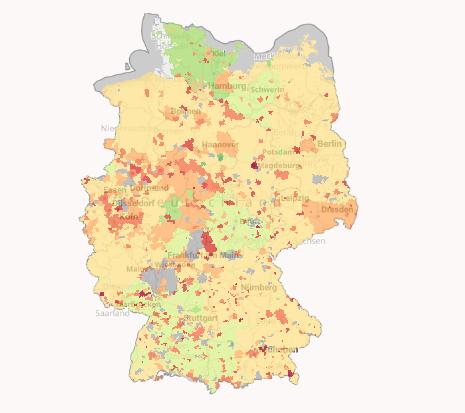
Federal Network Agency – Map of Germany showing the supply quality of distribution network operators. Screenshot: LZ
Specifically, there are apparently 866 distribution networks, including those operated by municipal utilities. Georg Gallmetzer’s response focused on these, and he did not wish to deny their right to exist. However, he says: “The municipal utility business model is indispensable given the acceptance of the transition. But what the municipal utility ultimately does, in my view, is not to take on the full scope of grid management, but rather to explain the energy transition at a local level, to operate a business model based on contracting, perhaps a bit of heat and electricity trading, and then, please, let the professionals handle the grid management.”
Bastien Gierull argues that it is inefficient if the transformation and digitalization have to be carried out 866 times.
Conclusion: So many topics were raised in the roughly 45 minutes that it is not possible to cover them in detail here. The key questions included: Are grid operators and storage operators already partners, or are they working against each other? Are guidelines needed, and if so, what sort? How can consumers – not just large-scale consumers – be involved and participate? Does Germany need 866 distribution networks, and if so, how can these be ‘synchronized’?
These and other questions could not be fully answered, but the potential partners are all interested in finding solutions. The following day, we spoke to Hartwig Kalhöfer from Stadtwerke Leipzig, Christoph Eger from enviaM and Jörg Kranzfelder from FlexHome.Energy, among other things on this topic. The latter introduced us to a new and interesting project. More on this in the next article.
Empfohlen auf LZ


So können Sie die Berichterstattung der Leipziger Zeitung unterstützen:





There is one comment