Dieser Artikel ist auch in deutscher Sprache verfügbar: Zum deutschen Artikel.
The taxi industry in Leipzig is also suffering from rising fuel prices. Since the last survey in 2022, the situation has deteriorated drastically. And so the proposal on fares in the Leipzig taxi industry, which came before the city council on 2 July, was long overdue. The minimum wage for taxi drivers, which has been in force since January, was also adding to the pressure. Only the Greens thought: ‘Couldn’t we link this to an environmental issue as well?’ That was probably not the right occasion.
Even though the concern raised by Green Party councillor Sylvia Herbst-Weckel was all too understandable: to seize the opportunity to encourage taxi companies to put more electric taxis into service. After all, Hamburg had managed to do just that.
The reasoning in the Greens’ motion was entirely plausible: “The fare increase is justified, amongst other things, by rising fuel, maintenance and operating costs. Before any further adjustment to fares, the cost structures of fully electric taxis should therefore be taken into account and legally permissible economic incentives for their use identified.”

However, this is a proposal that cannot simply be implemented in the short term, even though the Green Party group suggested: “Before any further adjustment to transport fares, the administration shall present the City Council with a comparative full-cost analysis for conventional and fully electric taxis, as well as a realistic mixed fleet. On this basis, it must be demonstrated whether, and by means of which legally permissible options – in particular those relating to tariffs and those that are budget-neutral – economic incentives can be created for the use of fully electric taxis.”
This is a substantial task, which is certainly worthwhile, but one that even Leipzig’s administration cannot complete in a matter of weeks.
Taxi industry under pressure
And the city’s proposal was a matter of days. This is because taxi companies in Leipzig – which, particularly with the suspension of tram services from 27 June, are demonstrating just how urgently they are needed even in such emergencies – have been suffering from rising costs for some time.
This has consequences, as the proposal from the Environment Department also clearly set out: “Owing primarily to the difficult business situation, the number of taxis has fallen by 48 to 510 since the last increase in fares in 2022. In collaboration with the Leipzig Chamber of Industry and Commerce, all taxi companies were consulted on the planned fare increase and the introduction of a flat-rate fare (fixed price). The majority of operators were in favour of a fare increase and against fixed prices. However, when considering the number of licences represented by the companies, a majority were found to be in favour of introducing flat-rate fares.”
Flat rates and flexible surcharges
In future, there will not only be flat rates, but also flexible surcharges, as the Department for the Environment explains: “The flexible structure of the surcharge, ranging from 15 to 25 per cent, is intended to create incentives to better meet the needs of market participants in a wide variety of demand situations. The introduction of fixed fares in the pre-booking market is intended to create greater price transparency for passengers. Furthermore, this will enable the service to keep pace with the trend towards advance information and decision-making, including advance payment (click & pay). The fare can then be arranged in advance using cashless methods (e.g. via the taxi app) with modern payment systems.”
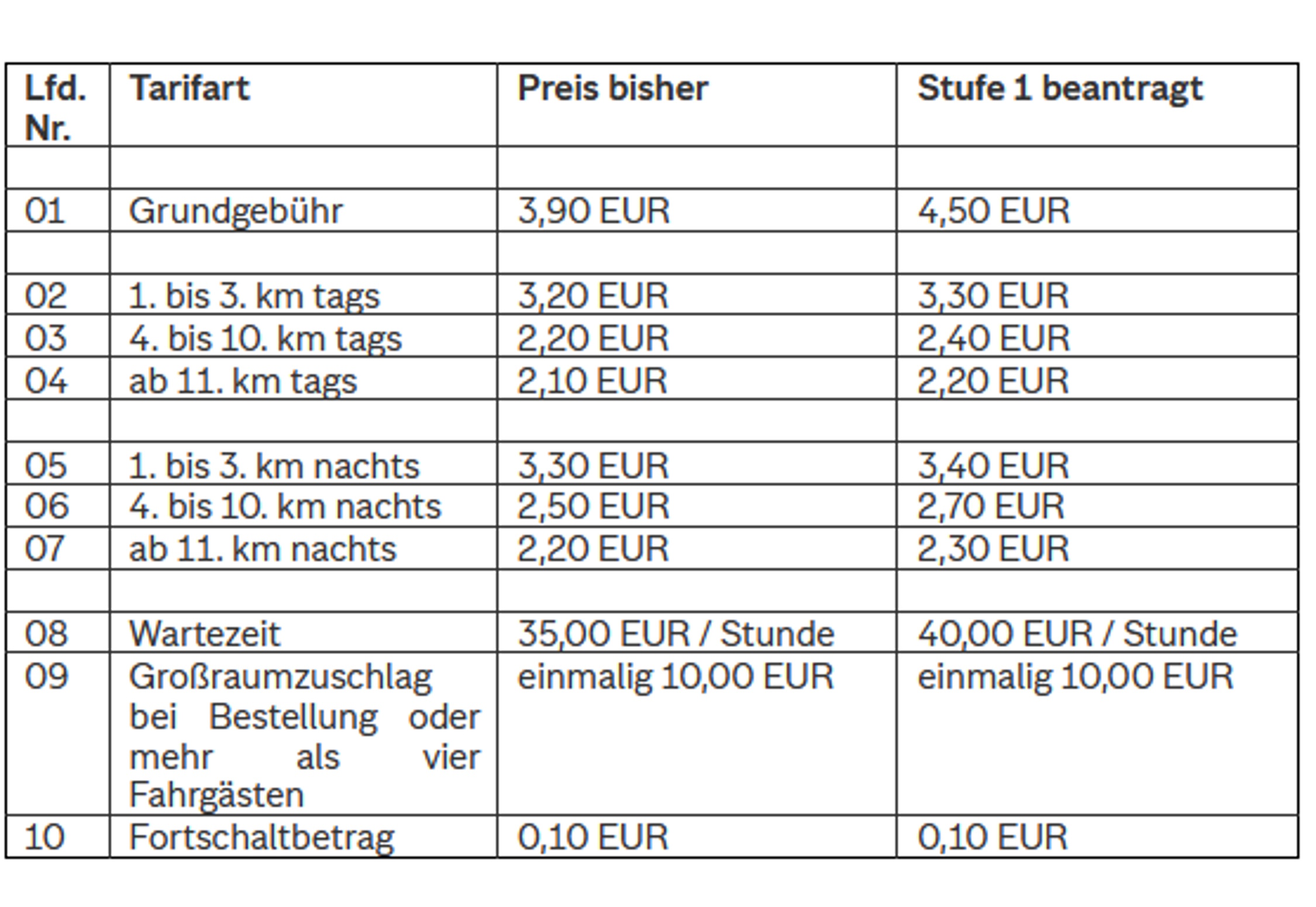
Comparison of old and new taxi fares. Graphic: City of Leipzig
“Currently, the average journey distance is seven kilometres. Based on the proposed fares for this distance, the licensing authority’s calculations show a price increase of around 7.5 per cent in Stage 1. By comparison, the price increase for the transport service provider Leipziger Verkehrsbetriebe GmbH has been approximately 22% since 2022.”
A thoroughly noteworthy observation.
Incidentally, Leipzig is not the only local authority where taxi companies have been pushing for higher fares, according to the Department for the Environment: “This fare increase marks the end of the Central German taxi fare structure. In the Saalekreis district and the city of Halle, applications for fare increases are currently pending, with per-kilometre fares and the initial charge exceeding the rates applied for in the city of Leipzig. No applications have been submitted in the districts of Leipzig and North Saxony at present. Should corresponding applications be submitted in these two districts, the licensing authorities of the three Saxon local authorities agree that a common taxi fare structure should be introduced for these areas.”
In Leipzig, the new fare structure will come into effect in the next few days, as the City Council approved the proposal on 2 July by 49 votes to 9.
Only the Green Party group voted against it, as their own motion had not been successful. That had previously been rejected by 24 votes to 31.
The Greens are therefore not alone in their aim of encouraging Leipzig’s taxi companies to purchase electric taxis. However, the package they proposed actually belongs in a separate motion and would have delayed the decision on the new taxi fare in a situation where taxi companies have long been under price pressure and needed a swift decision.
Empfohlen auf LZ


So können Sie die Berichterstattung der Leipziger Zeitung unterstützen:



There is one comment