Dieser Artikel ist auch in deutscher Sprache verfügbar: Zum deutschen Artikel.
The demographic decline in Saxony is now also becoming apparent in the employment statistics. Whilst the number of full-time employees with German citizenship is beginning to dwindle – because the size of the incoming age cohorts has halved – the proportion of foreign employees is growing. And that is only the figure for full-time workers. If precarious forms of employment were included in the statistics, the disparity would be even more evident.
At the end of December 2025, 1,627,111 employees subject to social security contributions were in employment in the Free State of Saxony, according to the State Statistical Office. This represented a decrease of 17,015 employees, or 1.0 per cent, compared with the end of 2024. This reflects not only rising unemployment but also the increasing number of older workers retiring.
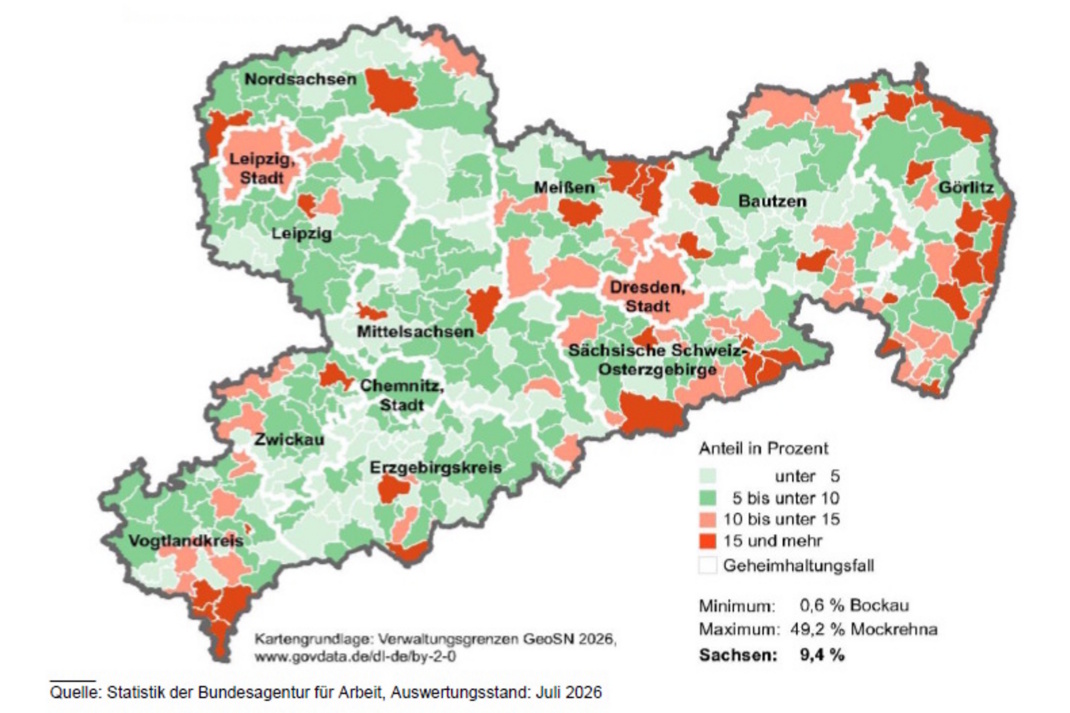
Of these full-time employees, 153,638 people – or 9.4 per cent – were foreign nationals. That is now almost one in ten. The number of foreign workers actually rose by 7,644, or 5.2 per cent, compared with the previous year. Their numbers are therefore growing, partly because in many sectors jobs can simply no longer be filled by candidates with German nationality.
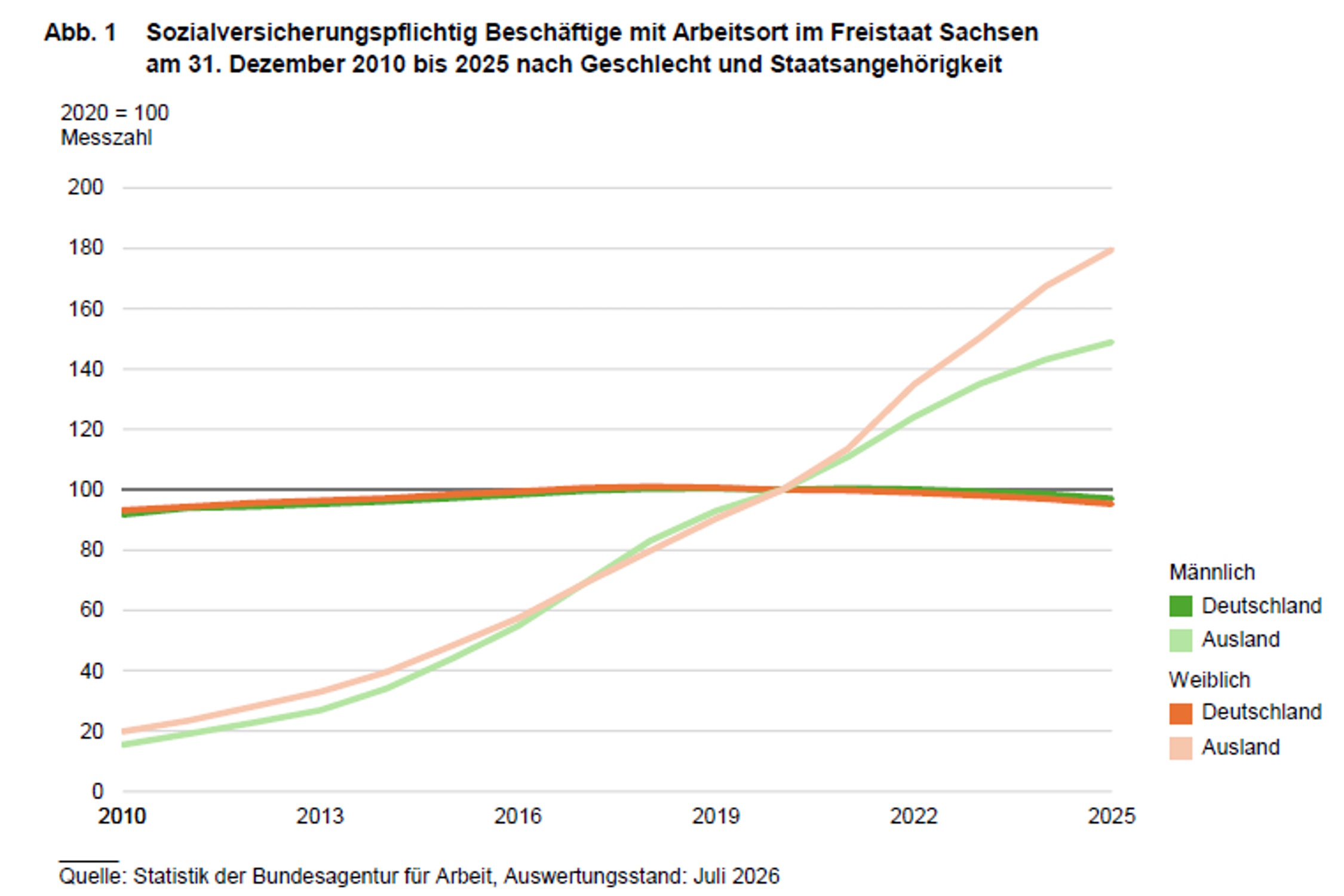 Employees subject to social security contributions working in the Free State of Saxony from 31 December 2010 to 2025, by gender and nationality. Graph: Free State of Saxony, State Statistical Office
The State Statistical Office also makes this clear when describing this now unmistakable trend: “A comparison with the end of 2020 shows an almost unchanged total number of employees (−0.1 per cent). However, the number of German employees fell by 3.8 per cent (−22,632 men and −36,207 women).
By contrast, the number of employees of foreign nationality rose significantly by almost 60 per cent (31,457 men and 25,628 women). Among employees of German nationality, the proportion of men was just over 51 per cent. Of those in employment with foreign nationality, just over 62 per cent were men.”
Major regional differences
And the statistics also highlight the role played by Leipzig in this regard. Regionally, the majority of foreign employees were based in the city of Leipzig at the end of 2025 (21,748 men and 12,870 women). With 297,141 full-time employees in the trade fair city, the proportion of foreign workers here had by then reached 11.6 per cent. And yet Leipzig was not even the frontrunner in Saxony.
At the level of Saxony’s districts, the proportion of foreign workers was highest in Görlitz at 13.3 per cent. By contrast, this figure stood at 6.2 per cent in the Erzgebirge District. At the local authority level, this proportion currently ranged up to just under 50 per cent (Mockrehna in Northern Saxony, and Ellefeld in the Vogtland district at almost 44 per cent). In 40 towns and municipalities within the districts, the proportion of foreign workers out of the total workforce was greater than 15 per cent at the end of December 2025.
When broken down by sector, foreign workers were particularly concentrated in ‘other economic services’. They were also primarily employed in the transport and warehousing, health and social care, and hospitality sectors. Within the manufacturing sector, the main areas of employment were construction, the metal industry and the production of food and beverages.
These are all sectors without which economic life in Saxony would function just as poorly as the healthcare system. Or to put it another way: without a steady inflow of immigrants from abroad, even the Free State of Saxony can no longer meet its labour needs. And this applies not only to the major cities, but also – and particularly – to many local authorities in rural areas.
Empfohlen auf LZ


So können Sie die Berichterstattung der Leipziger Zeitung unterstützen:





There is one comment