Dieser Artikel ist auch in deutscher Sprache verfügbar: Zum deutschen Artikel.
The pension reform is casting its shadow – and by that we mean its downsides – and much of the criticism stems from the plan to abolish the ‘full pension for those with particularly long insurance records’, also known as the ‘pension at 63’.
The East German CDU minister-presidents, trade unions and, in particular, the Left Party are all united in their opposition to this – a rather interesting coalition. The German Institute for Economic Research (DIW) is vehemently campaigning for the abolition of this scheme; according to Tagesschau, its president, Marcel Fratzscher, has stated that retaining it would be tantamount to putting an end to the announced rescue mission for the pension system.
What is the DIW’s basis for this?
The DIW has produced a study on this topic, commissioned by the Bertelsmann Foundation. It sets out the following premise:
“Abolishing the full-rate old-age pension for those with particularly long insurance records (pension at 63) – which is very popular among employees – could relieve the state coffers by 9.5 billion euros per pensioner cohort. Deferring the retirement age would also make 125,000 full-time workers available to the labour market. However, exceptions would be needed to avoid hardship for pensioners.”
Hardship cases
Yes, these cases of hardship – who isn’t familiar with them? However, the DIW defines them rather strangely:
“To avoid hardship, an individual health assessment could be considered as an eligibility requirement for the ‘pension at 63’, or a redesigned occupational disability insurance scheme. Proving that one has worked for many years in demanding jobs would also be conceivable. However, these approaches involve a great deal of bureaucratic red tape and high costs. It would be easier to implement if average income were also taken into account as a criterion. This is justified because physically demanding jobs are often associated with low incomes. An income threshold of, for example, 60 per cent of the average earned income, as proposed by the German Council of Economic Experts, would be conceivable here.”
There is a sleight of hand in this line of argument. The second sentence refers to ‘demanding jobs’, whilst the fifth sentence refers only to ‘physically demanding jobs’ as a criterion. The latter are ‘often associated with lower incomes’, according to the DIW.
Demanding jobs and income
Is the work of a steelworker at a blast furnace or in a foundry a “physically demanding job”? One would think so. Is it associated with a low income? With a monthly wage under a collective agreement ranging from €3,284 (entry-level salary in Saxony) to €5,260 (in Baden-Württemberg with over 10 years’ professional experience), the salary can hardly be described as low. So, according to the DIW, does this mean that steelworkers do not fall into the category of people entitled to a ‘pension at 63’?
It will probably be the case that the burden of proof for being a hardship case lies with the employee, and that approval for early retirement will be a discretionary decision by the pension insurer.
The ‘pension at 63’ myth
Who are the employees with particularly long service records who claim the ‘pension at 63’? Firstly, we must make a clear distinction here between pensioners and civil servants; for a teacher or local government civil servant, for example, this pension reform is completely irrelevant. But that is just by the way.
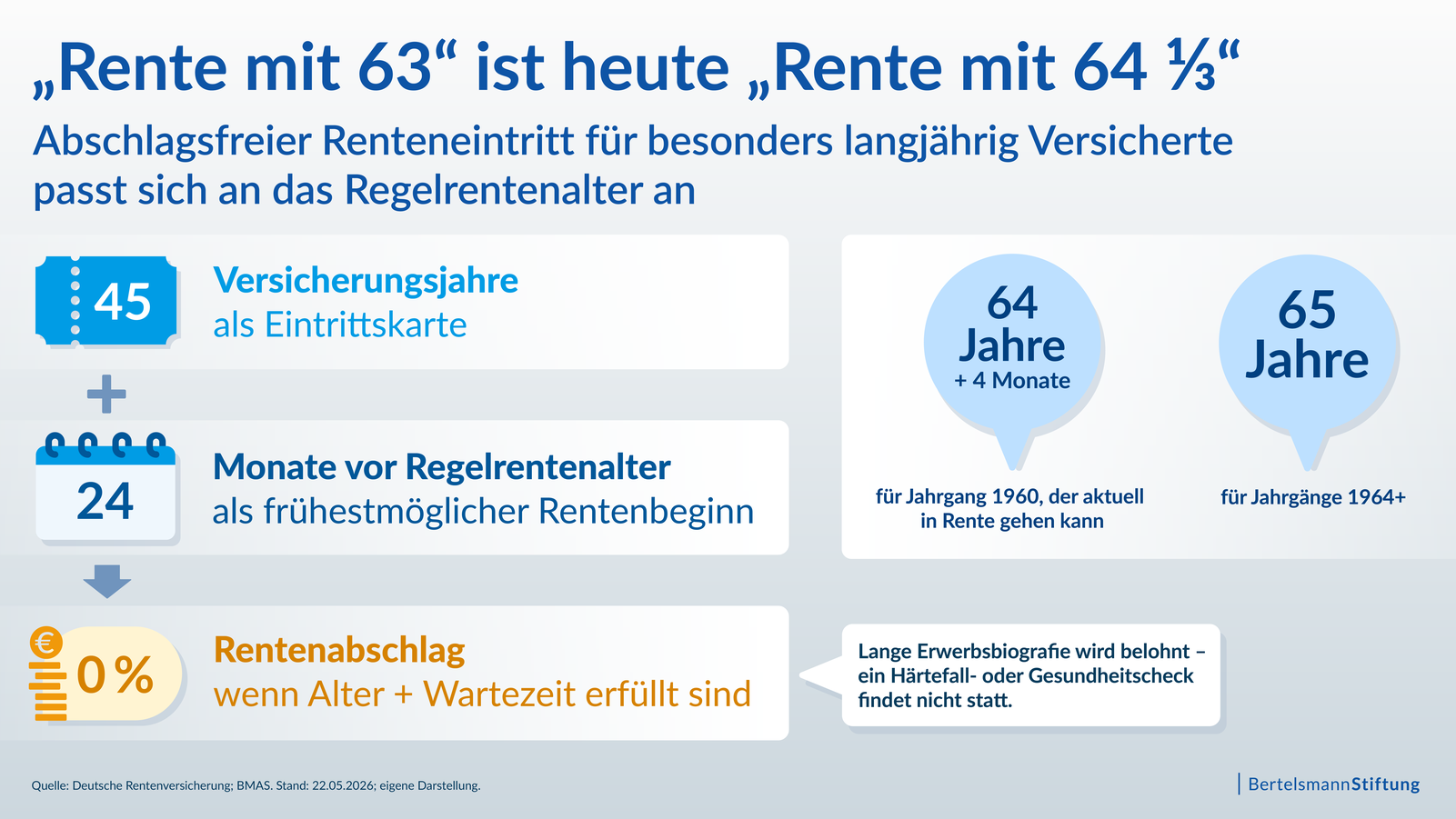
Retirement at 63 is now retirement at 64. Graphic: DRV, screenshot: LZ
The full old-age pension for those with particularly long insurance records does not mean that you can retire after 45 years of contributions. In the case of someone born in 1966 who starts an apprenticeship at the age of 16 and is continuously employed in a role subject to social insurance contributions, retirement would otherwise be at the age of 61. However, there is a catch in the pension system, as in addition to the 45 years of contributions, there is also a 24-month waiting period before reaching the standard retirement age.
In the case described, this means: starting work in 1982, 45 years of continuous employment in 2027, receiving the standard old-age pension in 2033, and the pension for long-term contributors becoming available from 2031. This means that the full pension is available at the age of 65, after 49 years of employment. Yes, the employee can also retire as early as 63, but with a permanent 14.4 per cent reduction.
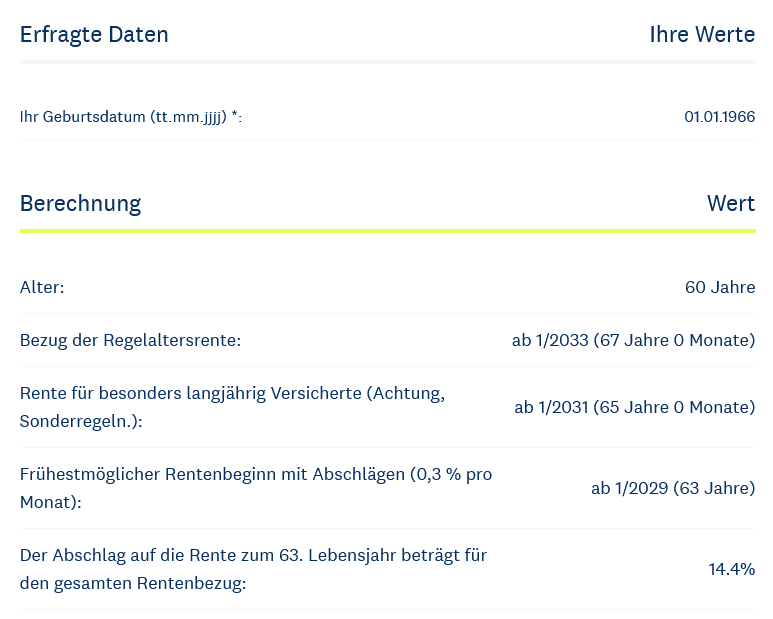
Pension age for those born in 1966. Screenshot: LZ
‘Pension at 63 is a myth’.
From the right pocket to the left
According to the DIW, the abolition of the so-called ‘retirement at 63’ could save the state coffers 9.5 billion euros per pensioner cohort. Doubts are certainly warranted. We are talking here about savings for the pension fund – but what about the other social security funds?
The premise that “the labour market would also have an employment potential of 125,000 full-time workers” could, in times of rising unemployment, also mean that there would be 125,000 more people claiming ALG1 unemployment benefit.
If we take into account the age-related increase in illness – incidentally, one of the reasons why companies are reluctant to hire older people – then the costs of continued pay and sick pay will also rise. Pensioners, after all, receive neither. The health insurance funds will not be pleased about this.
If preventive healthcare for older workers is taken seriously – which is unlikely – then the number of rehabilitation measures aimed at maintaining employability (rehabilitation before retirement), paid for by the pension insurance funds, will rise.
If you factor all this in – even without assuming that older workers register as unemployed a year before retirement or ‘squeeze in’ longer periods of sick leave – the savings in the pension fund might well be financed by expenditure from unemployment and health insurance. This is likely to be the case for at least part of the 9.5 billion.
Conclusion: Abolishing the so-called ‘pension at 63’ will not solve the problem of pension funding, even though this is repeatedly claimed. On the revenue side, a first step would be to make civil servants – who do not even pay into pension funds and whose pensions are paid by the state out of taxpayers’ money – contribute. A high-level pension commission should have further proposals up its sleeve, not just spending caps for those who dutifully pay their contributions.
Empfohlen auf LZ


So können Sie die Berichterstattung der Leipziger Zeitung unterstützen:




There is one comment