Dieser Artikel ist auch in deutscher Sprache verfügbar: Zum deutschen Artikel.
On Saturday, two demonstrations took place in Leipzig, protesting against a potential defence industry site in the Leipzig area and against gentrification. According to the police, at least one of the gatherings was not entirely peaceful. Also: All eyes are on Sunday’s state election in Mecklenburg-Western Pomerania and the Berlin House of Representatives election. The LZ summarises the key events from the weekend of 19–20 September 2026 in Leipzig, Saxony and beyond.
Demonstration against an arms factory in the Leipzig area with several hundred participants
Several hundred people demonstrated on Saturday from 1.00 pm against a planned arms factory in Leipzig. According to on-site estimates, the number of participants stood at around 500. The immediate trigger was the public disclosure of plans by the US defence contractor Covenant to begin manufacturing cruise missiles in the Leipzig area as early as next year. The participants then marched through the city under the slogan “No missile factory in Leipzig”. An alliance of the same name had called for the protest.
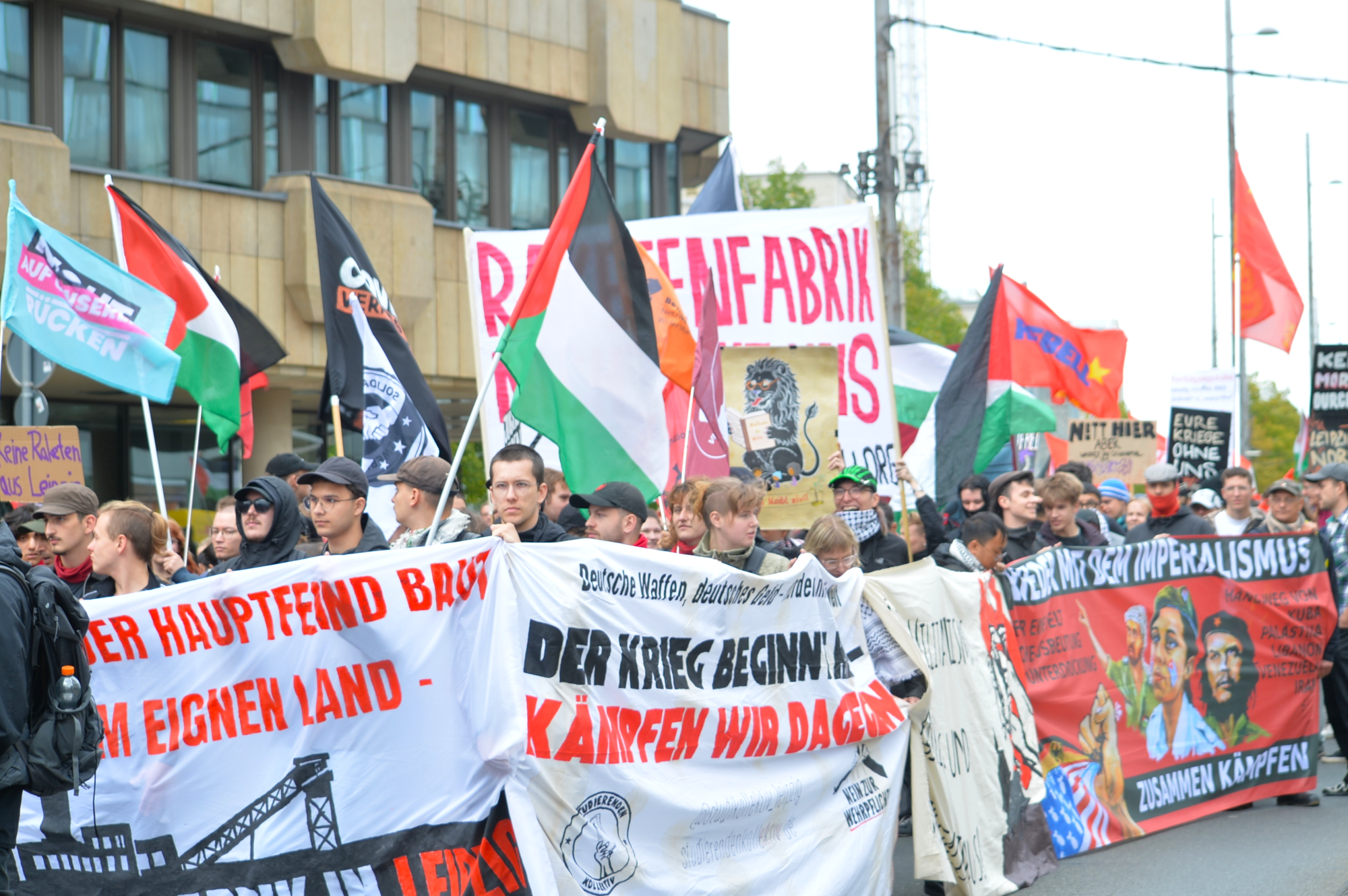
Demonstration against the possible establishment of an arms factory in Leipzig. © Lucas Böhme
The protest was supported by a large number of groups, including the BSW, the MLPD, the GEW’s Peace Working Group and the Leipzig Left, all of whom expressly backed the protest. Their OBM candidate, Skadi Jennicke, was unable to attend on Saturday due to prior commitments, but had a message of support read out at the opening rally on Augustusplatz.
The crowd, carrying numerous banners and placards, moved from Augustusplatz along the Ring to Wilhelm-Leuschner-Platz and Burgplatz for an interim rally. The march was due to conclude at the Steigenberger Hotel. Chants of “Viva, viva, Palestine” and similar slogans could be heard repeatedly.
Speeches highlighted, amongst other things, the concern that investment in armaments amounted to a gamble on war and that peace threatened profits. Furthermore, the state was criticised for its massive cuts to social services, which were said to facilitate rearmament. Critics also argued that Leipzig itself could become a target for attack.
Officers slightly injured: police investigating after march in the south
Initially, no incidents were reported at this demonstration. The situation was different at another gathering, which took place on Saturday afternoon from 5.15 pm onwards against gentrification under the slogan “1st Connewitz Noise Parade ‘Don’t Screw Things Up’”, marching from Alexis-Schumann-Platz towards Connewitz. According to police reports, the number of participants – initially estimated at 120 – rose to 250 by the time the rally concluded on Wolfgang-Heinze-Straße some three hours later.
The police, who had deployed over 100 officers, are now investigating several criminal offences. During and after the march, pyrotechnics were set off and glass bottles were thrown; a police vehicle and a bystander’s car were damaged. In addition, a female police officer was slightly injured but remained fit for duty. According to the police, a male colleague also sustained minor injuries whilst carrying out an identity check, but was likewise able to continue working.
The police launched investigations into, amongst other things, damage to property, assault on law enforcement officers, causing grievous bodily harm, breaches of the Assembly Act and particularly serious breaches of the peace. The rally officially ended late on Saturday evening at 10.10 pm.
A test of public sentiment amid the crisis: Berlin and Mecklenburg-Western Pomerania go to the polls
They are also seen as a barometer of public sentiment for the federal government and Chancellor Friedrich Merz (70, CDU), who has been under pressure following the debacle in Saxony-Anhalt: two further elections are taking place today, Sunday. 2.5 million Berliners are eligible to vote today to elect a new House of Representatives, whilst 1.3 million people in Mecklenburg-Western Pomerania
will decide on the future state parliament.
In Berlin, the latest polls put the ruling CDU and The Left at around 20 per cent each, with the AfD and the Greens trailing behind.
Mecklenburg-Western Pomerania can count on the popularity of its Minister-President (52, SPD), whose party has recently been in a neck-and-neck race with the AfD in the polls. It is conceivable that the AfD could become the largest party, but an absolute majority is considered unlikely. All other parties have ruled out any cooperation with the AfD. The CDU in Mecklenburg-Western Pomerania faces the prospect of a massive loss of votes.
Despite differing starting points, people’s concerns and criticisms are similar everywhere: the global situation, fear of war, the rising cost of living, social decline and dissatisfaction with the federal government. This election night is also set to be an exciting one.
What the LZ reported over the weekend:
The city council met: Leipzig’s Südfriedhof cemetery is to get a new memorial site by 2028
State Sports Games 50+ in Leipzig: Table tennis at the ‘Fuchsbau’ Videos
Compromise reached on the Capa-Wäldchen on Cottaweg: BUND Leipzig does not rule out legal action
When things get dicey on the tram: LVB is now trialling bodycams for ticket inspections “We
’re all leading actors”: This theatre work is good for life
Things get noisy from 4.30 pm: The ‘Krachparade’ winds its way through the south of Leipzig
What else was going on:
A motorcyclist (29) sustained serious injuries on Saturday in Eutritzsch.
Chemnitz missed out on a world record on Saturday.
North Korea is reported to have fired two missiles into the Sea of Japan.
Ukraine has attacked the Moscow region with drones.
US President Donald Trump (80) apparently refused several media representatives entry to the White House.
Empfohlen auf LZ


So können Sie die Berichterstattung der Leipziger Zeitung unterstützen:





There is one comment