Dieser Artikel ist auch in deutscher Sprache verfügbar: Zum deutschen Artikel.
It sounded as though Saxony’s government had finally got the message when the Ministry of Economic Affairs reported on 11 August: “It is getting increasingly hot in Saxony. Days with temperatures well above 30 degrees are on the rise, whilst at the same time water is becoming scarcer. Particularly in densely built-up towns and cities, sealed roads, squares and buildings are heating up. Everyone is affected by the rising temperatures, but the elderly, children and those with health conditions are particularly vulnerable, as high temperatures can pose a risk to them. According to the Robert Koch Institute, there have already been over 12,000 heat-related deaths in Germany this year alone.”
All of this is true. And then there was this announcement: “The Saxon State Ministry for Economic Affairs, Labour, Energy and Climate Protection (SMWA) is therefore providing direct support through measures to adapt to the consequences of climate change: even though we are aware of the tight municipal budgets, local authorities and other eligible applicants should now take advantage of this opportunity and apply for as much funding as possible.”
That sentence says it all. Because most local authorities in Saxony no longer even have the necessary own funds to apply for climate protection grants. That is why the Minister for Economic Affairs still has money in the coffers for which nobody has submitted an application.
Green roofs, drinking fountains, rainwater storage
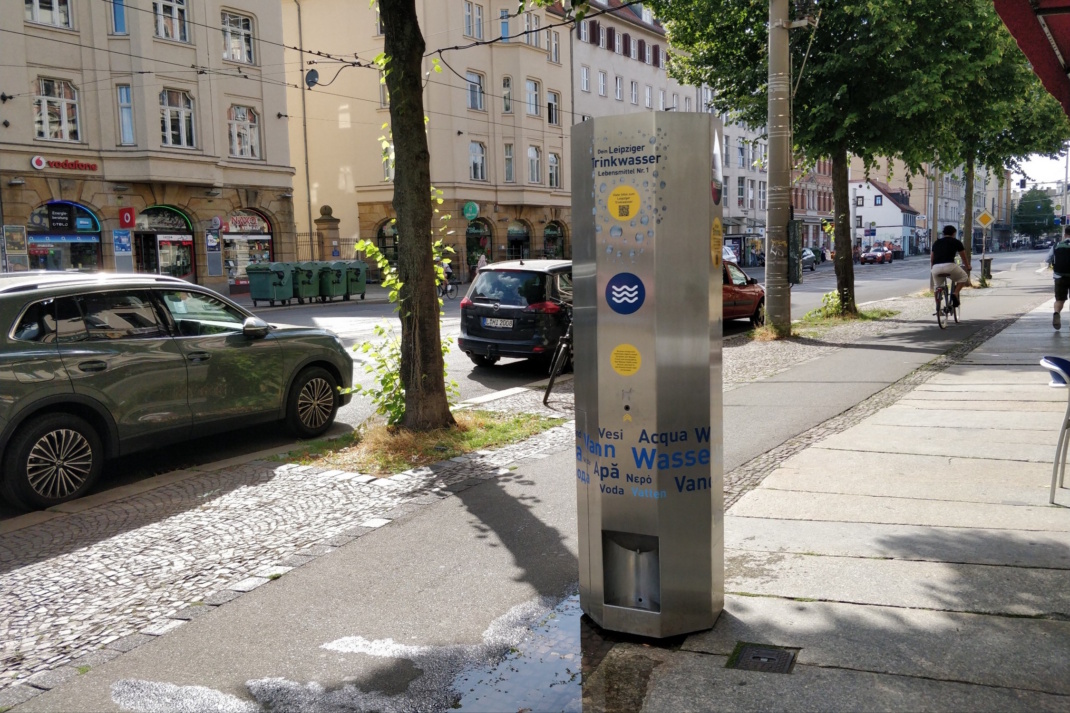
“Heat protection and climate adaptation are not a niche issue, but a vital task for the future of our cities, towns and business locations. And they actively protect public health! Those who plan and invest today are protecting local people whilst also improving their quality of life,” said Minister for Economic Affairs Dirk Panter on Tuesday. The available funding could be used to implement specific heat protection projects – for example, shaded areas, green roofs, drinking fountains or systems that store rainwater and make it quickly available for use when needed.
However, the Ministry is also aware that high funding rates are coming up against financial difficulties in many Saxon local authorities. “Nevertheless, I urge local authorities and all other eligible applicants to take action now and make the best possible use of the funding opportunities,” said Panter.
Up to 80 per cent funding
Under the EU’s Energy and Climate Funding Directive, the SMWA supports both the preparation and implementation of climate adaptation measures. The city of Leipzig, for example, is using around 144,000 euros in funding to update its urban climate analysis
.
In Freital, the outdoor area of the “Kinderland am Wiesenhang” nursery is being fitted with greenery and sunshades to provide shade, improved soil permeability and rainwater retention, at a cost of around 180,000 euros. In Pirna, the bus station is being redesigned to include drinking fountains and improved irrigation for the trees. In Eibenstock, structural heat protection (external and internal sun protection on windows) is being retrofitted at the town hall, and in Oberlungwitz at the Humboldt Primary School.
The municipality of Lossatal is building a rainwater collection and storage system on the site of its municipal works yard. Colditz is also drawing up an action plan for climate adaptation and heavy rainfall prevention, whilst Markleeberg is developing an integrated climate adaptation strategy.
According to the SMWA, the application process has been greatly simplified so that more projects can be launched more quickly. Depending on the measure, funding rates of up to 80 per cent are available.
Projects eligible for funding include, amongst others:
protection against heat in buildings, for example through external shading, green roofs or other natural cooling measures;
drinking fountains and shaded areas that can provide relief in public spaces, school playgrounds, play areas or facilities for older people during hot weather;
rainwater management, for example through cisterns, infiltration systems or other solutions that retain water and make it usable;
measures to protect against heavy rainfall and soil erosion;
preparatory concepts and planning that enable specific climate adaptation measures to be implemented locally.
Eligible applicants include, in particular, local authorities and municipal enterprises, small and medium-sized enterprises, charitable organisations, associations, foundations, cooperatives, recognised religious communities and private individuals.
Applications can be submitted via the Sächsische Aufbaubank (SAB) funding portal under Module 4 of the ‘Energy and Climate Funding Guidelines 2023’.
Not even half has been utilised
Under the funding guidelines, 55 projects with a total value of around 10.6 million euros have already been approved. According to the SMWA, around 17 million euros are currently still available for further projects.
Eighteen applications, with a total requested funding amount of around 4.5 million euros, are currently being assessed. Should all the proposed projects be approved, around 12.5 million euros would then remain in the funding pot.
And what is new is that at least one SPD-led ministry has realised that not even the small funding pots in the Free State are being emptied, because the local authorities are in dire straits. And 12.5 million euros is not much. A city like Leipzig alone could easily use that amount to tackle parts of climate adaptation measures that were decided on long ago – ranging from rainwater management to de-sealing and greening.
But the truth is: misguided austerity measures at federal and state level are ensuring that local authorities lack the financial leeway for the urgently needed climate adaptation measures.
Extreme weather meets indebted local authorities
Susanne Schaper, chair and health policy spokesperson for the Left Party group in the Saxon State Parliament, is very clear on this point.
“Apparently, even the Ministry of Economic Affairs has now realised that it’s too hot. After weeks of extreme temperatures and corresponding media coverage, the state government is now providing information on the limited options for applying for funding for heat protection and is urging people to submit applications. This should have happened long ago and now comes across as almost a little desperate,” notes Schaper.
“It is a damning indictment that the majority of the funding is still available and has not already been approved. This is likely also due to the fact that applicants – mostly local authorities – have to contribute considerable amounts of their own funds in some cases.”
The entire funding structure, which is designed for solvent local authorities, is failing at precisely the moment when local authorities – including those in Saxony – are sliding into debt in droves. This is due to a nonsensical mechanism, such as the ‘debt brake’, which has been introduced at both federal and state level.
This – as can now be observed across the whole country – is leading to local authorities being overwhelmed by debt.
“Even though it will get cooler again in the autumn, the issue of heat protection remains one of the key aspects we will be considering when reviewing the state government’s draft budget,” says Schaper.
“Extremely high temperatures are a strain and life-threatening for many people. Adapting to global warming is a task for the coming decades. Drinking water fountains, shade structures, misting systems and cool, publicly accessible rest areas are merely initial measures to alleviate the symptoms; they are urgently needed but are not sufficient. The state government must ensure the necessary coordination through a state-wide heat action plan – the state parliament will soon be debating our motion (Parliamentary Paper 8/7770
). In the long term, only the removal of impervious surfaces, greening, urban regeneration and, above all, the transition to renewable energy sources will be effective.”
Empfohlen auf LZ


So können Sie die Berichterstattung der Leipziger Zeitung unterstützen:





There is one comment