Dieser Artikel ist auch in deutscher Sprache verfügbar: Zum deutschen Artikel.
There is a world beyond our own. It is quieter, more melancholic, more contemplative. There, the music of Robert Schumann, Johannes Weyrauch and Alexander Zemlinsky resounds. It is the world of Romantic music, which did not end with the Romantic era, but continued to inspire composers such as Weyrauch and Zemlinsky well into the 20th century. The Leipzig-based tenor Patrick Grahl has now compiled an entire album from the lieder of these three composers. It is nothing short of a musical journey through time – an escape from a present that has become loud and shrill.
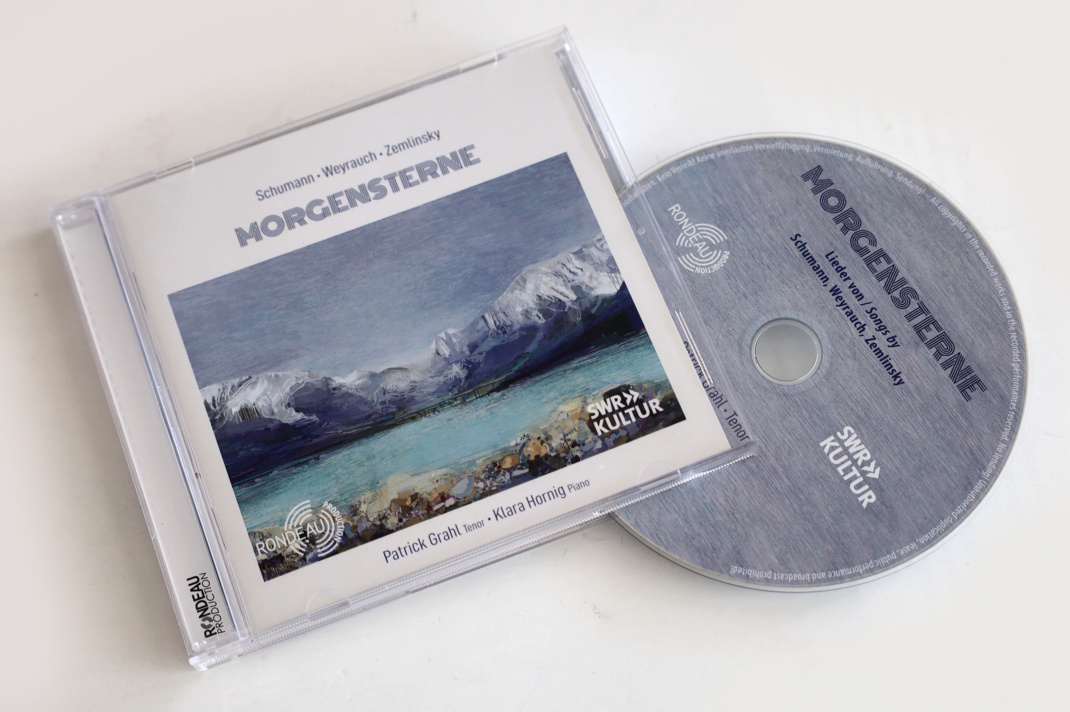
With the album ‘Morgensterne’, tenor Patrick Grahl and his pianist Klara Hornig focus primarily on the songs of Johannes Weyrauch. At its heart lies music of great introspection, which does not rely on external effects and draws its power from a focus on words and breath. And that is where it becomes truly compelling.
For Weyrauch, who maintained a special relationship with the human voice throughout his life, found a language for existential questions about humanity, hope and transcendence even in Christian Morgenstern’s poetry – particularly strikingly in his post-war cycle ‘Erdengang’ (1946) and the later songs based on texts by Christian Morgenstern from 1964. Thus, there are deeply Romantic references in the work of a poet who became famous above all for his humorous ‘Galgenlieder’ (Gallows Songs).
But his era – the turn of the century around 1900 – was also a profoundly late-Romantic period. Inner reflection met Art Nouveau; a sense of the end of an era mingled with the trombone sounds of Richard Wagner, who also made a deep impression on Weyhrauch. Yet when one listens closely to his songs, one realises that the sensibility of the Schumann era still lingers here. A counter-world to the loud and threatening developments of the time.
And this also applies to the third composer featured on this CD: these works enter into a fascinating dialogue with Alexander Zemlinsky’s settings of poems by the same poet. Whilst Weyrauch composes from a place of stillness and spiritual contemplation, Zemlinsky explores emotional extremes and unfolds a sonic language that is intense in sound and existentially charged.
The programme is complemented by songs by Robert Schumann set to poems by Heinrich Heine, which open up a historical resonance. Here, too, the delicate balance between external movement and inner experience becomes audible.
And, of course, Schumann’s idiosyncratic treatment of Heine’s songs, which, even in Heine’s *Book of Songs*, already represented a subtle break with melancholic Romanticism. And which, in fact, also hinted at a tone that ultimately defied the evening mood of Romanticism. Something that Schumann seemed to have all but forgotten in his settings.
And so, with this selection of songs, one is immersed in a sense of time that seems to come from another world. Introspective, turned away from the tumultuous outside world. Or, in the words of the music publisher: ‘Morgensterne’ is a musical quest for the ‘essence’ of the word – a journey through inner landscapes between the abyss and hope.
‘Morgensterne’, Patrick Grahl – tenor, Klara Hornig – piano, co-production with SWR, Rondeau Production GmbH, Leipzig 2026.
Empfohlen auf LZ

So können Sie die Berichterstattung der Leipziger Zeitung unterstützen:





There is one comment