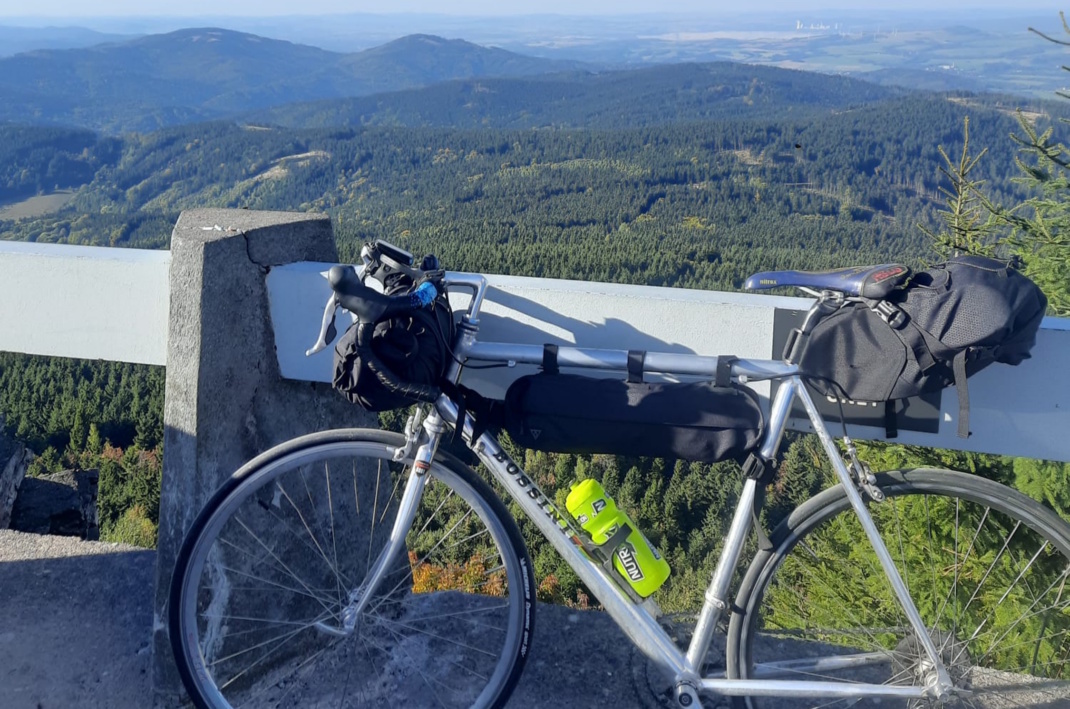
Somewhere in the east, dawn is already breaking. Berlin is getting ready for the blue hour. It’s six o’clock in the morning, the day after the Berlin Marathon. Near the Brandenburg Gate, Americans are hobbling towards the main railway station with heavy legs. By the River Spree, I pass some Japanese people who are already out on their morning run again. Fences are still blocking the way. The marathon finish area is being dismantled. “You don’t need to keep asking when the relief crew is coming. When they come, they’ll come,” explains the head of the security team.
But the most important thing is: you can walk through the Brandenburg Gate.
Last year, I cycled from my home town of Wuppertal to the Brandenburg Gate. This time, I’m set to carry on from here. Further east. And further into Europe. Through Lusatia and across the border into the Czech Republic, all the way to the source of the Elbe.
So I set off.
Unter den Linden, the Palace, the Cathedral, the TV Tower: in front of the Palace, behind a hoarding, the Monument to Freedom and Unity awaits completion. Somewhere, an SPD poster is still hanging: ‘Construction sites are for building, not for putting up posters.’
Then I’m already on the arterial road heading south-east.
Passing through Schöneweide, I go past the former Ernst Busch Drama School, which is being converted into a production and rehearsal centre. After about an hour, I reach Köpenick. I cycle along the Dahme; the sun is rising over the Müggelberge.
In Zeuthen, the going gets bumpier. Kilometres of cobblestones. The water keeps appearing between the trees; villas and small houses line the banks. That’s precisely why I love cycling so much: you discover the hidden corners of a region, places and landscapes you’d otherwise just cycle past.
Beyond Königs Wusterhausen, the roads get narrower and narrower. And at some point, something happens that I’m hardly familiar with from the densely populated west: there’s almost nothing left.
No cars for kilometres on end. Perfect tarmac. Lakes, fields, woods. The houses in the villages look renovated; it smells of autumn; the sun is shining.
A lot of problematic things are being written about eastern Germany this autumn. But is this picture actually accurate?
Eastern Germany: a problem? Germany: not beautiful?
For anyone gliding through the woods on a bike here, it feels a world away at that moment.
Because there’s always a ‘but’
Lunch break in the Spreewald. Lehde announces itself confidently from afar: “You can’t get more Spreewald than this.”
I’m sitting in an old house right by the canal, eating solyanka and bread with lard and Spreewald gherkins. The barges glide past like aeroplanes at Frankfurt Airport. Almost every barge captain talks about the three-sided bridge that connects the village across two canals. It was rebuilt in just three months in 2025.
“There it is, our new bridge,” says one. “But – because there’s always a but …”
I don’t catch what the ‘but’ is.
I think about it briefly. Is that actually true? Is there always a ‘but’?
Onwards to Cottbus.
A city that takes me by surprise: the old town, the River Spree, restaurants, alternative shops, ice-cream parlours. Plus the Pioneer Railway and the Energie Cottbus stadium. Everything sits together in astonishing harmony.
Onwards towards Spremberg. Perfect tarmac again. Then the industrial complexes of Schwarze Pumpe come into view. Lignite, structural change, Lusatia. The landscape has been dug up over the past few decades.
Shortly after the border with Saxony, the route ends at a ford across the Spree. Behind the water stands a construction hoarding, next to it a mill that’s being renovated.
“You’d be better off crossing the Spree in the village – that way you’ll be on the safe side,” says a man with a broad Swabian accent.
Apparently a newcomer to the area.
The detour costs time. After well over a hundred kilometres, I’m getting tired. I decide not to cycle the last few kilometres to Görlitz today.
Instead, I can enjoy Lake Bärwalder. Saxony’s largest lake, created from a lignite opencast mine. Water stretching to the horizon. What a transformation this region has undergone.
I cycle along the shore, towards the setting sun, and almost expect to find an Italian fishing village round the next bend.
I take the train for the rest of the journey to Görlitz. The conductor speaks with an accent that sounds Syrian. When I ask him for a cycle ticket to go with my Deutschlandticket, he seems almost pleased.
“Do you have a passport as well?”
In the evening, I arrive in Görlitz, Germany’s easternmost city. Near the station, a Polish sandwich chain has opened a branch. Young Poles are sitting outside it.
“Is it tasty?” one of them asks me in German.
“Yes, it really is.”
“Enjoy your meal!”
I nod and reply in Polish: “Dziękuję bardzo.”
He laughs. “Proszę!”
And the day ends with the feeling that it is particularly tragic that Görlitz – of all places, a ‘European city’ with its Wilhelminian and Art Nouveau façades and open borders with Poland – is an AfD stronghold, and that nationalist tendencies are on the rise.
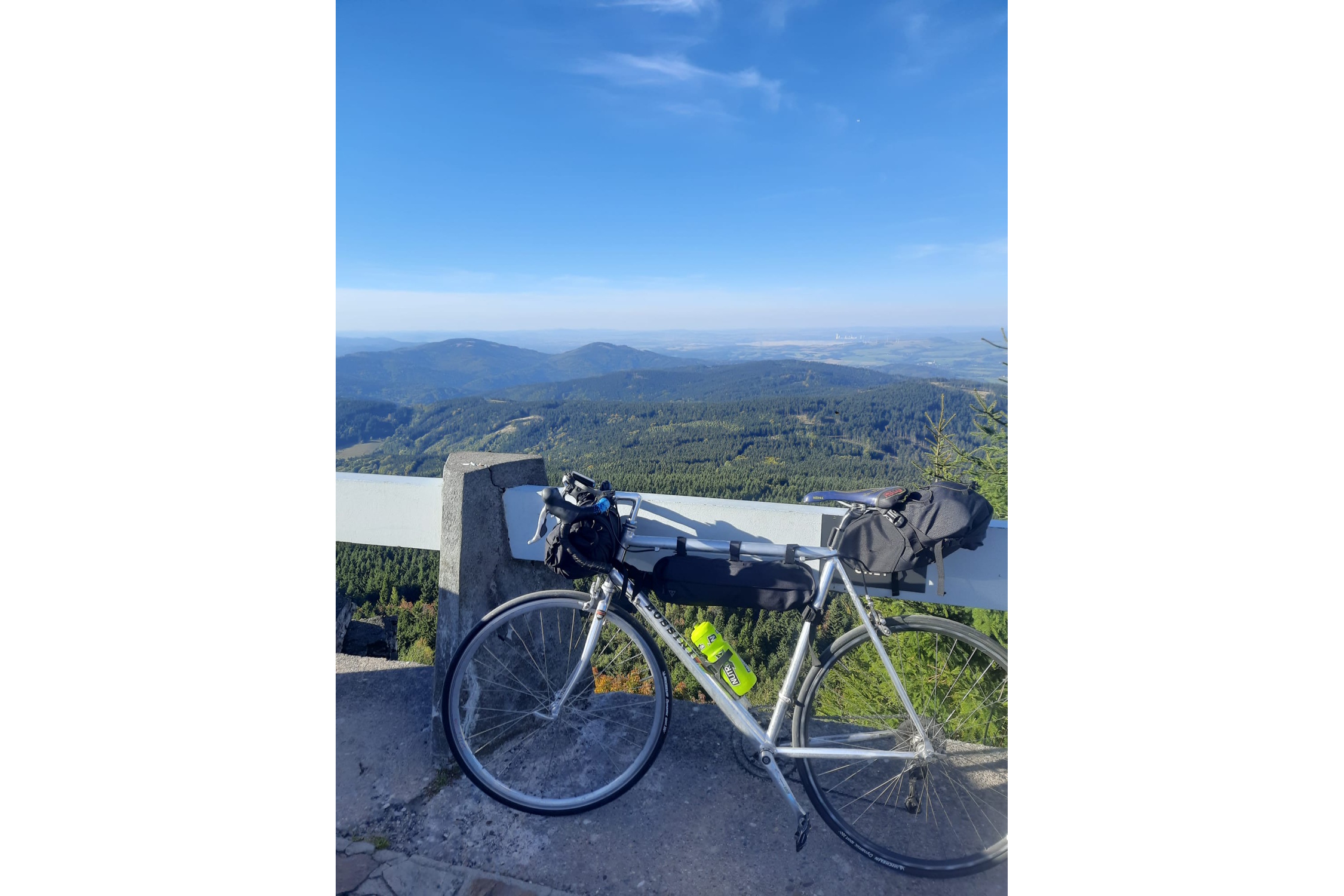
Cycling tour through eastern Germany, Poland and the Czech Republic. Photo: David Fleschen
Is there not still a great treasure to be found in German reunification and the growing integration of Europe – one that we sometimes lose sight of?
One jolt, and you’re in the Czech Republic
My journey takes me through three countries. The differences in purchasing power are evident from the accommodation costs. I pay roughly the same amount three times over: in Görlitz for a bunk bed, in the Czech Republic for a hotel with a breakfast buffet, and in Poland for a hotel with a sauna and swimming pool.
The next morning, I follow the Neisse southwards.
The huge, freshly painted boundary posts on the opposite bank unsettle me. As a child growing up in West Germany, I’m not used to such visible national borders.
The cycle path runs alongside the Neisse, through St Marienthal Monastery and on to Zittau. A landscape straight out of a postcard.
Germany ends just past the tri-border area near Zittau.
‘See you soon,’ it says.
Then a few metres of cobblestones. There’s a brief jolt.
And you’re in the Czech Republic.
My destination is visible from afar: Ještěd. The television tower overlooking Liberec looks as though it’s stepped straight out of a 1960s science-fiction film.
The climb drags on. Old crosses and images of saints line the path. Then the hairpin bends begin.
At the top, the view stretches across Northern Bohemia. The mountain played a special role during the suppression of the Prague Spring.
In 1968, what is now the hotel and television tower was still a building site. Following the invasion by Warsaw Pact troops, a makeshift radio station was set up here. Václav Havel, too, broadcast calls for civil resistance from this very spot. On 27 August, the station fell silent.
It is, in fact, a memorial to freedom. Yet there is little to show for it. The entrance is unassuming; it almost seems as though 1968 has been forgotten.
“No English”
The next morning, I set off again towards the Jizera and Krkonoše Mountains. For a stretch, I take the old railway line towards Tanvald.
“No English,” says the conductor warningly.
“Tanvald,” I say, pointing to my bike. “Kolo.” I’d Googled the Czech word beforehand.
He immediately nods friendly and issues me with the correct tickets.
You don’t really need much language, I think.
The Jizera Mountains are densely forested and deserted. Narrow roads wind through valleys and over hilltops. The history is complicated: Germans, Czechs and Poles lived here side by side and at odds with one another; borders were shifted; people were displaced.
Perhaps this very region is a good place to understand just how
little today’s Europe can be taken for granted.
Today I’m simply cycling through it.
Then the long climb up into the Giant Mountains begins.
Winding roads, forest, higher and higher. People cheer me on in Czech. I don’t understand a word, but I imagine someone said it’s going to get easier soon.
You can also take the bus up to the Giant Mountains ridge. German voices can be heard. I have to push my bike for the last kilometre to the source of the Elbe.
The wind blows across the heights. The barren landscape is reminiscent of northern Scandinavia. Without having to pedal, I can finally take it all in at my leisure.
Then I’m standing at the source of the Elbe.
The coats of arms of the towns through which the river will flow are mounted on a wall. From Špindlerův Mlýn to Cuxhaven. Next to it, a trickle begins, barely wider than a hand.
So this is supposed to be the Elbe.
You wouldn’t want to stay here long in this wind. But I briefly think of a quote from Helmut Kohl. ‘As surely as the Rhine flows to the sea,’ he once said, ‘so surely will German unity come – and European unity too.’
I look at the little trickle.
Yes, that’s true.
But the Elbe would have been a much better example.
Empfohlen auf LZ


So können Sie die Berichterstattung der Leipziger Zeitung unterstützen:




There is one comment