Dieser Artikel ist auch in deutscher Sprache verfügbar: Zum deutschen Artikel.
The older people amongst us, including the author, still remember the power cuts in the winter of 1978/79; there were various causes at the time. One of them was that, in Leipzig for example, the supply of coal to the power stations broke down. People living in older buildings were lucky, as there was town gas for cooking and the stoves still worked.
The blackout in Berlin in January 2026, triggered by an arson attack on the Berlin electricity grid, brought home to us just how totally dependent society is today on the electricity supply.
We are completely dependent on a functioning electricity supply; without it, there is no light, no heat, no communication and much more besides. However, Germany is not only dependent on the smooth supply of fossil fuels. Nor is the claim that ‘wind and sun are always free’ entirely accurate.
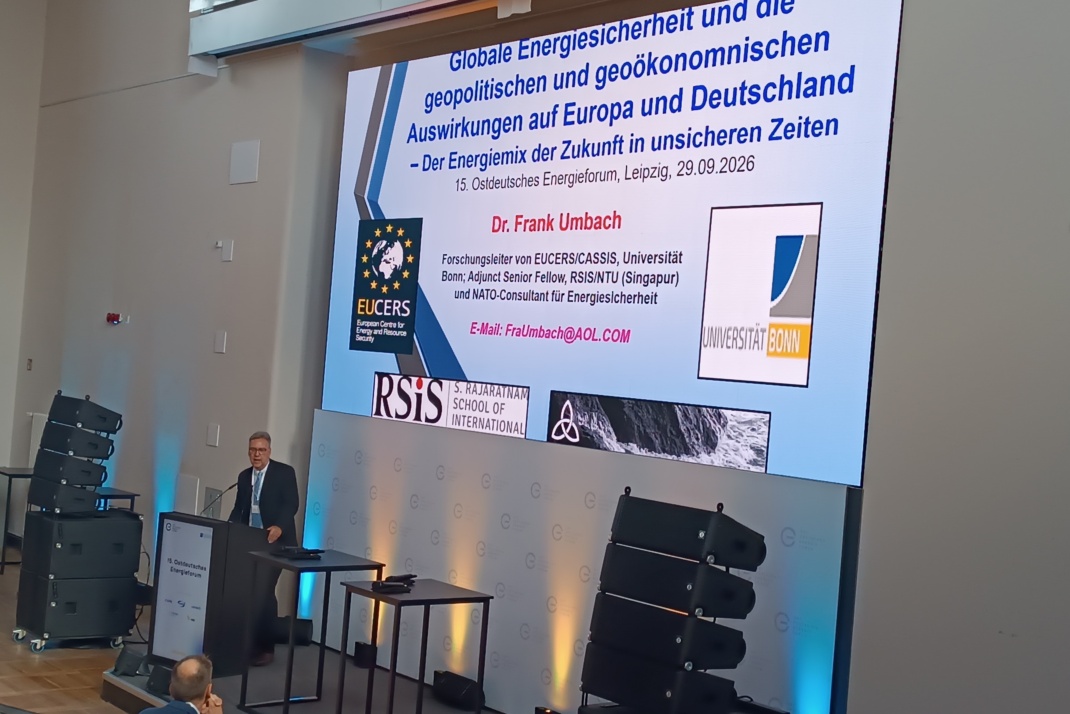
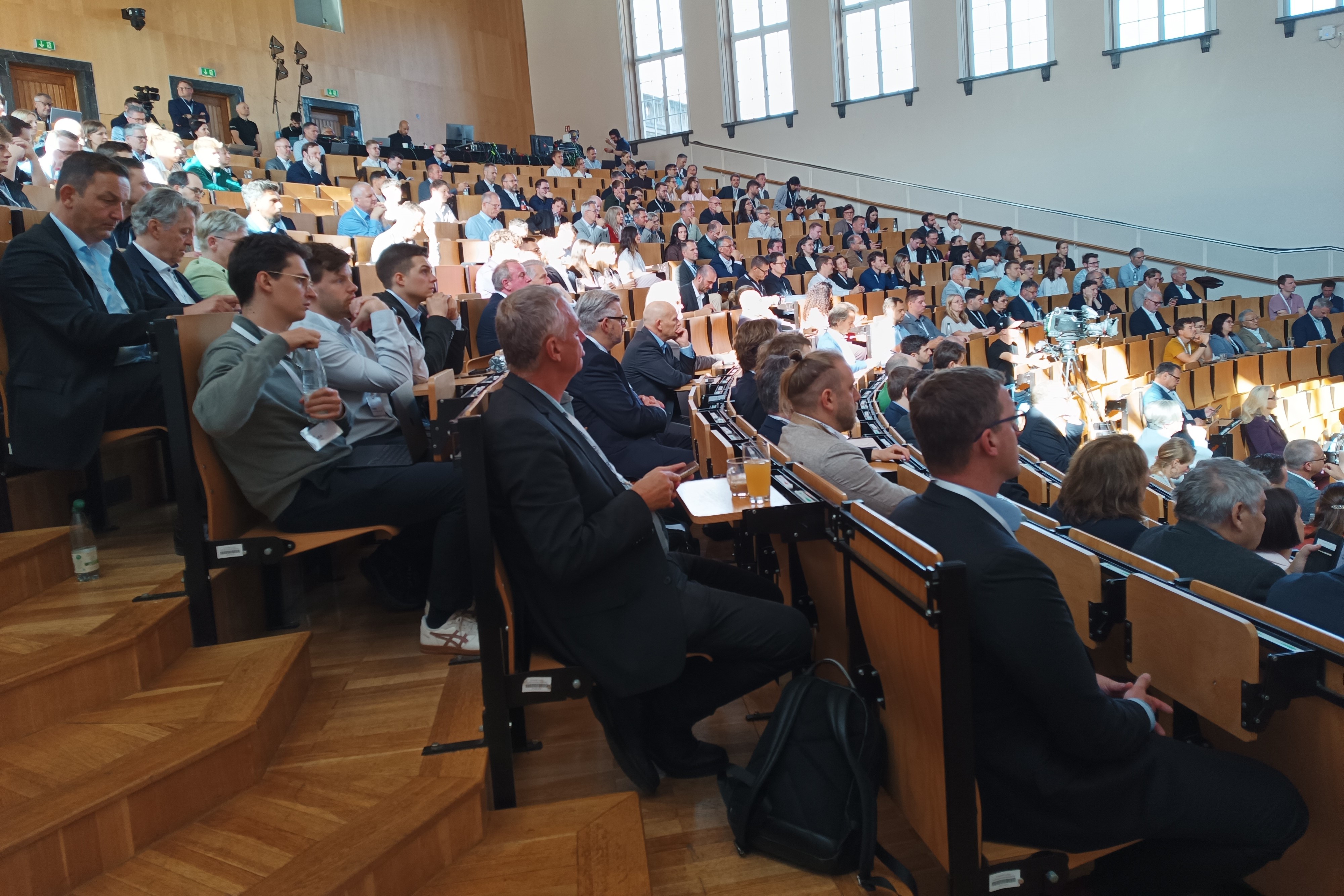
At the East German Energy Forum in Leipzig, Dr Frank Umbach, Head of Research at the European Cluster for Climate, Energy and Resource Security (EUCERS) at the University of Bonn, spoke on the topic ‘The energy mix of the future – security in uncertain times’.
There is no going back to the status quo ante!
Dr Umbach’s background is in research on the Soviet Union and Russia, so he knows what he is talking about when he says:
“We are facing a fundamental shift in the global, geopolitical and geo-economic framework. So the belief here that it’ll be business as usual – that once the war in Ukraine is over, once the war in Iran is over, we’ll simply return to the status quo ante – won’t work. I say this in the clearest possible terms because, in our political discussions, whether here in Eastern Germany or in Western Germany, we still tend to assume, so to speak, that all these events in the world are somehow a sort of operational mishap, that they are isolated incidents and that we can then return to the status quo ante.”
Warnings have also been issued, according to Dr Umbach: “I can only say – and not just as someone who warned of this very early on – that today there are a whole host of colleagues who have conducted studies on this: from around 2012 onwards, there was no longer any cheap Russian gas. That is a myth; no matter how often it is repeated in political and economic discussions, it is empirically and factually incorrect, and it does not become any truer simply because it is repeated all the more often.”
However, Dr Umbach did not merely warn against dependence on fossil fuels; even though wind and solar energy are available free of charge, we still need raw materials to generate energy, and these we have to import. Furthermore, the protection of critical infrastructure has become a ‘major issue’, as we saw in early 2026.
“All critical infrastructure depends on two things: a stable electricity supply and stable access to the internet. If neither of these is in place, all critical infrastructure fails. If we move even further towards electrification, digitalization and so on, then – whether we like it or not – we will become even more dependent on a stable and secure electricity supply. And if this critical infrastructure stops functioning – as a 2011 study by the German Bundestag has already shown – after about four or five days, virtually all aspects of public life as you know it will come to a standstill. There will be utter chaos.”
The full keynote speech is expected to be made available on the ODEF’s YouTube channel.
How bad is it really? We asked Dr Umbach following his keynote speech. We have transcribed the conversation below; you are also welcome to watch it on video.
The conversation
Dr Umbach, you touched on a great many issues in your keynote speech. First, the question: is it actually worth it for members of the public and politicians to read Mark Elsberg’s *Blackout* again today?
Yes, definitely. And this book, *Blackout*, is actually based – he didn’t just make it up himself – but is in fact based on a study by the German Bundestag’s Institute for Technology Assessment, which was published in 2011. In it, the authors spent two years examining the so-called cascading effects of power cuts. This is more relevant than ever, and so it’s absolutely worth reading the book.
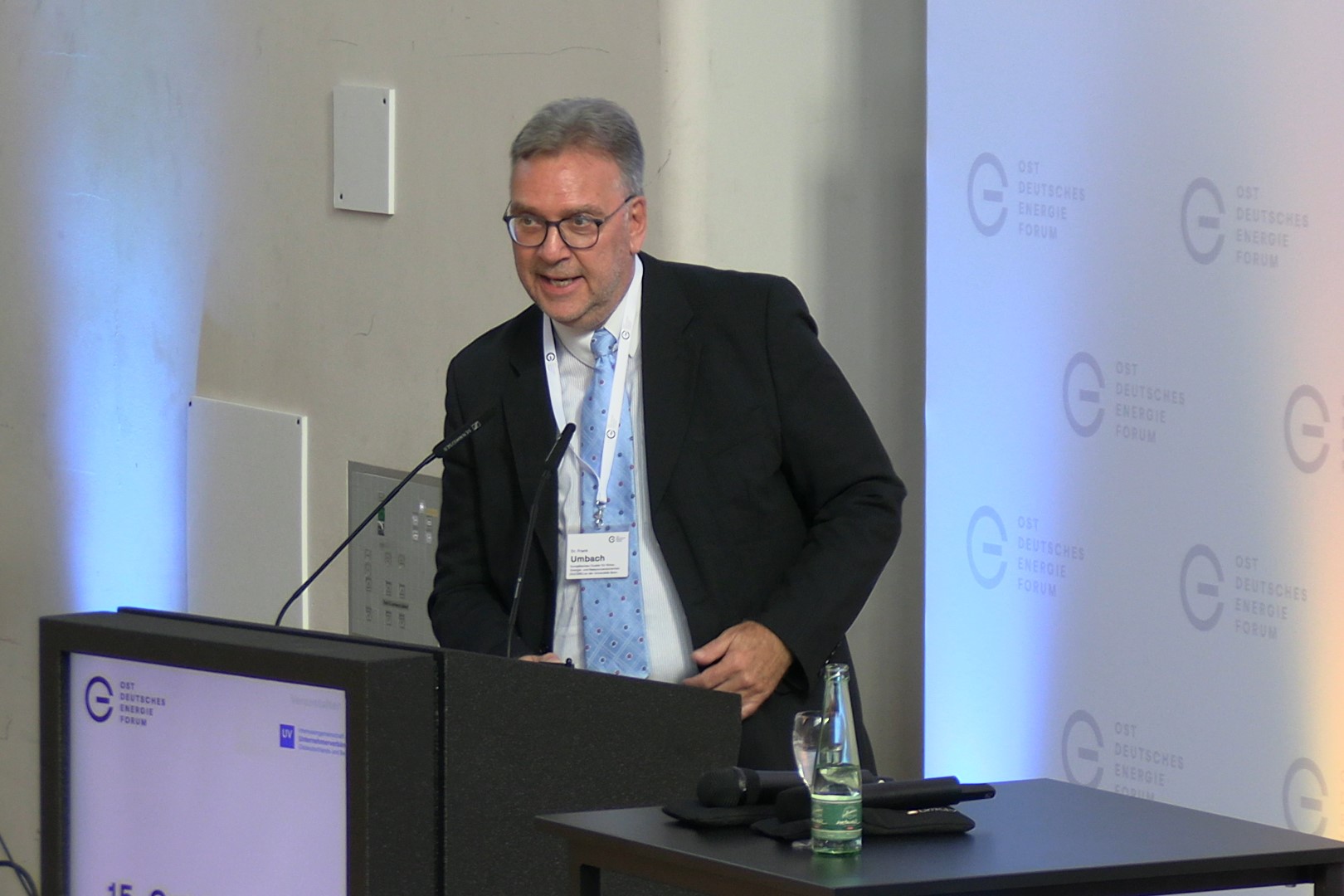
Dr Frank Umbach, Head of Research at EUCERS, University of Bonn, at the ODEF. Photo: Thomas Köhler
I’m bringing this up for a reason. We talk a great deal about renewable energies, nuclear fusion and so on; electricity is becoming increasingly important to us. I’m thinking of the power cut in January 1978–79. Back then, we still had gas here; we still had coal-fired stoves. It wasn’t quite so dramatic then. Today, it would be a complete disaster. Another point: these days, we’re no longer just talking about a shortage of energy sources, but about a shortage of materials needed for the energy supply to utilize these energy sources. That’s what’s often overlooked when it comes to solar and wind power. How can this be resolved, particularly when it comes to rare earths and other critical raw materials?
In 2005, discussions began with the Federation of German Industries, which had already recognized at that time that Germany’s imports of raw materials were causing increasing problems. And the reason for this was already very much linked to China. In 2010, I began to consistently integrate this factor – the security of raw material supply – into future energy security concepts in my publications on energy security. Up until then, it had always been the case that raw materials experts knew little about energy security, whilst energy security experts knew nothing about raw materials.
Thankfully, that has now changed. A World Bank study published in 2017 set this out in detail. And today, international energy organizations such as the IEA and the International Energy Agency in Paris are also working on this. They are conducting their own studies on the security of raw material supplies as a factor in the transition and decarbonization processes. So, in that respect, I believe the international energy sector has now come to understand this. However, I think we need to integrate this even more closely, because we also face the problem here that, globally, it takes seven to eight years from the planning stage to the opening of an international raw materials mine – and in Western countries, often ten to 15 years.
So here, too, we face the problem of bureaucratic processes that take far too long. And if, as I can illustrate with this example, you are an investor today and wish to invest in a raw materials mine – say, for lithium, the most important raw material for batteries – then in ten or fifteen years’ time you might suddenly find yourself in a situation where a new generation of batteries has been developed that no longer requires lithium at all. Instead, it uses completely different raw materials. Naturally, there are huge uncertainties here, which could lead to insufficient investment due to these uncertainties in this highly dynamic technological development.
Does that then mean we become increasingly dependent on those who are already extracting these resources?
Exactly, and we need to address this in good time and develop, so to speak, a very holistic overall understanding of our future energy system. This certainly includes the issue of security of supply for raw materials; we have already wasted far too much time on that anyway. Here, too, reliance on domestic raw materials, diversification and many other factors play an important role; here, too, we do not have a problem with understanding, but rather a problem with implementation.
Yesterday I attended another event: the opening of Deutsche Aircraft’s Final Assembly Line. The terms ‘resilience’ and ‘sovereignty’ came up time and again there. What does this mean in terms of energy supply and security of raw materials?
Resilience, if I were to translate it literally, means the ability to withstand pressure. Incidentally, the term originates from cybersecurity discussions from 20 years ago and has since taken on a certain degree of overuse, which I do not always appreciate. But at its core lies the concept of resilience. And that means strengthening security of supply.
So what do we need to do to be less dependent on China, and to respond less to – or better manage – supply bottlenecks? There’s a whole range of strategies, including at EU level. But we haven’t fully implemented some of these at national level. The EU also doesn’t have the same level of sovereignty on issues dealt with by the European Commission – for example, regarding gas supply security, where we, as national Member States, have ceded sovereignty to the Commission. So, whilst many strategies are being developed in this area too, in some cases we can only implement them appropriately at EU level.
Dr Umbach, thank you for the discussion.
Security of supply was an important topic not only in Dr Umbach’s keynote speech. Other aspects were also highlighted at the ODEF; we spoke to other academics, representatives from the energy sector, the political sphere and the business community. More on that later.
Conclusion: we also need various raw materials for the generation of renewable energy, for which we are reliant on imports. As will be discussed in later articles, this also applies to components such as inverters and solar panels, the majority of which are imported. Becoming more resilient in this regard is a task for politics, business, and academia. At present, however, politicians at federal level are working against this.
Empfohlen auf LZ


So können Sie die Berichterstattung der Leipziger Zeitung unterstützen:





There is one comment